
A New Tiny Vision Release From Xiaomi Built for OCR
Published · 6 min read
Xiaomi-OCR-0 is an open 0.8B vision model that reads documents and returns Markdown, HTML tables, LaTeX formulas or JSON fields. It is small enough for one GPU, has a browser demo, and posts strong document benchmark numbers. Xiaomi has published no speed figures, and a full local install takes more than pulling one file.
In this article
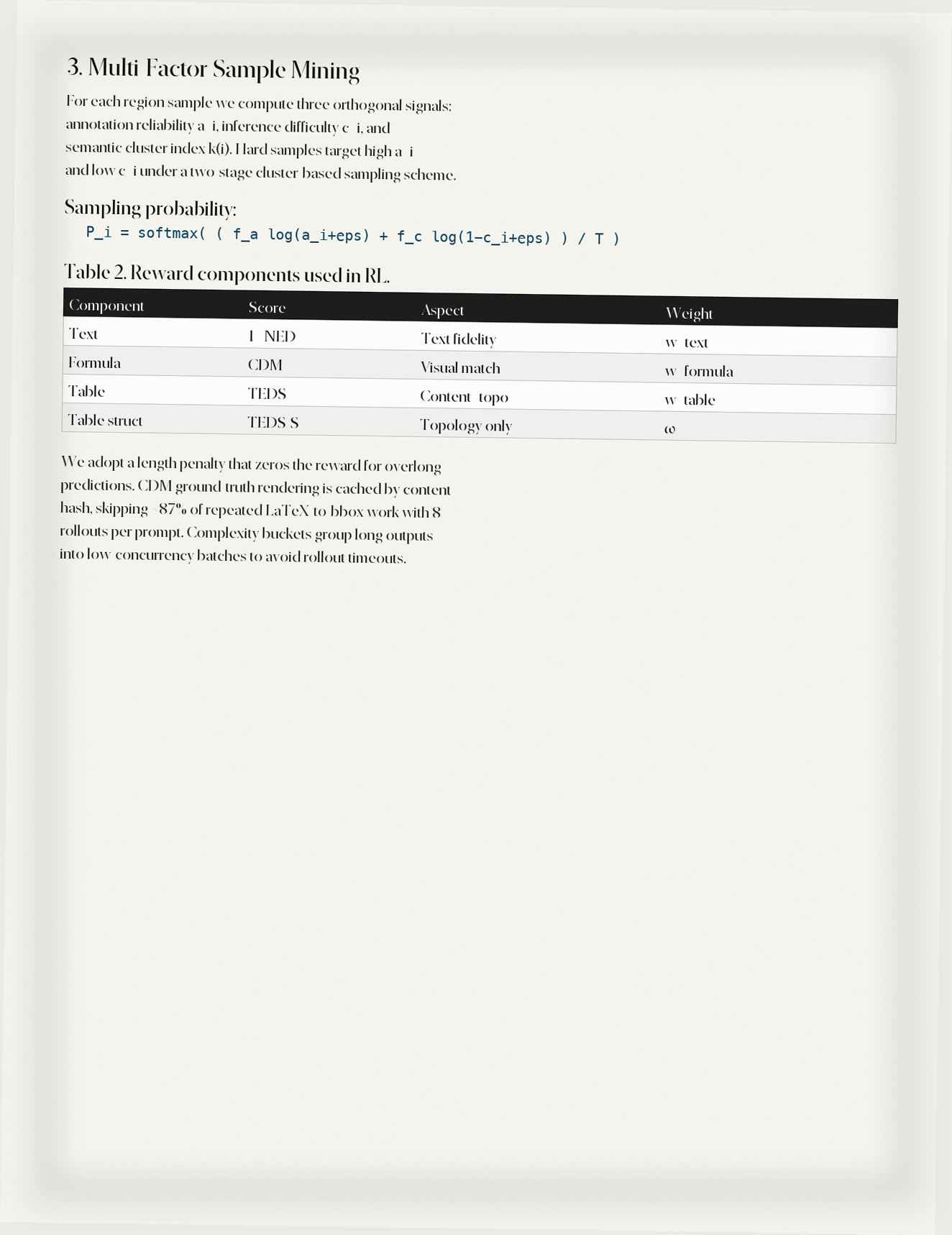
Xiaomi's research group released Xiaomi-OCR-0 on September 30, 2026, alongside an arXiv report. The name is new enough that most search results still point at the usual OCR stacks. This is not a general chatbot with an OCR feature bolted on. It starts from Qwen3.5-0.8B and is trained on roughly 170 million OCR-focused samples, with document parsing as the main job.
The weights are Apache-2.0. The 0.8B count excludes the separate PP-DocLayoutV3 layout detector used in region mode. On a page it produces ordered Markdown, HTML tables, LaTeX formulas and JSON fields, and answers questions about the text. That covers invoices, reports, scanned books and research PDFs. The official demo runs on a 24 GB A10G, which suggests a modest machine rather than a cluster.
Try it in a browser before you install anything
The fastest test is the project's Hugging Face Space. A live demo at loongwayX/Xiaomi-OCR-0-demo accepts an image or PDF, and a static project page links to the same interface. Upload a page, choose whole-page or region parsing, and read the result in the same window. The UI has an English switch.
This suits one job: finding out whether the model reads your documents well enough to keep looking. One dense page with a table, a formula and a few footnotes will tell you more than a leaderboard. If reading order holds and the table survives, a local trial is worth it. If the table collapses, no parameter count will fix your workflow.
There are limits, though. The hosted demo is shared hardware, so a long PDF may queue. There is no batch upload and no API key. Do not put contracts, medical records or customer data into a public Space.
Running it on your own machine
Local is more involved, but not exotic. The code is at xiaomi-research/Xiaomi-OCR-0 on GitHub. You need Python 3.10 or newer, a supported GPU, and one runtime. Xiaomi documents SGLang and vLLM; an experimental community Ollama package is about 1.8 GB with the vision projector. BF16 weights are about 1.75 GB. The official demo used 24 GB, but Xiaomi has not published a minimum, so treat that as a comfortable reference.
The flow: clone the repository, start SGLang or vLLM on port 8000, then start the demo on port 8787 in a second terminal. For Ollama, pull the community model and point the demo at the local endpoint instead.
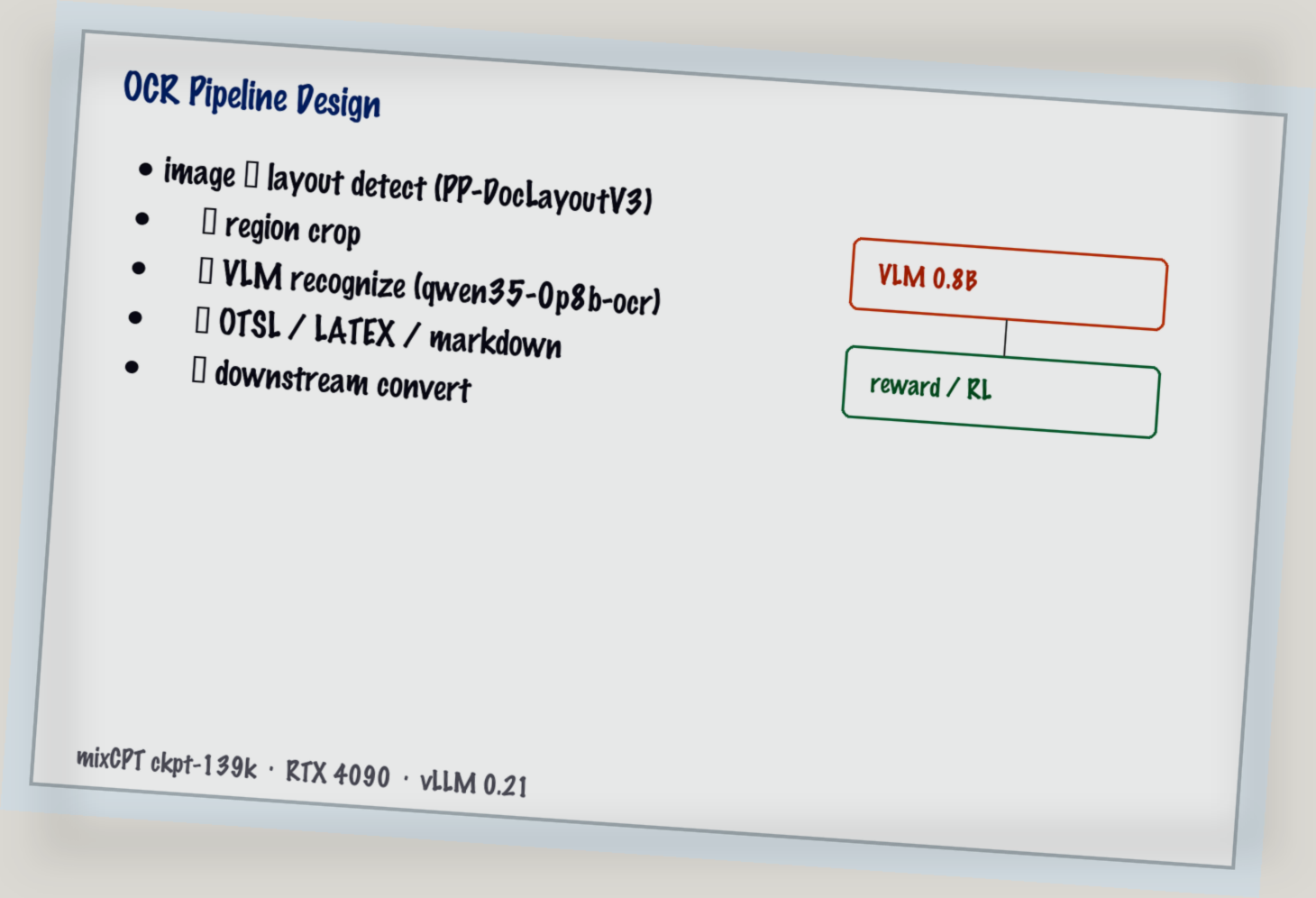
Three things tend to slow people down. The runtime must support the Qwen3.5 architecture, so an old vLLM or SGLang build may fail before loading. Region mode adds PaddlePaddle, PaddleX and PP-DocLayoutV3; whole-page OCR does not need them, so start there. PDF input needs pypdfium2, and the first launch downloads the checkpoint, which can look like a hang.
Self-hosting makes sense when documents cannot leave your network, when volume is steady, or when you want the MCP service inside an agent workflow. For a few pages a week, the demo is enough. Ollama is the easiest entry point, but Xiaomi labels it experimental and says the community conversions were not benchmark-evaluated. Use it to try the model, not to sign off on accuracy.
How it stacks up against other small OCR models
The useful comparison is the sub-1B group, because those fit on one consumer card. The table uses the document parsing scores Xiaomi published next to its model card. All numbers are vendor-reported; n/a means the model is not listed for that test.
| Model | Size | OmniDocBench v1.6 | Real5 | Wild |
|---|---|---|---|---|
| Xiaomi-OCR-0 | 0.8B | 96.83 | 95.24 | 87.94 |
| TeleOCR | 1.2B | 96.87 | n/a | 88.53 |
| OvisOCR2 | 0.8B | 96.58 | 92.29 | 87.91 |
| PaddleOCR-VL-1.6 | 0.9B | 96.33 | 93.19 | 87.36 |
| MinerU2.5-Pro | 1.2B | 95.75 | 88.94 | 87.33 |
| GLM-OCR | 0.9B | 95.22 | 90.32 | 85.08 |
Scores are overall parsing scores. Xiaomi's Real5 figure is listed as 95.24 on the model card, while an evaluation file in the repository records 92.73 for a different run. Ask which setting produced any number you plan to rely on.
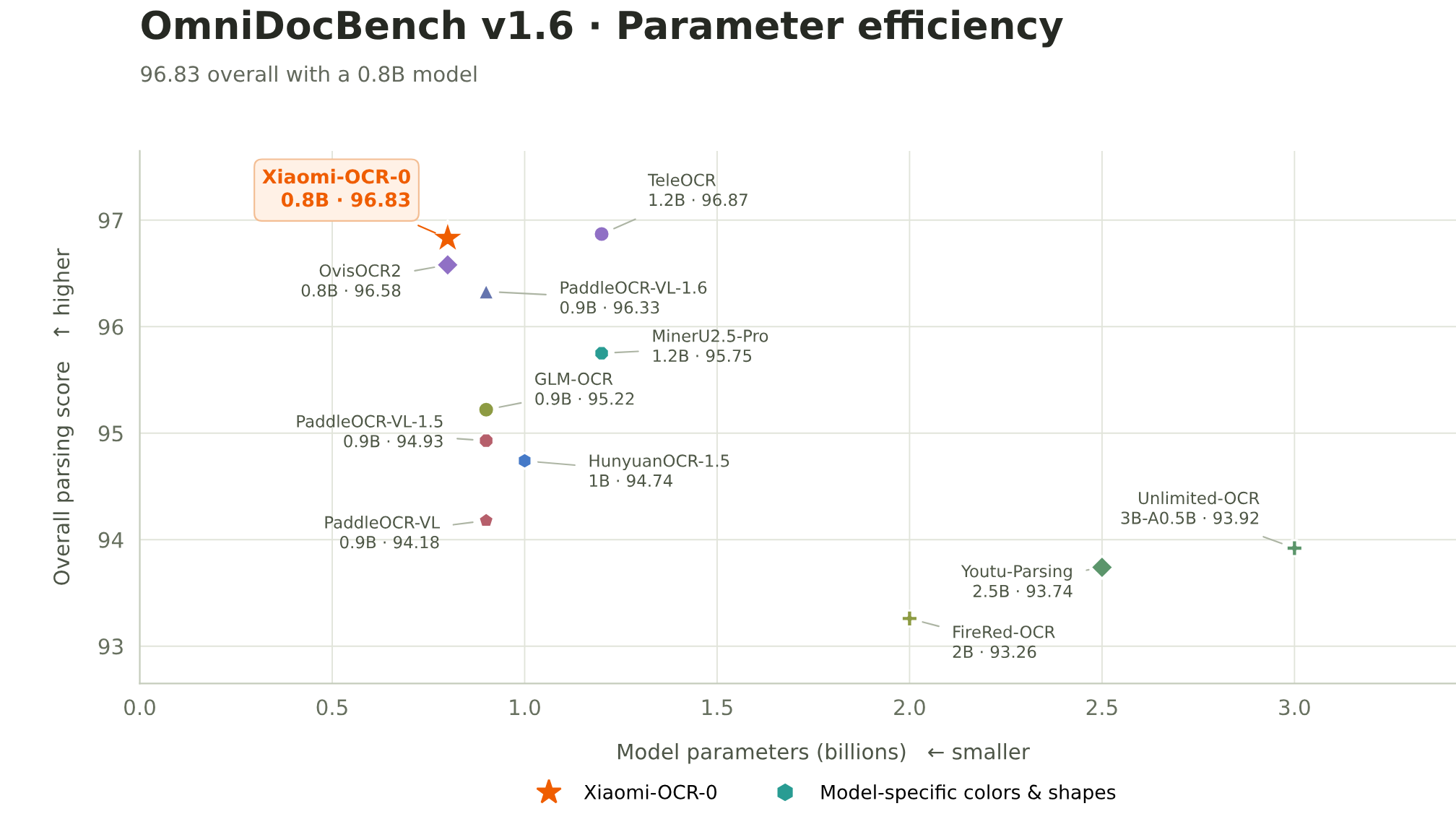
The spread is narrow: first and fifth differ by about 1.6 points on OmniDocBench while parameters run from 0.8B to 1.2B. Parsing quality is close enough that runtime, license and table handling will decide more deployments than a point or two. Xiaomi's edge is the combination of a small footprint, Apache-2.0, and one model for parsing, fields and questions.
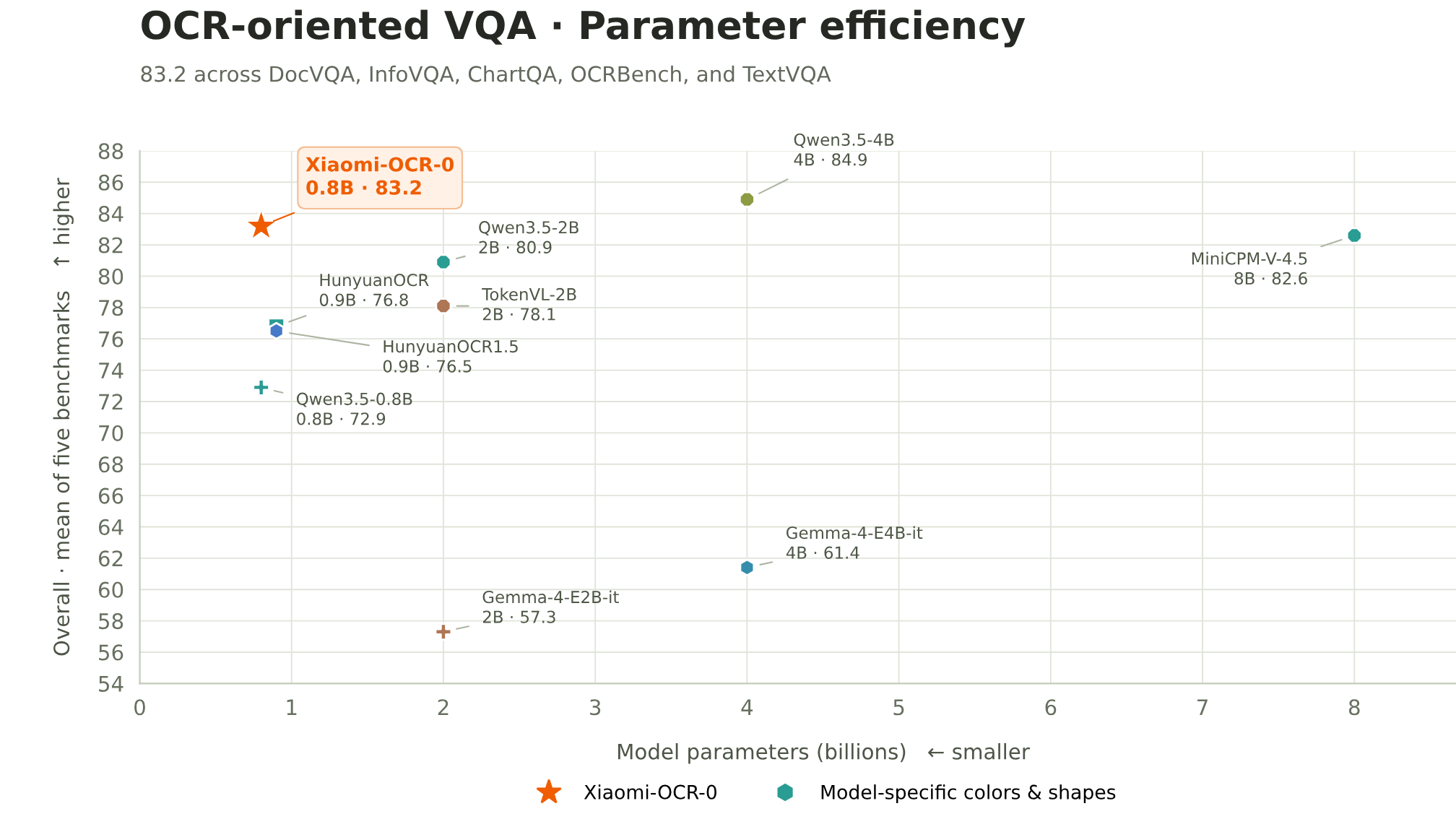
On OCR-oriented visual question answering it averages 83.2 across DocVQA, InfoVQA, ChartQA, OCRBench and TextVQA. That beats Qwen3.5-2B at 80.9 and comes close to Qwen3.5-4B at 84.9 with a quarter of the parameters. It is not a general visual assistant.
Speed is the missing column. Neither the report nor the model card publishes tokens per second, latency or pages per minute. A 0.8B model does less math per token and fits smaller cards, but image resolution and the two-stage pipeline can dominate. Test on your own pages before promising a throughput number.
The caveats are short. The benchmark table is Xiaomi's own, not an independent run. Supported languages are not enumerated; the demo UI is English and Chinese, but that is a UI feature, not a language guarantee. Region mode adds Paddle dependencies. The Ollama and GGUF builds are community work Xiaomi says it has not evaluated. First week should be a test, not a rollout.
Where it fits
Start with invoices and receipts that need to become JSON, report PDFs that need to become Markdown, datasheets with tables, or a chart you want to question. The size also suits local pipelines where pages cannot go to a cloud API.
Be careful with handwritten archives at volume, mixed-language documents outside English and Chinese, and anything where a 2% parsing error changes the answer. Run a sample of your own pages through both this model and your current tool before switching.
If you would rather test OCR through an API than maintain a local runtime, our token-based access is the shorter path: one key, a standard request format, and no model download. Current plans and token rates are on our pricing page.
Source: Xiaomi-OCR-0 technical report and official model card, arXiv:2609.36136, checked November 5, 2026.