
Tencent Hy4 weights are out: what you can download, deploy and license
Published · 5 min read
Tencent has released the weights for Hy4, its FP8 variant and the pretrained Hy4 Base model. The language backbone has 770 billion total parameters, activates 49 billion per token and supports a 1,048,576-token context, with text, image and video understanding. The release is useful news for teams that want more control over deployment and fine-tuning, but two details deserve attention: this is still a very large model to serve, and the Tencent Hy License is not standard Apache 2.0.
In this article
What exactly did Tencent release?
Tencent's release includes three distinct artifacts, not just one chat checkpoint. Hy4 is the instruction-tuned model, Hy4-FP8 is its FP8-quantized counterpart, and Hy4 Base is the pretrained foundation for further training. The base model is not an instruction-tuned chat model, so it is not a drop-in replacement for the other two.
The official repository also includes deployment recipes, fine-tuning documentation, a system card and safety material. Weights are available through Hugging Face, ModelScope and GitCode. A GGUF build is available for end-to-end testing.
What is inside the model?
Hy4 uses a mixture-of-experts architecture. Its language backbone has 78 layers: one dense feed-forward layer followed by 77 MoE layers. Each MoE layer has 256 routed experts and one shared expert, with eight routed experts plus the shared expert active for each token.
The headline parameter counts do not describe the entire system. Tencent lists a separate 1.23B-parameter vision encoder and a 3.3B-parameter DFly2 drafter for speculative decoding. The latter reuses Hy4's KV cache and sparse indices to support long-context decoding without maintaining a separate draft-model KV cache.
| Component | Official specification |
|---|---|
| Architecture | Mixture-of-experts language model with a vision encoder |
| Language backbone | 770B total; 49B active per text token |
| Vision encoder | 1.23B parameters; 1.23B active for vision |
| DFly2 drafter | 3.3B parameters for speculative decoding |
| Attention | Gated DeepSeek Sparse Attention with IndexCache |
| Context length | 1M tokens (1,048,576) |
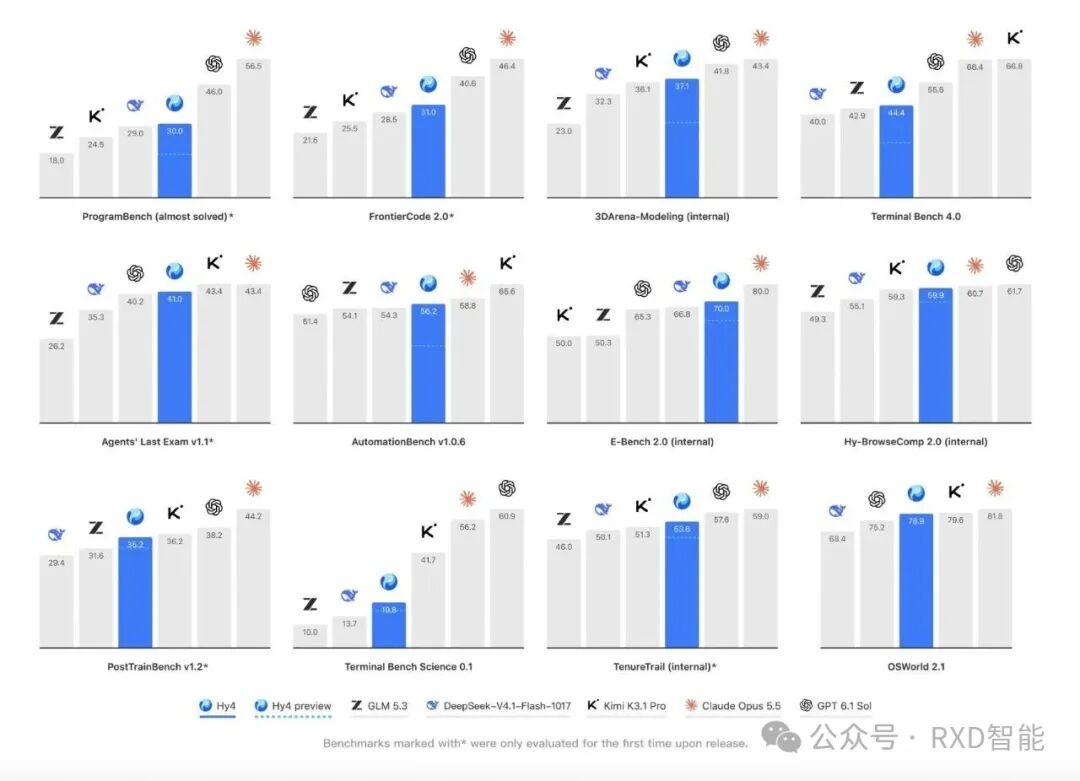
Tencent says the full release improves on Hy4 preview in instruction following, long-context understanding, long-horizon tasks and deep research, while adding vision capabilities. Its own documentation still acknowledges a gap to leading proprietary models on difficult research mathematics, long-horizon coding, model self-improvement and advanced visual question answering.
Is Hy4 really Apache 2.0?
No. Hy4 uses the Tencent Hy License 1.0. It takes Apache 2.0 as its starting point and permits downloading, deployment, modification, fine-tuning and redistribution, subject to the license conditions. But it adds a separate commercial requirement for some Model-as-a-Service businesses.
If you operate MaaS, meaning that you provide third parties with model inference or fine-tuning, you need separate written permission from Tencent before using or continuing to use Hy4 when either of these thresholds applies:
- Your aggregate worldwide gross revenue exceeds US$50 million, or the equivalent, during any consecutive 12-month period. The license counts all revenue, including revenue unrelated to Hy4.
- Hy4 or a derivative is used in or for a product or service with more than 100 million monthly active users in any calendar month.
The additional MaaS permission requirement does not apply when use is solely internal and the model, its derivatives and their outputs are not made available to third parties. This is a practical summary, not legal advice; review the full license for your own use case.
That makes open-weight the more precise description. Calling the release “Apache 2.0 open source” would hide a condition that matters to API providers and very large consumer products.
What does local deployment involve?
Local deployment is supported, but “local” should not be read as “runs comfortably on a workstation.” The official vLLM and SGLang examples use eight-way tensor parallelism with the FP8 checkpoint. Teams should budget for multi-GPU serving, model storage, KV cache and the extra memory demands of long contexts and visual inputs.
For production serving, Tencent recommends vLLM or SGLang and supplies prebuilt container recipes. Once the server is running, the model can be called through an OpenAI-compatible chat-completions API. The official quickstart recommends temperature=0.9 and top_p=1.0, with reasoning effort set to high by default and an optional no-think mode for direct answers.
The GGUF release lowers the barrier to experimentation, but Tencent describes it as a compressed version for end-to-end testing. It should not be treated as evidence that the full production model has become a lightweight desktop model.
Who should try Hy4 now?
Hy4 is most interesting to teams that need open weights for fine-tuning, controlled deployment or multimodal research and already have the infrastructure to serve a large MoE model. The base checkpoint gives training teams a starting point, while the instruct and FP8 releases are the practical choices for application evaluation.
For smaller teams, the decision is less about whether the weights can be downloaded and more about the total serving bill. Compare a managed endpoint with your expected GPU utilization, latency target and context usage. A model with 49B active parameters can still carry substantial serving costs because the full expert pool must be stored and made available.
Before committing, run your own workload: a long-document task that actually needs the context window, an image or video task, and a representative coding or agent workflow. Check answer quality, time to first token, throughput and GPU memory together. Vendor benchmark charts are a useful shortlist, not a substitute for that test.
Where can you get the weights?
To compare managed model access for your next build, explore our Coding Plan.