
Choosing Between Kimi K3.1 Pro and Claude Opus 5.5 for Agent Work
Published · 7 min read
Kimi K3.1 Pro and Claude Opus 5.5 both support 1M-token contexts for long coding and agent tasks. Kimi offers a separate Highspeed model, developer-controlled search and a planned release of its weights. Claude offers fast mode on the Claude API through a request setting, along with hosted search that returns citations. Both charge more for faster output. The choice depends on how you want to run and manage the work.
In this article
- Kimi context1M tokens, 3T-class model
- Kimi speedSeparate ID; claimed 2 to 3x output speed; 2x input/output rates
- Claude context1M tokens, 128k max output
- Claude speedClaude API:
speed: "fast", $8 input and $40 output
Both models arrived in the second half of 2026 for developers running long coding tasks and tool-using agents. Their context windows are similar. The differences become clearer when you look at how you request faster output, connect search and deploy the model.
What do the two models offer?
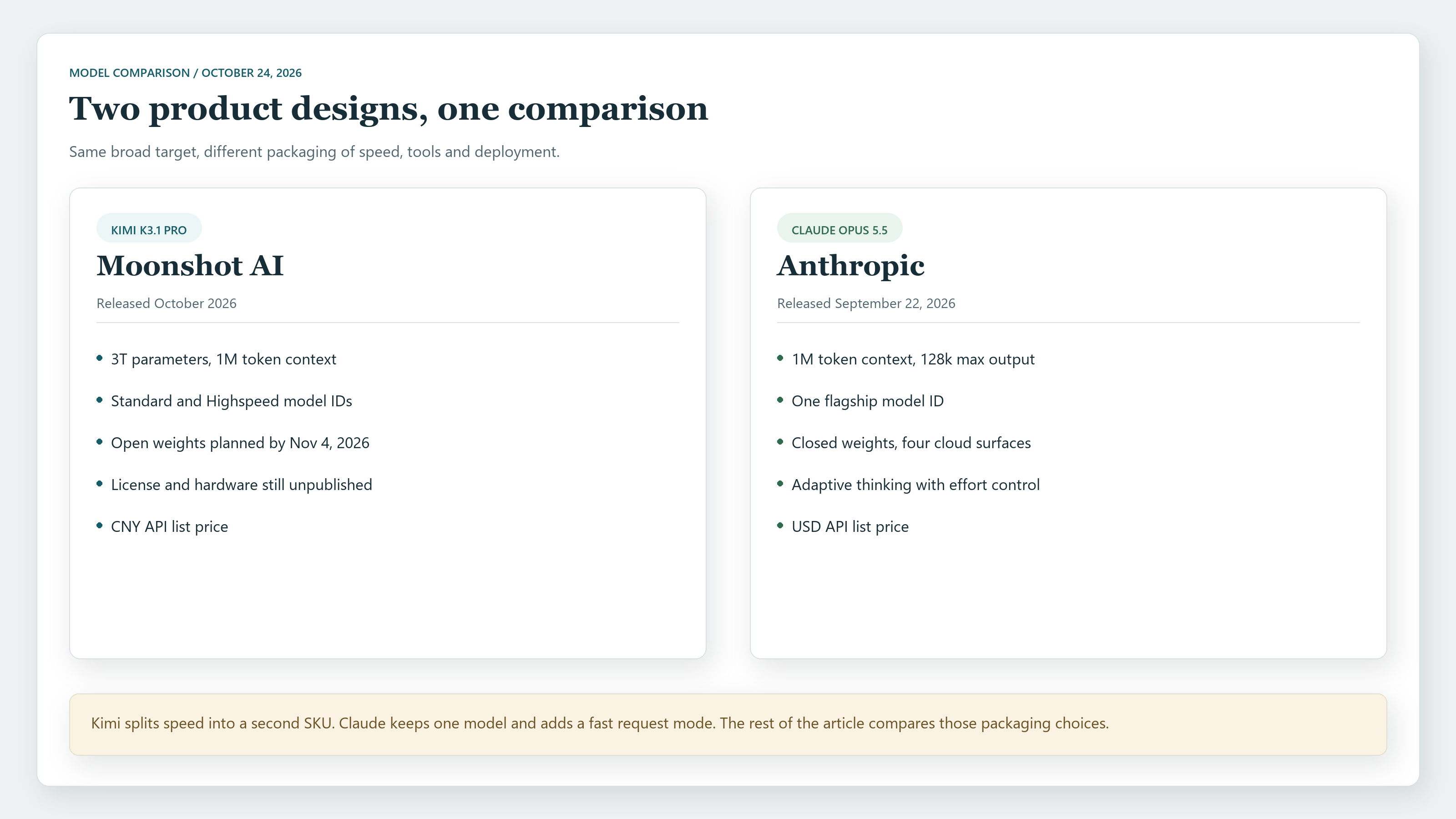
Kimi K3.1 Pro is Moonshot AI's 3T-class flagship. It accepts text and images and supports a 1M-token context window. Moonshot plans to publish the full weights by November 4, 2026. The original article's October 24 review did not have a published license or hardware specification to assess. Its public API IDs are kimi-k3.1-pro and kimi-k3.1-pro-highspeed.
Claude Opus 5.5 launched on September 22, 2026. It also accepts text and images, with a 1M-token context window and a standard maximum output of 128k tokens. The weights are closed. You can access it through the Claude API, Amazon Bedrock, Google Cloud and Microsoft Foundry, although feature availability and request settings vary by platform.
| Specification | Kimi K3.1 Pro | Claude Opus 5.5 |
|---|---|---|
| Provider | Moonshot AI | Anthropic |
| Model IDs | kimi-k3.1-prokimi-k3.1-pro-highspeed | claude-opus-5-5 |
| Release | October 2026 | September 22, 2026 |
| Parameters | 3T-class | Not stated in the checked docs |
| Context | 1M tokens | 1M tokens |
| Max output | 128k default, up to 1M | 128k, 300k on Batch API beta |
| Reasoning | Always on; low / high / max; public API default max | Adaptive, always on, effort parameter, default medium |
| Speed option | Separate Highspeed model ID | Request-level fast mode on the Claude API |
| Weights | Open-weight release planned by November 4, 2026 | Closed |
| API list price | CNY 13 input / CNY 68 output per MTok | USD 4 input / USD 20 output per MTok |
| Availability | Kimi API, Kimi Code, Kimi apps | Claude API, Bedrock, Google Cloud, Microsoft Foundry |
Thinking stays on in both models. On the public Kimi API, the default effort is max; Claude Opus 5.5 defaults to medium. Kimi Code's model documentation lists high as its default, so check which service your client uses before comparing latency.
How do you enable faster output?
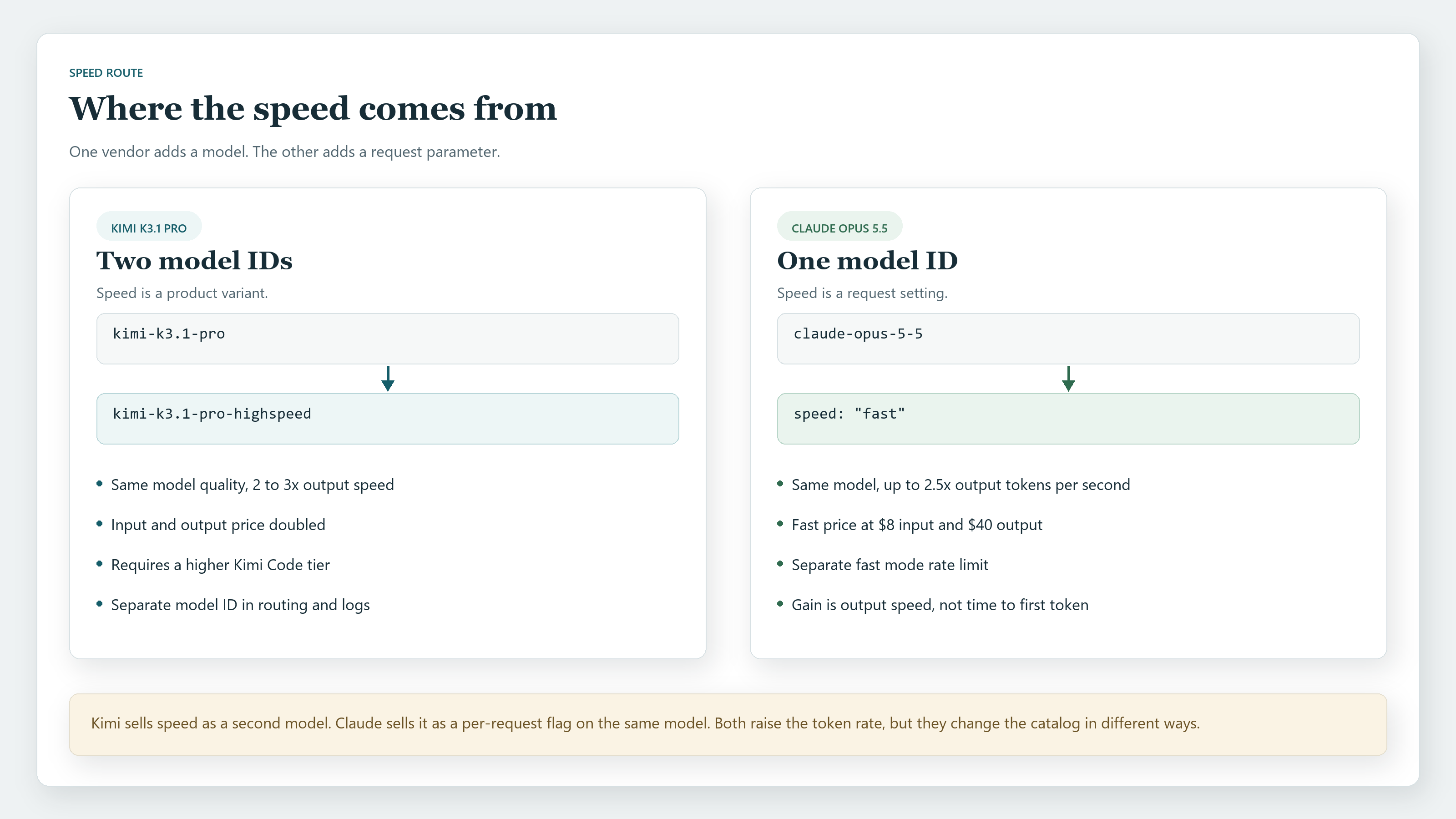
With Kimi, you switch model IDs to buy more speed. Moonshot says kimi-k3.1-pro-highspeed has the same capabilities as the standard model and produces output about 2 to 3 times faster. Input and output token rates double. Kimi Code also requires a higher membership tier for Highspeed. Your routing rules and logs need to distinguish the two IDs.
On the Claude API, you keep claude-opus-5-5 and send speed: "fast". Anthropic advertises up to 2.5 times more output tokens per second with unchanged capabilities, at USD 8 for input and USD 40 for output per million tokens. This is an output-throughput gain, rather than a promised reduction in time to first token. Fast mode has a separate rate limit.
Kimi makes the speed choice visible in the model name. Claude's API makes it a request option. In either case, log the option you used alongside token usage, or a faster run can look like an unexplained increase in cost. The speed figures above are vendor claims; this article does not report a head-to-head latency test.
Who controls search and tool calls?
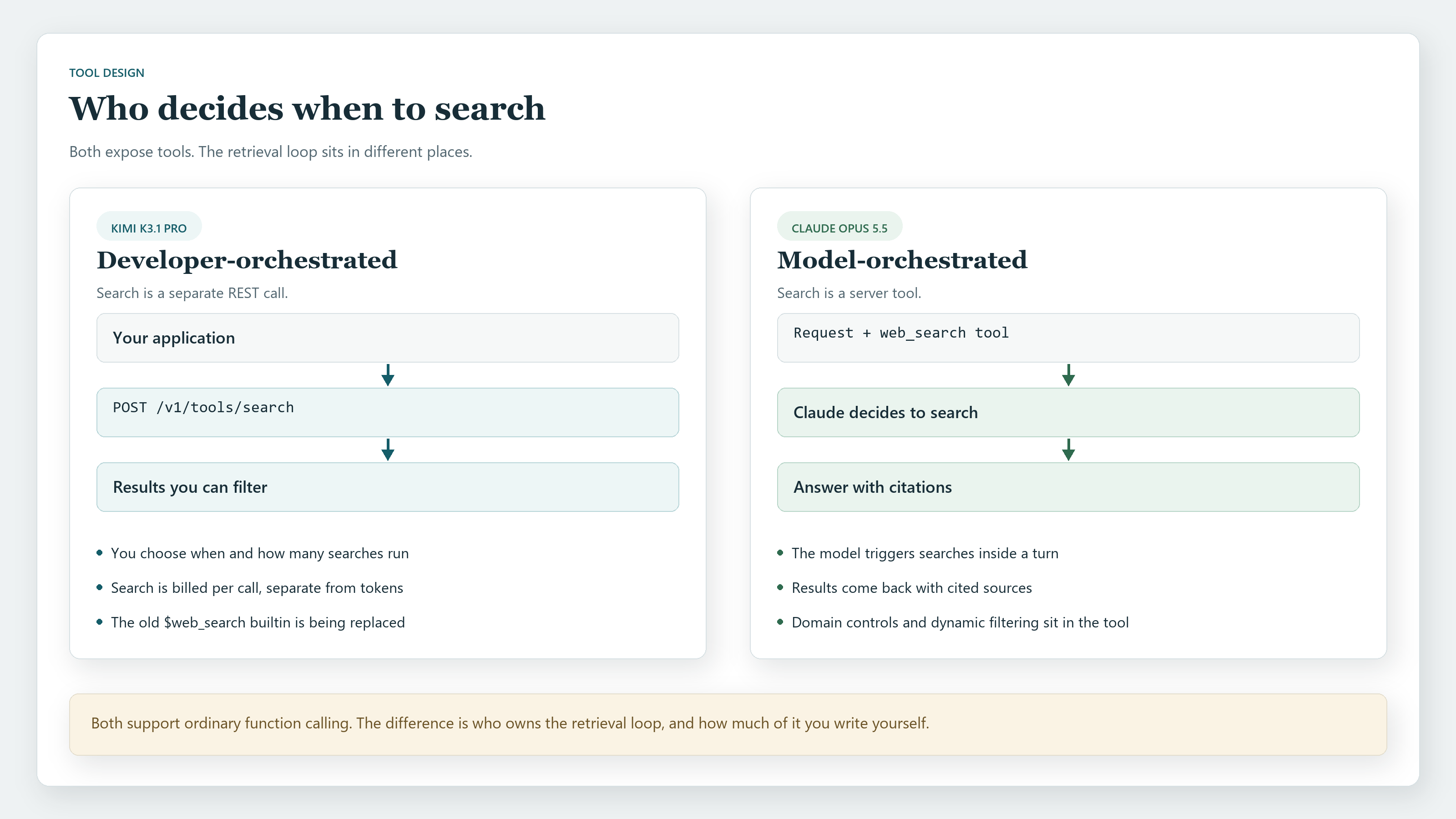
Kimi's search REST interfaces let your application choose when to search, how many results to retrieve and which material to pass to the model. The documented endpoints are /v1/tools/search, /v1/tools/search_pro and /v1/tools/fetch, billed per call separately from model tokens. They provide an alternative to the older $web_search builtin. Kimi also supports function calling, dynamic tool loading and tool_choice. Its K3.1 Pro quickstart currently warns that web search is being updated and advises against production use during that transition.
Claude's hosted web_search tool runs within the model's response loop. After you enable it, Claude can decide when to search and return answers with citations. The tool supports domain controls and dynamic filtering. Claude's wider tool set also includes web fetch, code execution, computer use and MCP integrations.
The Kimi approach gives you direct control over retrieval calls and the context they produce, which can make the steps easier to inspect. Claude's hosted search handles more of that orchestration for you. This comparison concerns those search interfaces; both models can also work with tools defined by your application.
What do the API prices cover?
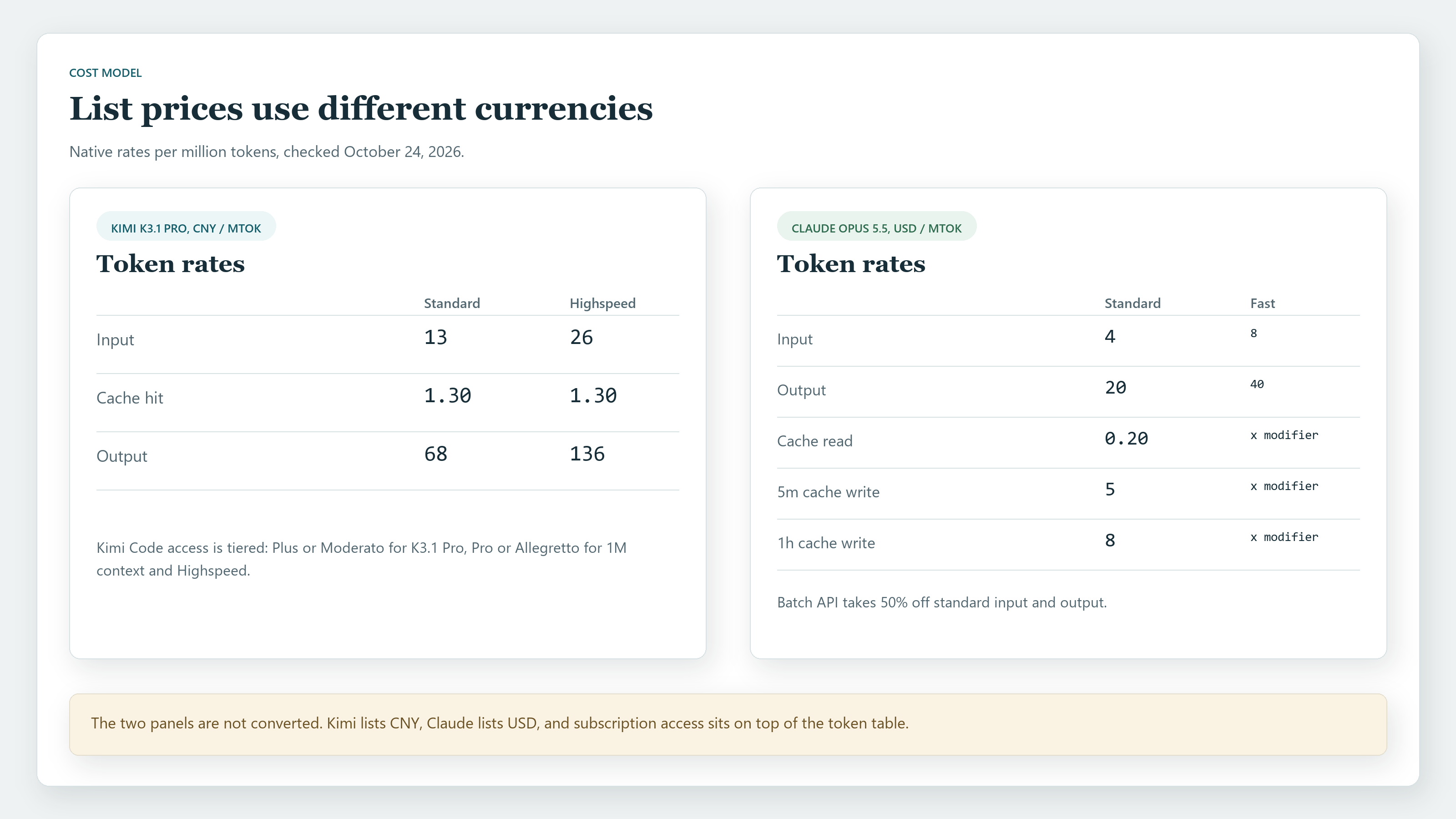
On Moonshot's CNY public API, Kimi K3.1 Pro lists CNY 13 for input and CNY 68 for output per million tokens, with cache hits at CNY 1.3. Highspeed raises input and output to CNY 26 and CNY 136. Kimi Code is a separate membership product: Plus or Moderato provides standard K3.1 Pro access, while Pro or Allegretto unlocks Highspeed and the full 1M context. Public API access requires a recharge of at least CNY 10; the CNY 15 new-user voucher cannot pay for K3.1 Pro.
Anthropic's standard Claude API rates are USD 4 for input and USD 20 for output per million tokens. Cache reads cost USD 0.2, five-minute cache writes USD 5, and one-hour cache writes USD 8. Batch processing discounts input and output by 50%. Fast mode costs USD 8 for input and USD 40 for output; check its own conditions before combining pricing options.
These are provider list prices in their original currencies, checked on October 26, 2026. They are separate from SiAPI.ai's retail rates. Moonshot's API token billing and Kimi Code membership quotas are also separate products. To compare a bill, use the same currency and account for cache usage, output volume and search calls. Tokenizers can produce different token counts for the same text.
Explore SiAPI.ai pricing for API access and Coding Plan options.
Which approach fits your team?
Kimi is worth evaluating if access to weights and a future self-hosting option matter to your team. That choice still depends on the released license and hardware requirements. Its separate standard and Highspeed IDs also suit applications that route different tasks to different speed tiers.
Claude fits teams that want a hosted model available across several cloud platforms and a search tool that can return citations within the response. Check the feature support of your chosen platform, especially if fast mode is part of your plan.
You can also route by task: use standard speed for work that can wait, then pay for faster output where interactive delays matter. Test that policy on your own workload. The packaging comparison here does not establish which model writes better code.
What should you check before switching?
For Kimi, the open-weight release remains a future milestone in this comparison. The original review could not assess the license or hosting requirements, and a 3T-class model calls for substantial infrastructure planning. Thinking stays on. Highspeed doubles input and output rates, and Kimi Code places it behind a higher tier. The search transition also needs attention before production use.
For Claude, closed weights rule out self-hosting this model. Opus 5.5 keeps adaptive thinking on and rejects forced tool use. Fast mode doubles the base input and output rates and targets output throughput. Text between tool calls can appear in thinking blocks whose text is empty at the default display setting, so an existing progress display may need an adjustment.
FAQ
- Does Kimi K3.1 Pro have a Highspeed model?
- Yes. The public API uses
kimi-k3.1-pro-highspeed. Moonshot says it has the same capabilities and about 2 to 3 times the output speed, with twice the input and output token rates. - Does Claude Opus 5.5 have a separate Highspeed model?
- On the Claude API, fast mode is a request setting on
claude-opus-5-5. Cloud providers can expose it differently; check the deployment you use. - Can I compare the API prices directly?
- Use a common currency and a realistic usage profile. The CNY Kimi rates and USD Claude rates shown here need an exchange rate, token counts, cache assumptions and tool costs before they describe a comparable bill.
- Can either model turn thinking off?
- Neither model supports disabling thinking. Kimi rejects requests that disable it, and Claude Opus 5.5 keeps adaptive thinking on. Adjust effort within the options each service supports.