
Kimi K3.1 Pro Open Weights: Lower Hallucinations for Coding, 3D and Finance Tasks
Published · 7 min read
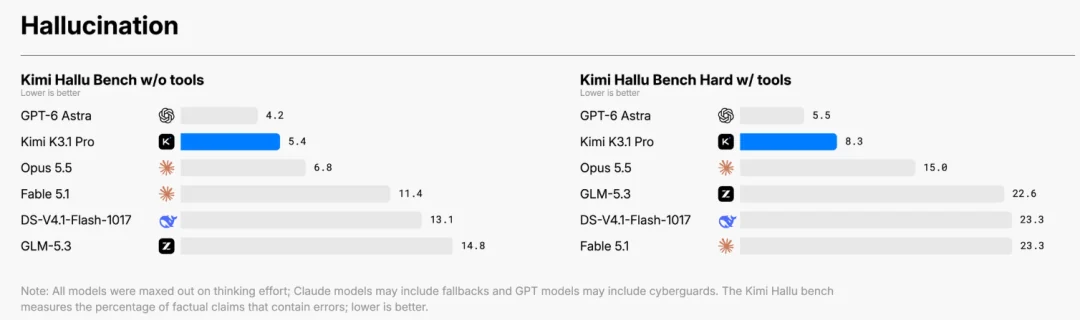
On 5 November 2026, Moonshot opened Kimi K3.1 Pro: 2.8 trillion total parameters, a one-million-token context, and downloadable weights. Terminal-Bench 4.0 comes in at 65.7%, with Claude Opus 5.5 slightly higher at 66.4% and GPT-6 Astra lower at 58.2%. BenchCAD with tools reaches 92.7; Opus 5.5 posts 96.2. OfficeQA Pro v2 scores 64.4, and claim-level hallucination drops to 8.3% from 23.4% on K3. Open weights at this scale still require a data-center deployment, so renting access remains the practical route for most teams.
In this article
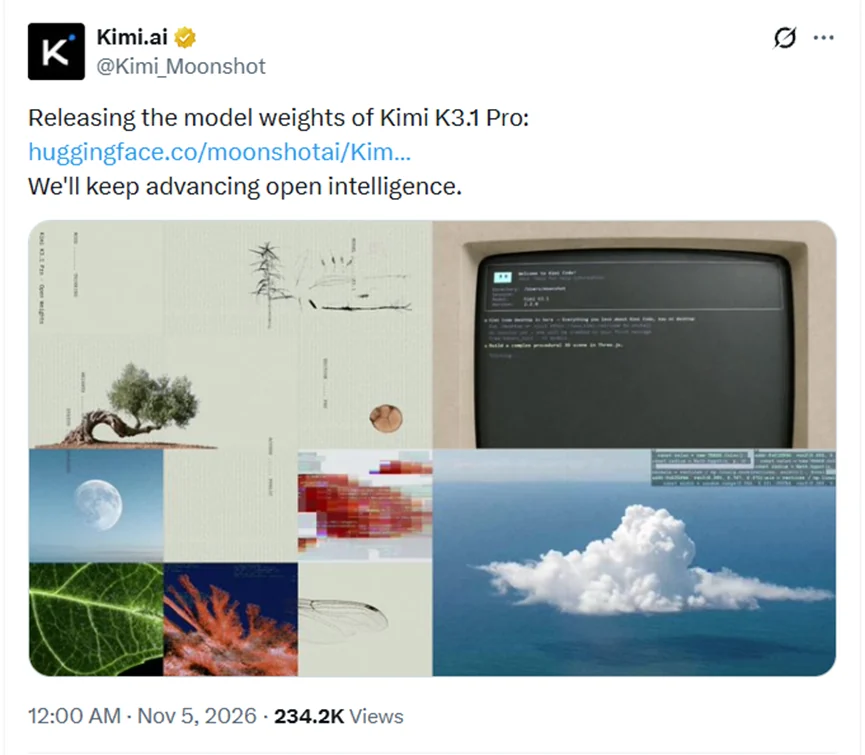
On November 5, 2026, Moonshot pushed the Kimi K3.1 Pro repository to Hugging Face shortly after midnight. The path is moonshotai/Kimi-K3.1-Pro. Inside sits a sparse mixture-of-experts model with 2.8 trillion parameters and a context window that holds one million tokens. NVIDIA AI offered congratulations that morning, and replies described the release as a downloadable model in the Fable class.
Developers who ship code and agent workflows have a narrower question than the timeline. Which of these numbers survive inside a real pipeline, and what does it take to serve a model this size?
What landed on Hugging Face
Two specs explain the reaction. Total parameters reach 2.8 trillion, arranged as a sparse mixture of experts. The context window accepts one million tokens. Together they place the model among the biggest open releases to date.
The release also included a consumer feature. 3D Make is live inside kimi.ai, and the Kimi App carries it as well. It can open and adjust a 3D model inside the browser, export a file for printing, and render video or a Live Photo. This remains a consumer product rather than an API. Even so, it marks an area where the team trusts the model in front of users.

Terminal-Bench is the score to argue about
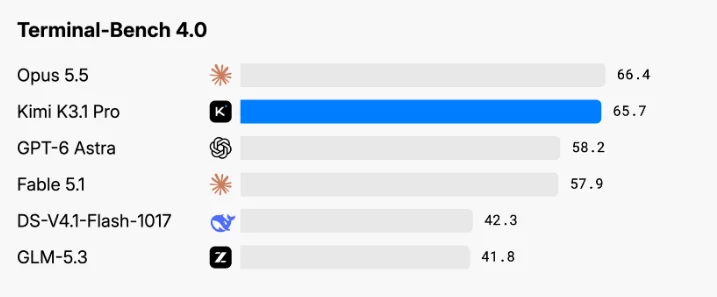
Terminal-Bench 4.0 asks for a job completed in a shell. On that test, Kimi K3.1 Pro records 65.7%. Claude Opus 5.5 posts 66.4%, and GPT-6 Astra reaches 58.2%.
| Model | Terminal-Bench 4.0 |
|---|---|
| GPT-6 Astra | 58.2% |
| Kimi K3.1 Pro | 65.7% |
| Claude Opus 5.5 | 66.4% |
The 0.7 point shortfall against Opus 5.5 is noise from prompt scaffolding, retry limits, and harness setup. The 7.5 point lead over GPT-6 Astra carries more weight. It undercuts the assumption that open models occupy the cheaper, weaker tier.
One caveat applies to every score in this piece: Moonshot published them. No independent harness has reproduced them yet, and vendor results describe a best case.
The robot demo tests the environment, not the answer
Moonshot chose a task with no canned solution. The model had to construct a bipedal walking simulator from scratch. Its scene contained 296 bone parts and 402 muscle parts. The first controller toppled after two steps.
K3.1 Pro reviewed the run, found the controller fault, corrected it, and produced a gait that held the simulated body upright for 11.2 seconds. Arm motion stayed weak. Instead of continuing to tune the reward, it examined the simulator's physics and uncovered 36 wrong entries in the shoulder muscle's moment-arm math. After repairing them, it retrained.
The repair is the interesting part. What got fixed was the environment doing the grading. That kind of behavior matters when buying an agent, and benchmark tables rarely capture it.
3D output is usable, with one condition
Feed it text, a rough drawing, or a reference photo and it works out shape, scale, and spatial layout, then returns a file you can open. One release demo pushes this further: a robotic-arm landing page authored in code, running inside a browser and carrying 2,300 components, with nearly 300 pipes that animate.
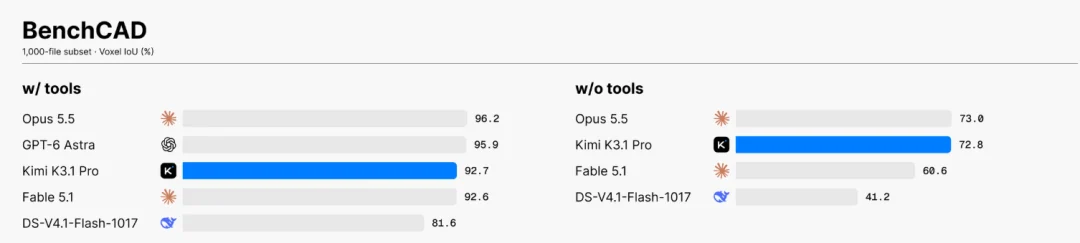
Scripting Blender and CAD extends the same capability to parametric jobs such as mechanical pieces, building assemblies, and bespoke furniture. BenchCAD with tools gives Kimi K3.1 Pro 92.7. Claude Opus 5.5 takes 96.2, and GPT-6 Astra takes 95.9.
The 92.7 has a condition. Moonshot reports two columns, one with tools and one without, and this number sits in the first. A setup that lets the model run scripts should land near it. A setup that does not should lower its target.
Finance: the error rate is the real headline
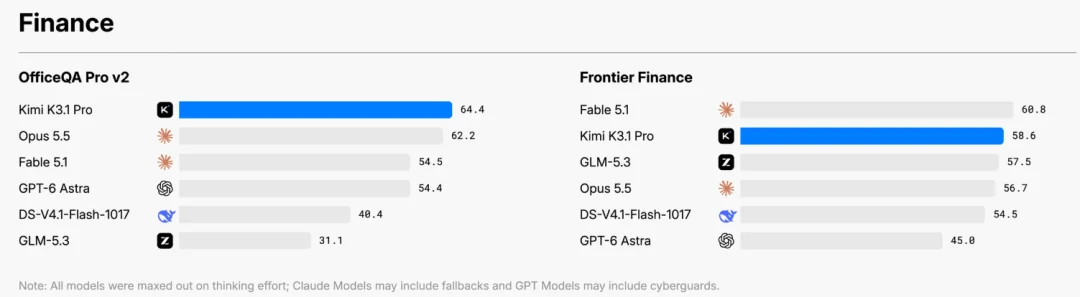
Moonshot frames finance as a chain of work: pull documents, reconcile numbers across files, construct a model, then analyze profitability. OfficeQA Pro v2 evaluates analysis over actual financial documents. Kimi K3.1 Pro reaches 64.4, described at release as the top result on that benchmark.
The demo produces an NVIDIA valuation workbook. Formulas link across sheets, assumptions are written down, operating drivers shift by scenario, while a sensitivity table translates each move into a valuation impact.
Precision matters more in finance than in code. The company's Kimi Hallu Bench Hard, an internal test, puts the claim-level hallucination rate at 8.3%, down from 23.4% on K3. The share of replies carrying at least one wrong fact is 42.4% of the earlier model's figure.
One wrong claim in twelve is progress, and still too much for unchecked delivery. Draft work, yes. A client signature, no.
Five checks before you commit
Ordered by how often they cause trouble.
- Scale. A model with 2.8 trillion parameters needs a data-center deployment. Sparse activation cuts compute per token; it does not cut operational work. Budget for a large GPU fleet and a serving crew, or buy access through an endpoint.
- Context economics. A one-million-token window suits repo-scale agents, yet each turn bills the input again. Holding an entire repository in context costs more than fetching the relevant files.
- Score provenance. Every result here originates in Moonshot's release material. No independent harness has reproduced them, and vendor-run tests tend to present the best case.
- Tooling. BenchCAD and the finance examples assume code execution. Check your sandbox before setting your results against those numbers.
- Speed. The release says nothing about latency at scale. A cheap token can still feel slow inside an interactive agent loop. Ask whoever serves the model.
The last item is the one to settle before a migration, not after.
If calling a hosted endpoint fits better than assembling a 2.8T serving stack, SiAPI.ai lists access options and rates on its pricing page.
FAQ
Do the Kimi K3.1 Pro weights really ship as open?
Moonshot placed them on Hugging Face on November 5, 2026, inside the company's moonshotai organization. The release material describes 2.8 trillion parameters in an MoE layout, a one-million-token context, and a base model offered as downloadable weights.
How close is it to Claude Opus 5.5?
Terminal-Bench 4.0 shows 65.7% for Kimi, with Opus 5.5 at 66.4%. BenchCAD with tools puts the pair at 92.7 and 96.2. Moonshot supplied both results, so treat the ranking as directional.
Can one server host it?
Not in any practical setup. With 2.8 trillion total parameters, the deployment begins at data-center scale before throughput enters the picture. A hosted endpoint is the realistic choice for most teams.
Source: Moonshot AI, Kimi K3.1 Pro release materials, November 5, 2026.