
Kimi K3.1 Pro Enters the Global Top Four: Benchmarks and Pricing
Published · 9 min read
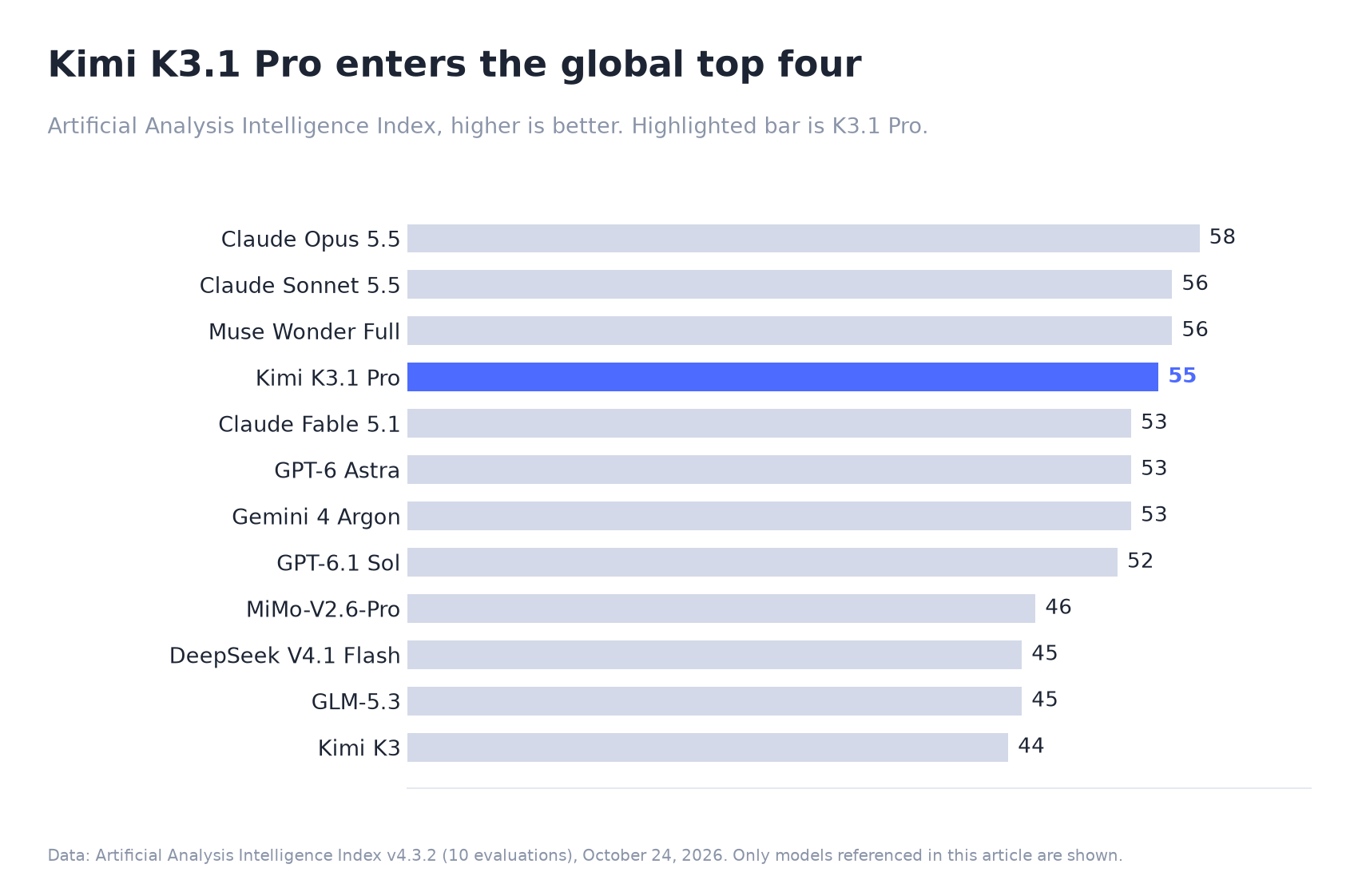
Kimi K3.1 Pro launched at No. 4 on the Artificial Analysis Intelligence Index with 55 points, ahead of GPT-6 Astra and Gemini 4 Argon at 53. Its clearest gains are in agent tasks: it leads AA's Terminal-Bench 4.0 run at 67.2%. Official API rates are $2 per million input tokens and $10 per million output tokens. Human preference results are less decisive, and lower token prices have not translated into an equally large drop in measured task cost.
In this article
Kimi K3 scored 44 when it arrived on July 16. Three months later, K3.1 Pro reached 55 using the same base model and parameter count. Moonshot put more compute into post-training and lowered the API price.
That puts it ahead of GPT-6 Astra and Gemini 4 Argon on this index. Claude Sonnet 5.5 still scores higher at the same token price, while blind human voting places Kimi further down the field. The fourth-place finish is useful evidence for choosing a model, with a narrower meaning than the headline might suggest.
What can you use today?
K3.1 Pro is available through Kimi's web and mobile apps, Kimi Work, Kimi Code and the Kimi API. The standard API model ID is kimi-k3.1-pro. Moonshot says Highspeed provides the same model quality with roughly two to three times the output speed, at twice the base input and output rates. Enterprise administrators must enable access; it was off by default at launch.
Moonshot has promised the full weights by November 4, 2026. At launch, AA described it as a model that would lead open weights once released. That is a forecast based on its hosted results; the release and license still need to be checked when the weights arrive.
How did it gain 11 points without adding parameters?
Moonshot attributes the improvement to more post-training compute. K3.1 Pro keeps K3's 2.8 trillion total parameters and 104 billion active parameters per token. Its training spans hundreds of domains, supported by changes to reinforcement learning infrastructure, sandboxes and rollout scheduling.
For context, the original comparison put MiMo-V2.6-Pro at 46 with 1.02 trillion parameters and GLM-5.3 at 45 with 753 billion. Kimi's roughly ten-point advantage comes from a larger model that activates only part of its parameters for each token. Those counts alone do not establish how cheaply any of these models can be served.
Where does K3.1 Pro perform best?
The strongest gains are in agent tasks where the model has to work in an environment, use tools and finish a job. AA's independent Terminal-Bench 4.0 run is the clearest example: K3.1 Pro scores 67.2%, compared with Sonnet 5.5 at 63.6% and K3 at 12.6% in the original comparison.
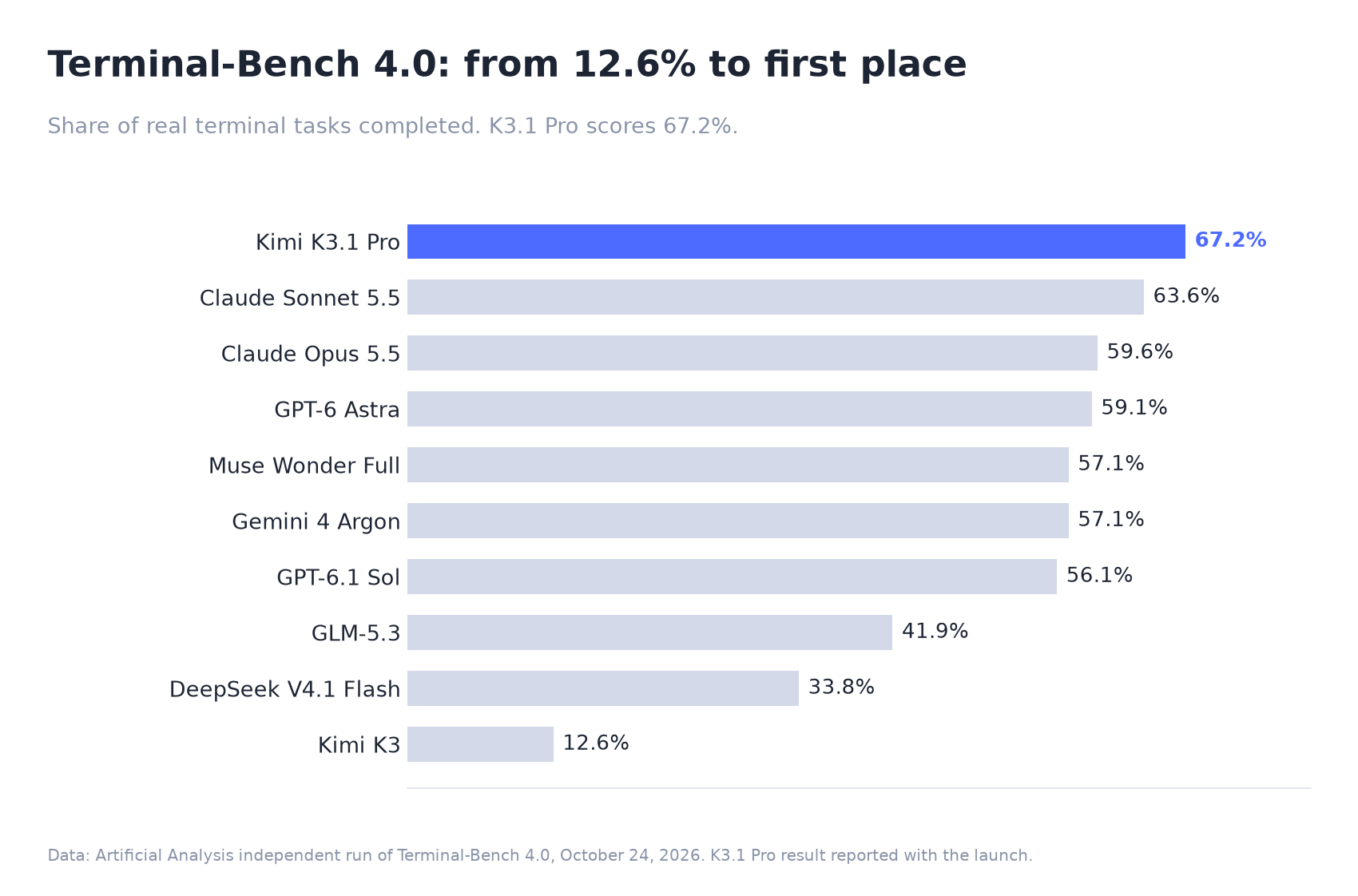
AA's launch report also placed it third on GDPval-AA, 312 Elo above K3. AutomationBench-AA rose from 58% to 73%. These results support a trial for terminal work and longer workflows.
| Test | K3.1 Pro | Comparison | Evaluation source |
|---|---|---|---|
| Terminal-Bench 4.0 | 67.2% | Sonnet 5.5: 63.6% | Artificial Analysis |
| GDPval-AA | 3rd; +312 Elo vs K3 | Behind Opus 5.5 and Muse Wonder Full | AA launch report |
| AutomationBench-AA | 73% | K3: 58% | AA launch report |
| SWE Marathon | 51.7 | Above Opus 5.5 in the original comparison | Moonshot-reported run |
| Terminal-Bench Science | 38.1 | GPT-6 Astra: 68.1 | Moonshot-reported comparison |
Moonshot's demonstrations cover similar work: a playable Unreal Engine 5.8 scene, a browser view of a 2,317-part robotic arm, a FreeCAD turbofan with 2,100 solids, and a simulated human that walked for 11.2 seconds after 167 tasks and 420 reviews. These are vendor demonstrations. On BenchCAD, Kimi trails Opus 5.5 and GPT-6 Astra with tools and comes close to Opus without them.
Why does it rank eighth in human voting?
Arena WebDev asks people to choose between outputs without seeing the model names. That measures preferences in the finished work, so its ranking can differ from a fixed benchmark suite.
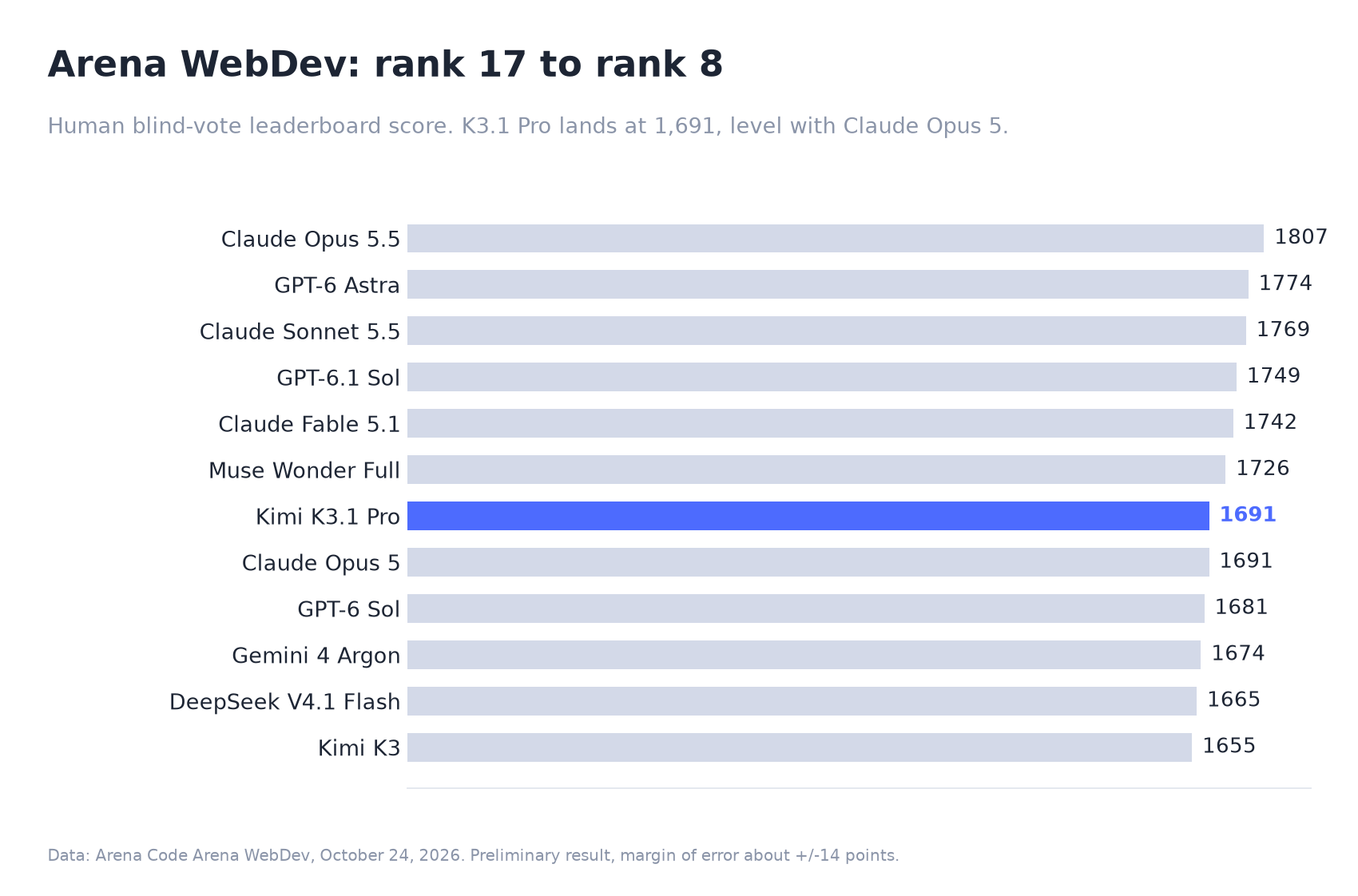
The original article recorded K3.1 Pro at 1,691 points, up from 17th to eighth and level with Claude Opus 5. On the overall board checked for this rewrite, it remains eighth at 1,692, with a preliminary interval of about ±14 points. Opus 5.5 is at 1,807, GPT-6 Astra at 1,774 and Sonnet 5.5 at 1,769.
It leads the Chinese models on that board. The launch-time expectation that it would also lead open weights depends on the weights actually being released. Human voters still leave a wider gap to the leaders than the intelligence index does.
What does the API cost?
Moonshot's standard USD rates are $2 per million input tokens and $10 per million output tokens. The original article also quoted the domestic CNY rates of ¥13 and ¥68. These are separate regional price listings, rather than a live currency conversion. Highspeed doubles the base input and output rates.
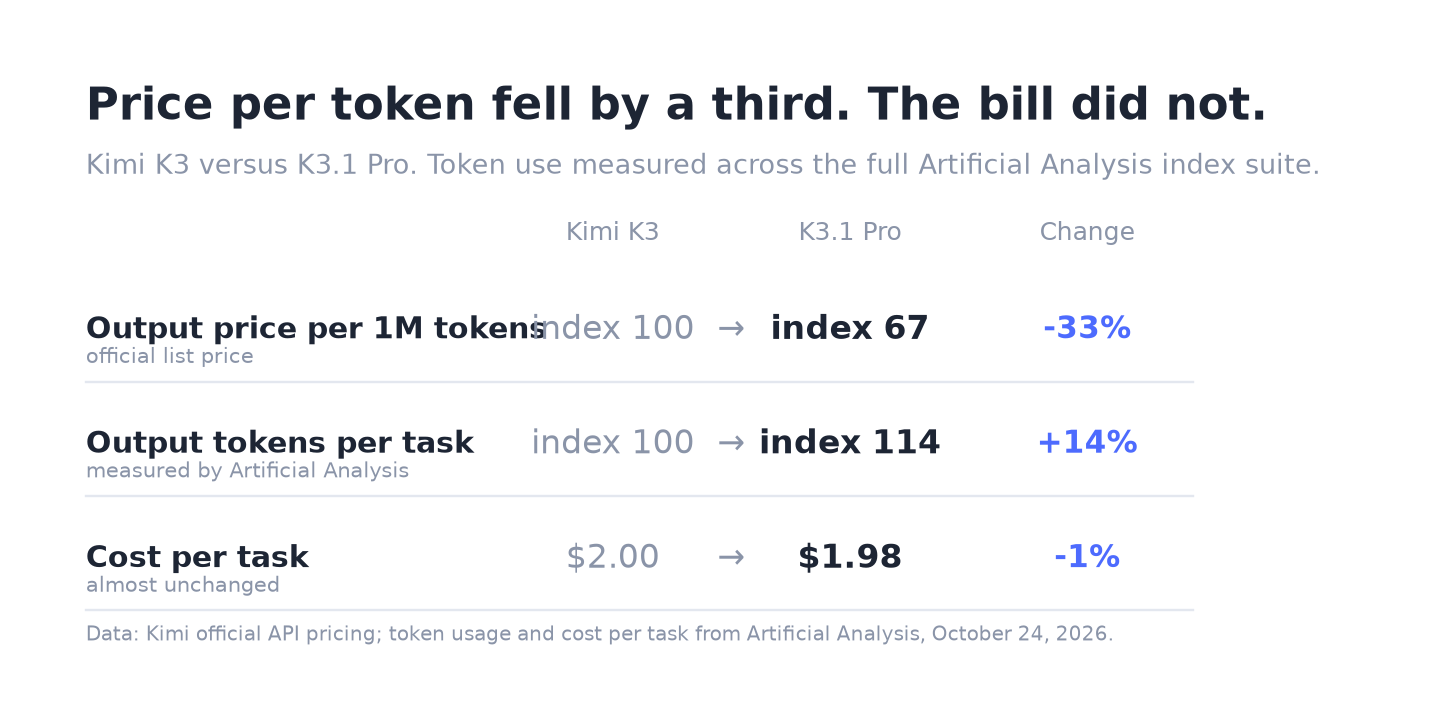
AA's October 23 launch report put K3.1 Pro's cost at $1.98 per Intelligence Index task, roughly equal to K3; the original article quoted K3 at $2.00. It also reported 14% more output tokens per task despite token rates being about a third lower. Those are measured results from that evaluation. The two percentages alone do not explain the total bill, which depends on the mix of billed tokens.
AA's model page checked on October 26 lists $2.11 per task. The practical conclusion holds: a lower rate per token does not guarantee the same percentage saving per completed task.
| Model | Input / 1M tokens | Output / 1M tokens | AA score |
|---|---|---|---|
| Claude Opus 5.5 | $4 | $20 | 58 |
| Claude Sonnet 5.5 | $2 | $10 | 56 |
| Kimi K3.1 Pro | $2 | $10 | 55 |
| GPT-6 Astra | $10 | $50 | 53 |
| DeepSeek V4.1 Flash | $0.3 | $1.2 | 45 |
Provider list prices from the original article, not SI-API checkout prices. Scores reflect the reasoning settings used in that comparison. Cache billing and applicable taxes can change the bill.
In the original snapshot, Kimi sits at the same base rates as Sonnet 5.5, Gemini 4 Argon and GPT-6.1 Sol, half Opus 5.5's rates and one fifth of GPT-6 Astra's. DeepSeek V4.1 Flash and GLM-5.3 are cheaper, with roughly ten fewer index points. The original Arena snapshot reported a median of $1.23 per task, 29% below K3; that is a different workload and statistic from AA's task cost.
How does it compare on value?
Within the original article's comparison set, K3.1 Pro scores above GPT-6 Astra at much lower token rates. It also scores above Gemini 4 Argon and GPT-6.1 Sol at the same base rates. That makes it worth considering for workloads where the index is a useful guide.
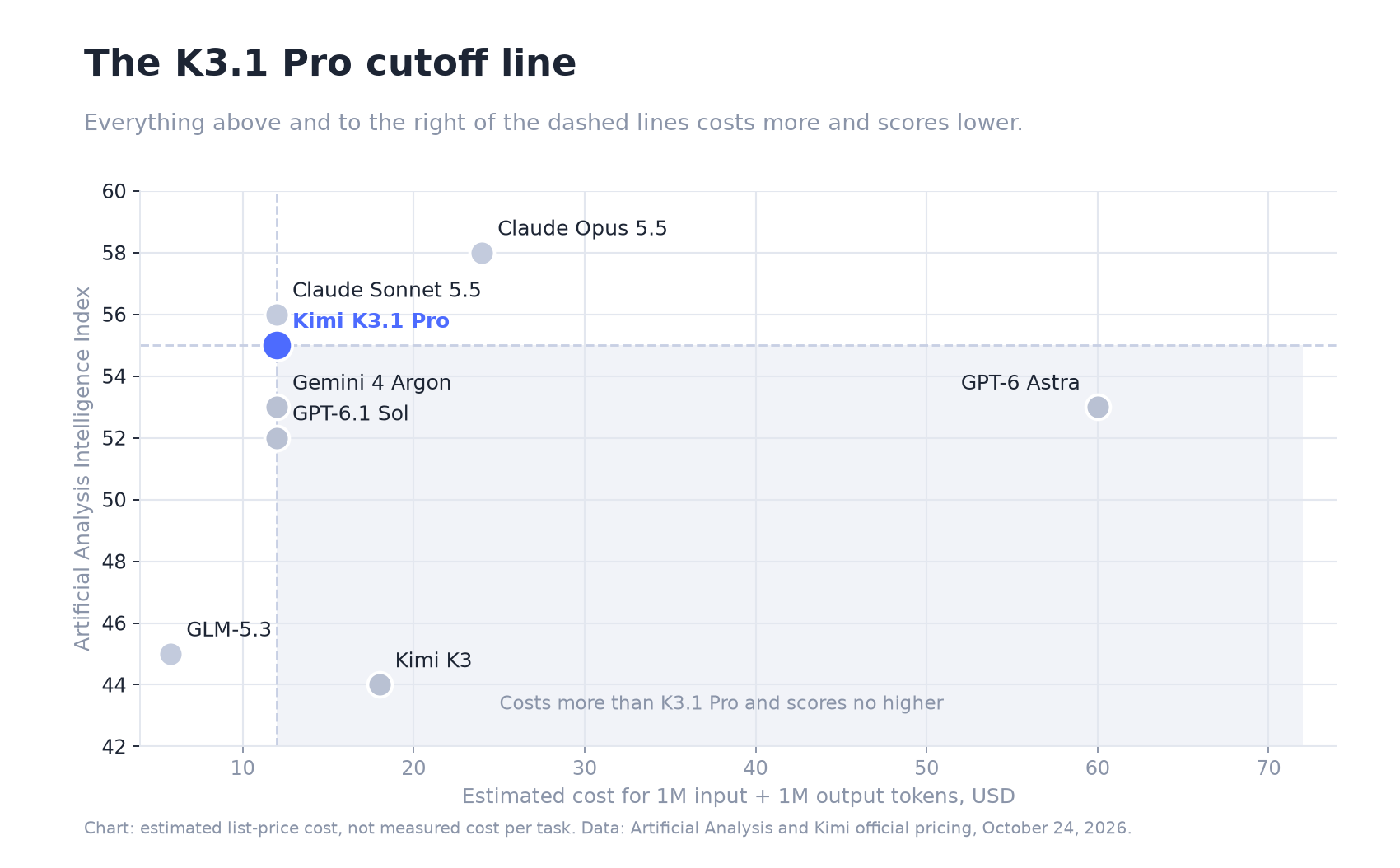
Sonnet 5.5 scores one point higher at the same price. Opus 5.5 scores three points higher at twice the price. The chart describes that limited score-and-price comparison; it does not account for latency, reliability, human preference or the number of tokens each task needs.
What remains unproven?
Much of the launch evidence comes from Moonshot's own runs, including OfficeQA Pro v2, SWE Marathon, Agents' Last Exam, finance tests and demonstrations. AA's evaluations and Arena voting provide external checks. Moonshot says it assigned zero to some external-model OfficeQA runs that retrieved reference answers online, so that result needs to be read with its scoring rules.
The original comparison also shows a clear science gap: 38.1 on Terminal-Bench Science against GPT-6 Astra's 68.1. It recorded output speed around 77 tokens per second against a similar-price median of 81. AA's page displayed 52.2 tokens per second when checked for this rewrite, so the earlier figure should not be treated as a fixed speed guarantee.
The source article mentions users exhausting a five-hour coding quota sooner than on K3. That remains an anecdotal report, not a controlled quota comparison. More output tokens can affect usage, but plan rules and workload mix also matter.
Moonshot also deliberately reduced cyber capability by removing related training data. Its internal xdev-bench-hard test puts the unrestricted checkpoint at 90.5%, the released model at 81% and K3 at 33.3%. That comparison describes a training choice, rather than an accidental loss of capability.
Should you switch to K3.1 Pro?
It is worth a trial for terminal work, long agent runs and code changes that must be executed and tested. The evidence is less convincing for scientific tasks or web output judged mainly by human preference. For answers that must be right on the first attempt, evaluate accuracy on your own examples.
Use a small set of representative jobs and record four things:
- Cost per accepted result. Include billed tokens, retries and failed runs.
- Context quality. Test your repository within the advertised up-to-1M-token window; check the limit your chosen access channel actually allows.
- Completion time. Measure the whole run against your timeout budget.
- Allowance use. Track how quickly repeated jobs consume your plan quota.
For routine refactors and documentation, a cheaper model may be enough. One option is to use DeepSeek V4.1 Flash for bulk work and reserve K3.1 Pro for harder agent tasks. Compare that split against a fixed coding budget using our coding plan options and their current allowance rules.
Verdict
Kimi K3.1 Pro makes a substantial improvement over K3: eleven more index points, a leading independent terminal result and lower token rates, all with the same parameter count. The gains are strongest where an agent has to keep working through a task.
Sonnet 5.5 remains ahead on the index at the same base token price and wins more human preference votes. The 3D and finance examples are mostly vendor demonstrations, and measured task costs have changed since launch. K3.1 Pro earns a place in an agent evaluation, with enough evidence to test it and enough unresolved trade-offs to measure the result.
Frequently asked questions
What is the API model ID?
The standard Kimi API ID is kimi-k3.1-pro. Hosted access is available through Kimi's apps, Kimi Work, Kimi Code and its API; identifiers and access rules can differ by channel.
How much does Kimi K3.1 Pro cost?
The standard provider rates are $2 per million input tokens and $10 per million output tokens. AA's launch report quoted $1.98 per task; its model page checked on October 26 shows $2.11. Neither figure is a quote for your own workload or SI-API billing.
Does it beat GPT-6 Astra and Gemini 4 Argon?
On the launch intelligence index, yes: 55 against 53 for each. Arena's overall WebDev board still places it eighth, behind GPT-6 Astra. The answer depends on the task and the evaluation.