A four-model showdown: how good is the new Kimi K3.1 Pro?
By WaWaGitHubOriginal:
Published · 9 min read
At a glance
The reviewer ran Kimi K3.1 Pro, GPT-6 Astra, Claude Opus 5.5 and DeepSeek V4.1 Flash 1017 through five visual and 3D build cases. Claude Opus 5.5 produced the best-looking results overall, Kimi K3.1 Pro took the aesthetics call on the merged SVG case, and Kimi and GPT-6 Astra were the only two to solve the embedded math problem. Across all five cases the total API spend came to $137.40 for GPT-6 Astra, $89.09 for Claude Opus 5.5, $31.08 for Kimi K3.1 Pro and $23.96 for DeepSeek V4.1 Flash 1017, the last one at peak rates. This page is an English translation of the review. SiAPI has not rerun the tests.
In this article
What did the reviewer test?
For a while the overseas labs shipped one release after another while China's labs stayed quiet. That has now flipped: DeepSeek V4.1 Flash 1017 arrived a few days ago, and Kimi K3.1 Pro followed it.
Moonshot says that on coding, agent and knowledge benchmarks, Kimi K3.1 Pro reaches or sits just behind the strongest closed models. On Terminal-Bench 4.0 it scores 65.7%, ahead of GPT-6 Astra at 58.2% and a sliver behind Claude Opus 5.5 at 66.4%.
Numbers alone never show how big a jump feels, so the honest way to judge a model is to build with it. This review pits four models against each other, DeepSeek V4.1 Flash 1017, Kimi K3.1 Pro, GPT-6 Astra and Claude Opus 5.5, to find out where the new Kimi actually lands.
01 · Hands-on tests
Case 1: What happens when three classic tests merge into one?
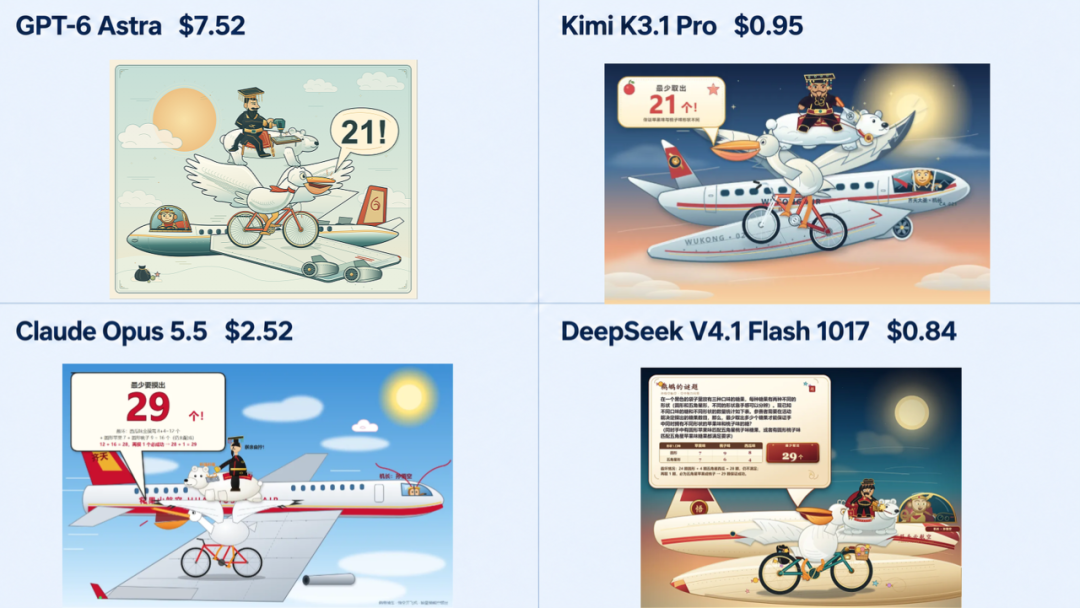
Whenever a new model shows up, the reviewer usually starts with the three classic drawing tests. Recent models clear those small tasks without trouble, so this time everything was fused into one harder brief: combine the three images into a single picture, then add a math problem on top.
The four case 1 outputs side by side, with each run's cost overlaid. Image published with the review.
Elapsed time per model for case 1, as reported in the review.
Model
Elapsed time
GPT-6 Astra
11 min
Kimi K3.1 Pro
15 min
Claude Opus 5.5
3 min
DeepSeek V4.1 Flash 1017
17 min
GPT-6 Astra and Kimi K3.1 Pro both solved the math. Draw 9 round candies and you are guaranteed an apple or a peach; draw 12 star candies and the set must contain both flavors, so the answer is 21. GPT-6 Astra placed the airplane engines above the wing, which pulls you out of the scene a little. On looks, Kimi is the strongest of this case, and its palette is the one the reviewer likes most.
Claude Opus 5.5 and DeepSeek V4.1 Flash 1017 are knocked out here: both got the math wrong.
On speed, Claude Opus 5.5 and GPT-6 Astra were the fastest, and the later cases follow the same pattern. Costs are overlaid on the images and videos, with a full tally at the end.
Case 2: How far can a clockwork 3D unicorn go?
Prompt
Act as a world-class creative developer and 3D technical artist. Build an interactive 3D web experience called "Unicornis Mechanica", a clockwork mechanical unicorn, in a single HTML file. You must use Three.js (r128), OrbitControls and Tailwind CSS loaded from a CDN.
Absolute constraint: you may not load any external 3D model files such as .gltf or .obj, or any texture images. The entire unicorn must be generated procedurally from Three.js primitive and math geometry (Cylinders, Spheres, ExtrudeGeometry, TubeGeometry, Torus and so on) to simulate an enormously complex mechanical beast built with Swiss-watch precision.
Detailed specification:
1. Aesthetics and UI design
Typography: 'Cormorant Garamond' serif for a classical, mythic feel, 'JetBrains Mono' for the technical telemetry readouts.
Layout: top left, an editorial title block ("Unicornis Mechanica - Concept No.08"). Top right, a theme switcher ("Ivory & Gold" versus "Obsidian") plus live system status readouts. Bottom left, a telemetry and component-spec panel that updates dynamically when the raycaster hovers different 3D parts (output power, gait frequency and similar). Bottom center, a frosted-glass control dock holding an explode/assemble slider, a "Gallop" button, camera presets (ISO, SIDE, FRONT, BACK), an auto-orbit toggle and a gait "Tempo" slider. Background: a subtle drafting-board frame with corner registration marks over a radial gradient.
2. Procedural 3D modeling
The unicorn must be extremely detailed and organized in code into at least 16 specific hoverable, explodeable component groups. Core requirements:
Gears: write a helper function that builds high-detail cut-out gears with ExtrudeGeometry. The joints and the belly must expose dense, interlocking gear trains.
Spiral Horn: built from path-extruded geometry with a twist parameter, or interlaced TubeGeometry, producing a highly ornate horn with helical fluting.
Chassis & Spine: a thoracic power core with a glowing heart escapement inside, segmented articulated neck vertebrae, and a rib-cage shell.
Limbs & Hooves: front and rear legs with true equine skeletal proportions, scapular armor, knees and hocks with hydraulic damper rods, and hooves assembled from multiple metal plates.
Mane & Tail: stacked, independently moving metal blades or glowing cables (CatmullRomCurve3) that suggest a flowing yet strictly mechanical mane and tail.
Cranial Housing: a faceted, sculpted head shell with glowing optical sensor eyes and mechanical ears.
3. Materials, lighting and themes
Build a procedural studio softbox environment with PMREMGenerator so the metals reflect cleanly. Define two palettes that switch seamlessly:
Ivory & Gold (default): warm parchment background, 24k gold gears and joints, ivory ceramic armor, and a crystal-glowing horn and eyes.
Obsidian: dark blueprint background, brushed titanium skeleton, deep red-copper gears, an obsidian-sheen shell, and a power core glowing a faint red or violet.
Use LineBasicMaterial to lay a combined magic circle and engineering survey grid on the floor beneath the unicorn.
4. Animation and kinematics (the render loop)
Gait kinematics: clicking "Gallop" eases smoothly into a run. The legs must follow real gallop or trot phase gaits, the shoulders and pelvis rise and fall with the stride, the neck reaches forward and back rhythmically, and the tail and mane whip through in follow-through.
Breathing and idle: at rest the torso breathes with a slight rise and fall, with an occasional ear flick and a light hoof stamp.
Tempo: run speed, leg swing frequency and the rotation of the internal gears must all track the Tempo slider in real time.
5. Exploded view and 3D callouts
Bind the "Explode" slider to the 16-plus component groups so they drift apart smoothly through 3D space.
Above slider value 0.1, fade in a DOM-based SVG/HTML callout layer. Dynamic SVG lines must track each part's projected position on screen and connect to polished HTML labels, for example "Spiral Horn: Aetherial Resonator" or "Thoracic Core: Mainspring Engine".
Write production-grade, heavily commented, cleanly structured JavaScript. All gait-phase trigonometry, the sine and cosine math, must be exact. All CSS, HTML and JS logic must live in one self-contained index.html file.
▲ Scroll to read the full prompt
The four unicorn builds compared in video, with each run's cost overlaid. Published with the review.
Elapsed time per model for case 2, as reported in the review.
Model
Elapsed time
GPT-6 Astra
48 min
Kimi K3.1 Pro
54 min
Claude Opus 5.5
56 min
DeepSeek V4.1 Flash 1017
52 min
GPT-6 Astra: both themes run and the basic interactions work, but the design reads as a cartoon mechanical toy, and some of the gears drifted outside the body.
Claude Opus 5.5: the aesthetics kill the contest. It built the best-looking unicorn of the set. The head, neck, shoulder armor and hooves are proportioned, and the rivets, metal trim, belly gears and the wind-up key on the back add believable mechanical detail. The Obsidian theme is complete as well. In the code, the gear ratios, the foot-tip trajectories and the inverse kinematics are all genuinely implemented.
Kimi K3.1 Pro: the strength is interaction and adaptation. Its 31 components drill down to each limb segment and the hooves, with hover readouts, click-to-pin values and a component dropdown, but the art still needs another pass.
DeepSeek V4.1 Flash 1017: the large serif title, paper background, thin gold rules and the left-right exploded labels are consistent. It does seem to have misread the brief, because the whole unicorn came out black.
Case 3: Can the models ship a playable mini-game?
Prompt
A Xiaohongshu-style infographic, cartoon style, hand-lettered text, light mint-green background.
Left-right composition: on the left, a cartoon speech bubble plus brain, labeled "autoregressive model | understands instructions | overall composition". On the right, a cartoon brush plus letter strokes, labeled "diffusion decoder | detail rendering | letter strokes".
Connect the two with hand-drawn arrows and write the headline at the top: "read the instructions right, write the words right".
Highlight the keywords "cognitive generation" and "knowledge + reasoning" with marker strokes.
Overall style: hand-drawn, cute, clear and easy to read, minimal information, generous whitespace.
Watermark in the lower right corner: "K姐研究社".
▲ Scroll to read the full prompt
Video as published under case 3 in the original article.
Elapsed time per model for case 3, as reported in the review.
Model
Elapsed time
GPT-6 Astra
24 min
Kimi K3.1 Pro
32 min
Claude Opus 5.5
71 min
DeepSeek V4.1 Flash 1017
34 min
Claude Opus 5.5: still the best-looking and most classic of the set, with rich gameplay detail. Kicking turtle shells, shell kills, sliding down the flagpole, walking to the castle, all of it makes the level feel like an actual game.
GPT-6 Astra: visual completeness is decent. The 3D title, the character's features, terrain thickness, the underground crystals and the castle scene are all there. But why is the character facing me? A little strange.
Kimi K3.1 Pro: the interface is unified and clean, hints and controls are clearly explained, and the offline deliverable is complete. The characters and scenery are on the simple side, the route is straightforward, and the page design is more finished than the level content.
DeepSeek V4.1 Flash 1017: the core mechanics are implemented and every element shows up, but the picture feels like an early prototype and the polish lags a step behind.
Case 4: Can they model the Bird's Nest in Blender?
Prompt
Build a maximally detailed 3D scene of China National Stadium, the Bird's Nest, in Blender.
The four Bird's Nest scenes compared in video, with each run's cost overlaid. Published with the review.
Elapsed time per model for case 4, as reported in the review.
Model
Elapsed time
GPT-6 Astra
27 min
Kimi K3.1 Pro
24 min
Claude Opus 5.5
30 min
DeepSeek V4.1 Flash 1017
58 min
GPT-6 Astra: the silhouette is right. The shell bulges, the base tucks in and the roofline varies, but the radial beams and the circumferential grid are too regular, which weakens the woven feel of the nest.
Kimi K3.1 Pro: the stadium reads clearly, with a clean warm-cool separation and a clear subject. It is just too dark: once the render finishes you cannot see anything around it.
Claude Opus 5.5: carries the beams from the roof down through the facade to the ground, so the steel structure reads as one object.
DeepSeek V4.1 Flash 1017: the building comes out a straight tube with a flat roof, missing the shell undulation the Bird's Nest needs.
Case 5: Can they rebuild the Tesla flying-car stunt?
Prompt
Role and task: build a single-file interactive Three.js telemetry page, a flying-car HTML, that fully simulates and breaks down the October 15, 2026 Tesla × SpaceX Roadster test at the McGregor site: launch off an inverted C-shaped half-pipe ramp, an upside-down horizontal ejection at the crest, a 180° barrel roll in mid-air, a 1 m cold-gas hover, and a four-wheel landing, so the reader can learn the whole kinematic sequence at a glance.
Design style (Archival Telemetry × Risograph): a base texture of 1970s NASA archival off-white paper (#F3EDE0) overlaid with SVG paper-fiber noise and an orthogonal engineering grid. Four risograph inks: Federal Archive Blue (#004E98, body color and ramp structure), fluorescent orange-red (#FF432E, SpaceX cold-gas plumes, active spoiler and force vectors), peacock teal (#00916E, the 2G vacuum suction field under the chassis), archival ochre (#D99414, the wedge nose headlight and the center-of-mass trace), and lead black (#1B1D21, heavy borders, solid tires and cartoon outlines).
3D solid car modeling (no cheap wireframes): the car must be a procedural solid 3D coupe mesh. Hollow transparent wireframes are forbidden. Use THREE.Shape plus ExtrudeGeometry with beveled edges for the low wedge nose, the streamlined dark glass canopy, the wide fenders, the raised active rear wing and four independently spinning solid wheels. High-contrast two-tone: top surfaces in Federal Blue with a dark canopy, underside in peacock teal fan zones with a fluorescent red nozzle plate, plus BackSide lead-black ink outlines, so head from tail and roof from floor read instantly during 3D flips.
2. Single-stage minimalist layout
Drop the right-hand multi-canvas sidebar and the dense parameter tables. Use one 100vh no-scroll screen in three bands: a full-bleed 3D stage, a light floating lecture card and a six-stage timeline along the bottom.
Top archival header bar (46 px): on the left, the archive title TSLA × SPACEX ROADSTER // FLIGHT TELEMETRY with a classified stamp tag; on the right, one-click 3D view buttons ([default tilted 3D axonometric] / [free mouse orbit] / [first-person chase from the tail]) plus a [blueprint darkroom mode].
Center full-bleed 3D stage (82% of the screen): one main visual. On the left, the steel-trussed, three-dimensional C-shaped cantilever ramp; on the right, the flat-launch flip zone, the 1 m hover and reverse-thrust zone and the landing runway.
3D solid strobe ghosts: at the 6 key nodes of the trajectory, park semi-transparent (opacity 0.30) solid car ghosts, so a single view shows every attitude change, with a one-click toggle.
Top-right floating stage card: one title, two plain-language sentences and three core status badges (heading / pitch / roll) explaining the physics of the current stage in real time.
Bottom six-stage timeline (74 px): top row, play/pause, 0.25x slow motion, a ghost toggle, a force-vector toggle and a continuous scrub slider from 0.00 s to 3.40 s; bottom row, six stage bookmark buttons that jump straight to a stage and lock the camera.
3. Core trajectory and the six-stage attitude spec (100% physical fidelity)
The whole run plays out on one continuous timeline, t from 0.00 s to 3.40 s, strictly following the coordinates and rigid-body Euler angles below:
01 Ground acceleration, 0.00 s to 0.55 s: heading strictly left (−X), pitch 0° level, roll 0° wheels down. The car sprints left into the base of the C ramp off the right-hand approach lane, a fluorescent red conical cold-gas plume streaming from the tail.
02 2G suction climb, 0.55 s to 1.35 s: heading swings clockwise along the arc tangent through nose-up; pitch rotates with the arc tangent from 0° to 180°; wheels locked to the surface. A peacock teal suction halo, a 2.0 G force pressing normal into the ramp, glows under the chassis as the car climbs the inverted wall against gravity.
03 Upside-down launch at the crest, 1.35 s to 1.75 s: heading strictly right (+X), pitch 0° parallel to the ground, roll 180° wheels to the sky. At the cantilever crest the nose has already swung right, the wheels press the ceiling and the dark roof faces down as the car shoots out over the edge exactly parallel to the ground.
04 High-altitude level barrel roll, 1.75 s to 2.50 s: heading strictly right (+X), pitch 0° level the whole way, roll from 180° through 90° back to 0°. Fans off after launch. On the first half of the falling parabola the body stays level while cold-gas nozzles on either side fire one up and one down, a couple that rolls the solid body back upright through 180° about its long axis.
05 1 m cold-gas hover, 2.50 s to 2.95 s: heading strictly right (+X), pitch 0° strictly level, roll 0° wheels down. Already recovered, at about 1 m of altitude the underbody fires a hard vertical cold-gas blast, thrust far above weight, for a brief horizontal hover in mid-air, with a 3D shockwave ring spreading over the ground.
06 Four-wheel touchdown, 2.95 s to 3.40 s: heading strictly right (+X), pitch 0° strictly level, roll 0°, all four wheels land together. The reverse thrust tapers off, the four solid wheels touch down gently and level, and the car glides out to the right to finish.
4. 3D force-vector visualization, bound straight to the car's center of mass
No side charts. Render three high-contrast solid cone arrows (THREE.ArrowHelper or custom solid arrows) live at the center of mass:
Gravity (lead black, constant and straight down along −Y): present in every stage as the reference baseline.
Vacuum fan suction (peacock teal, pointing normal into the C ramp surface): active only in stages 01 to 03, showing plainly why the car can stick to the inverted ceiling.
SpaceX cold-gas thrust (fluorescent orange-red):
Stages 01 to 03: pushes along the heading to accelerate the car.
Stage 04: the two sides of the body fire one up and one down in opposition, forming the rotating couple arrows around the body.
Stage 05: the underbody fires hard downward, producing a thick vertical lift arrow that makes the mid-air stop and hover obvious at a glance.
▲ Scroll to read the full prompt
The four flying-car telemetry pages compared in video, with each run's cost overlaid. Published with the review.
Elapsed time per model for case 5, as reported in the review.
Model
Elapsed time
GPT-6 Astra
22 min
Kimi K3.1 Pro
21 min
Claude Opus 5.5
20 min
DeepSeek V4.1 Flash 1017
30 min
GPT-6 Astra: the most complete ramp of the set, thickness, cantilever, trusses, runway and shadows, with rich body and undercarriage detail too. Some of the ghosts crowd together and the text along the bottom is too small.
Kimi K3.1 Pro: the presentation is on the spare side, but every key attitude is there, the braking after the flip, the stationary hover and the rest.
Claude Opus 5.5: trajectory, rulers and force notes are organized, and clicking a stage focuses the matching action. It even computes how the front and rear wheels track the arc at a fixed wheelbase, and reverse-fires to brake through the second half of the barrel roll, so the detail thinking runs deep. The labels crowd the frame a bit, and it leans on an external CDN, so it will not start offline.
DeepSeek V4.1 Flash 1017: the car, the two-tone flip livery, the six stages and the main controls are all present, and the large body reads clearly mid-flip, but the launch, hover and landing ghosts bunch together.
What did the full run cost?
Across the whole comparison, the total spend came to the figures below.
Total API spend per model across the five cases, as reported by the reviewer.
Model
Total spend
GPT-6 Astra
$137.40
Claude Opus 5.5
$89.09
Kimi K3.1 Pro
$31.08
DeepSeek V4.1 Flash 1017
$23.96
On price alone, DeepSeek V4.1 Flash 1017 is the clear value, and that is at peak rates. The best results came from Claude Opus 5.5. GPT-6 Astra and Kimi K3.1 Pro sit in the middle tier, roughly level, each with its own wins and losses.
You can watch Chinese open-weights models steadily chasing the closed frontier. A gap is still there, but on these cases the results now land close, and each model wins somewhere.
At the pace the open models are improving, it may be only a few years before open and closed models run level with each other.
For indie developers and small teams, the practical move is to build the idea at a low price first, then decide which details deserve the extra time.
On today's front-end and 3D capability, Kimi still holds a competitive position once price and output are weighed together. More full-stack comparisons will follow as the testing continues.