
Kimi K3.1 Pro 3D Benchmark: Temple of Heaven in Blender, Robot Motion, and the Cost of Each Run
Published · 7 min read
Three briefs, three models, one day. Kimi K3.1 Pro turned a single photo into a structurally correct Temple of Heaven by writing Python inside Blender, landed every motion on a Unitree G1 humanoid, and held GPT-6 Astra to a draw on a procedural Three.js park that Astra detailed better but built with the coaster through the castle. The meter read $2.87 to $5.72 for K3.1 Pro, against $6.47 for Astra and $1.87 on the DeepSeek V4.1 side; the real ceiling turned out to be speed, not skill.
In this article
A coding model is usually graded on diffs and bug fixes. This one was graded on whether its output is something you can walk through.
Comparisons in this space tend to stop at code scores. The exercise recapped here asked something else: give models the same visual 3D briefs and judge what comes back that a person could actually use. One operator ran everything in a single sitting, and a cost counter recorded each session as it went.
Three candidates took part: GPT-6 Astra, DeepSeek V4.1, and Kimi K3.1 Pro. A fourth, Opus 5.5, left the lineup almost immediately, and not over its output. The test accounts kept getting banned.
The scenes below are ordered by how much they say, not by when they ran.
First, the showpiece: a temple assembled by scripts
Verdict: nothing else in the round matched it for completeness. It was also the slowest.
Given one reference photo, K3.1 Pro opened Blender, authored Python inside it, ran that code, and returned an exploded view of the building's structure rather than a handsome hollow shell.
Everything that makes the Temple of Heaven readable survived the trip: three tiers of eaves, the round footprint, dark blue glazed tiling, vermilion doors and windows, decorated beams, the white marble terrace, the golden finial. The orbit and interaction design wrapped around the model was the last thing to expect from something that only writes scripts.
Two footnotes. Generation drags. And the operator's side build, a Shenzhen metro station modeled halfway in Blender with the lighting untouched, suggests the geometry scales better than the wait does.
Motion, where most models fall over
Verdict: every motion landed.
Unitree's G1 set the reference here. Humanoid figures punish small mistakes: dozens of joints, rigid surfaces, and a kinematic chain where one wrong offset reads instantly. The K3.1 Pro output pulled off a boxing combination, a backflip, and a wave, with joints that move like they were planned rather than interpolated.
DeepSeek V4.1 supplied the comparison. It is a Flash-class model sold on light duties, yet it produced a watchable humanoid animation in a single attempt, which says more than its positioning does.
The one direct fight: two parks, one clipped castle
Verdict: close enough to call a draw.
K3.1 Pro generated its park natively in Three.js. Castle, rides, water, illumination, surfaces: all procedural. The camera behaves like a visitor's, with free orbit, saved viewpoints, and zoom and rotate, and the grounds read as one connected place instead of props on a grid.
Astra sculpts the prettier park at first glance, with spires that stack more detail. The flaw hides until you orbit around: coaster rails run right through the castle walls. On the K3.1 Pro side the surfaces are plainer and the buildings simpler, yet nothing intersects, the layout makes sense at a glance, and its water clearly beats Astra's.
What the meter recorded
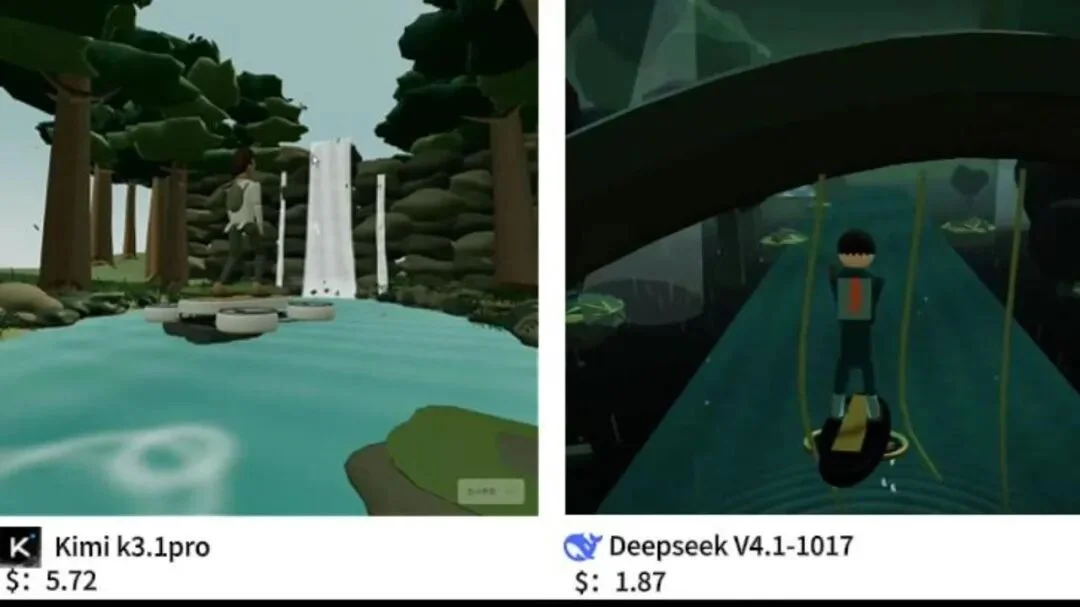
The harness totals every session, and two match-ups are worth quoting. K3.1 Pro closed at $2.87 where Astra reached $6.47 on comparable work. Against DeepSeek V4.1, K3.1 Pro landed at $5.72 while DeepSeek settled at $1.87.
Read those as direction. No run published token counts, retry counts, or scoring rules, and one extra-long reasoning chain can swing a total as hard as switching models.
Where the friction sits
- Speed. Waiting on a render becomes the limiting factor before quality does.
- Access limits. The tester hit 429 responses and a subscription quota ceiling, and reports that Kimi has owned the problem.
- Surfaces. Astra keeps its edge on fine detail and small components.
- Runaway cost. Subagent sprawl and marathon reasoning chains bill faster than the scenes themselves justify.
Which model belongs where
Reach for GPT-6 Astra when the job is a large scene that must render stably and carry fine parts; its park proved that even with track through the castle. Reach for K3.1 Pro when structure, procedural builds, and interaction logic lead the requirements; its Blender temple was the most finished artifact of the round. DeepSeek V4.1 is the budget option, and the tester still flags the widest visual front-end shortfall.
One difference benchmarks tend to skip: K3.1 Pro operates Blender, SolidWorks, and Rhino through their native scripts, so no MCP connector sits in the middle. Anyone shipping real models rather than screenshots loses a layer of glue code, and that shifts a workflow further than any marginal quality gap would.
The tester's own summary puts K3.1 Pro at the open-source frontier for front-end work. Across these scenes that reading fits structure and interaction. Materials tell a different story.
Scoreboard
| Scene | Brief | Match-up | Outcome |
|---|---|---|---|
| Temple of Heaven | A faithful structure built up from one photo | Solo run | Round's most finished build; slowest of the three |
| Humanoid robot | Joint animation on Unitree G1 proportions | DeepSeek V4.1 | All motions landed |
| Amusement park | Procedural Three.js grounds with its own camera rig | vs GPT-6 Astra | Draw; Astra ahead on materials, behind on structure |
FAQ
Did Kimi K3.1 Pro beat GPT-6 Astra?
The test staged a single direct meeting, the park, and it ended level: Astra ahead on materials and fine detail, K3.1 Pro ahead on structure, layout integrity, and water. The robot round compared K3.1 Pro with DeepSeek V4.1, and the temple had no opponent.
Does Kimi K3.1 Pro need a connector to drive Blender?
No. It wrote and executed Python inside Blender to produce the temple, and the same session covered SolidWorks and Rhino scripts. Nothing sat between model and tool.
What does one 3D scene cost on Kimi K3.1 Pro?
Session totals ran $2.87 to $5.72 in this test. Astra reached $6.47 in its match-up and DeepSeek V4.1 finished at $1.87. All of it comes from one harness on one day.
What hurts first when you scale this up?
Waiting. Renders are slow enough that iteration, not output quality, sets the pace, and 429 responses plus a subscription quota ceiling showed up during testing.
Every model in this test is reachable through one key on SI-API: Kimi, DeepSeek, GLM, MiniMax, and Qwen behind OpenAI- and Anthropic-compatible endpoints, with setup guides for Claude Code and Codex. Coding plans start at $29.9 a month, and the pricing page lists current point rates, including the 15× rate for Kimi K3.1 Pro.