
GLM-5.4 Hands-On: Six Coding Projects Reveal Its Strengths And Limits
Published · 7 min read
GLM-5.4 is Zhipu's first flagship with a Loop Transformer. It sends each token through the 28 middle layers twice, adds image understanding, and targets code-generated video, games, and 3D. There is no official benchmark suite yet. On the independent KingBench 4 list it scores 33.2 out of 60, seventh overall and first among open models, 0.4 behind GPT-6.2 Astra. In six builds it handled well-specified websites, apps, and 3D scenes, but fell behind on free-form 3D modeling. The bigger problem is throughput: peak-hour requests failed about half the time, and long tasks took hours.
In this article
Zhipu released GLM-5.4 in November 2026. The pitch is unusual. Instead of adding parameters, the model sends each token through the same 28 middle layers twice. Zhipu calls the design Loop Transformer and says a 750B model now reaches the intelligence level of 2T to 3T models. The release also adds vision, which the company uses to push what it calls generalized coding: video, games, and 3D scenes built from code.
I spent a few days with it through the GLM Coding Plan. The API is not public yet, so the plan is the only way in. I paid for the Max tier, 1,078 yuan a month (about $150), to get faster queue priority. I ran six prompts: a marketing site, a B2B quote calculator, a portfolio with a shop, a web app, and two 3D scenes. The results separate what the model can do from what the service can deliver.
What the Loop Transformer changes
A standard transformer sends a token through each layer once. GLM-5.4 sends it through the 28 middle layers, then through those same layers again before the output. The parameter count does not change. The compute per token does.
Zhipu's claim is that the extra pass gives a 750B model the effective depth of a 2T to 3T model. That is a vendor claim, not a measured result. The company did not publish a complete benchmark table with the release. The best public number is KingBench 4, an independent coding benchmark. GLM-5.4 scores 33.2 out of 60. It sits seventh of 19, first among open-weight models, and 0.4 behind GPT-6.2 Astra. Claude Fable 5.2 leads at 42.0; Gemini 4 Neon is second at 37.9.
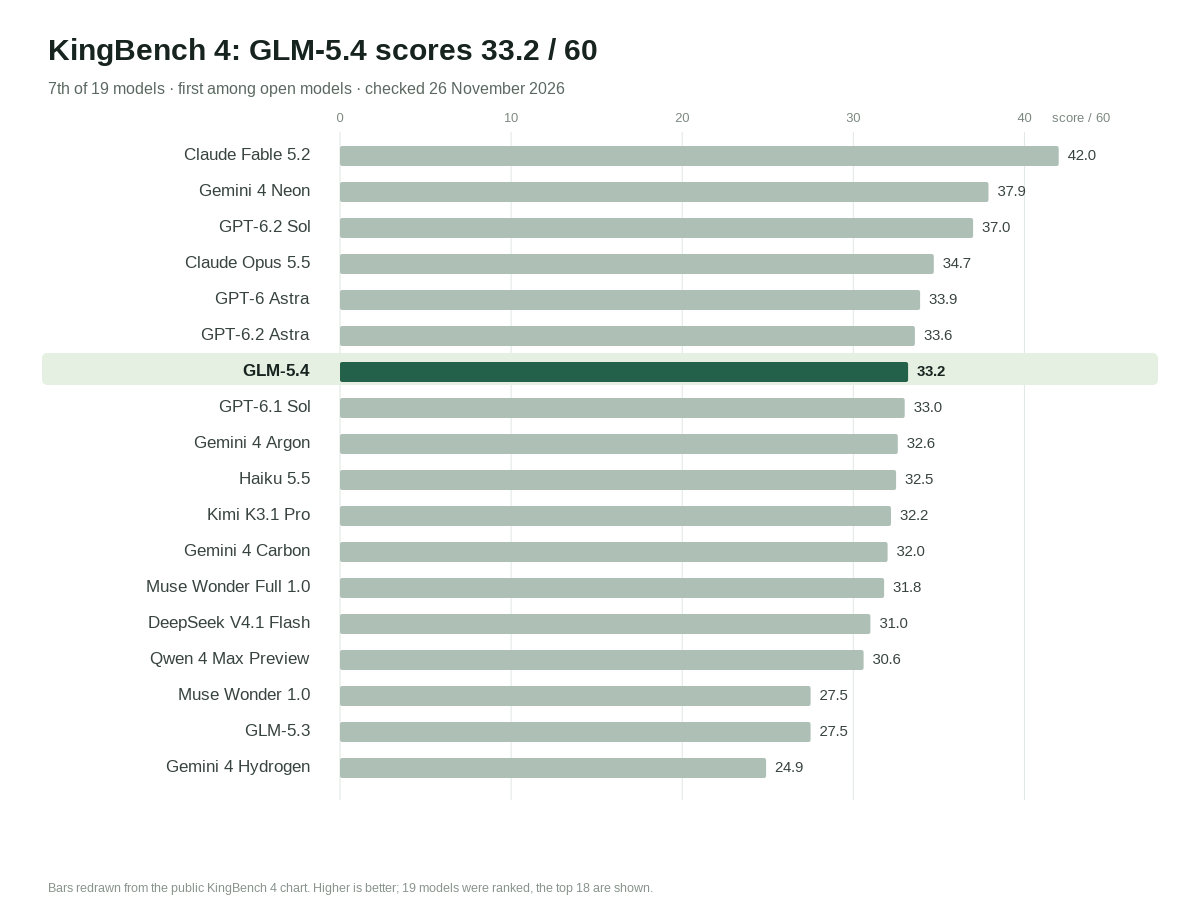
A 0.4-point gap on a 60-point test is small. It is also not a win. The useful reading is that GLM-5.4 is now in the same band as the second tier of closed models, not that it has caught the leader.
The other change is vision. GLM-5.4 can read images, which matters for a coding model asked to rebuild a layout or inspect a screenshot. Zhipu's demo material focuses on using code to generate video, games, and 3D assets. That is a broader target than the usual web-app benchmark, and it is where the six tests below spend most of their time.
The speed tax
Speed is the first thing you notice. A public side-by-side after launch put Gemini 4 Neon at 11 minutes and GLM-5.4 at 108 minutes for the same basketball-court scene. My runs were less extreme, but the pattern held.
I started six tasks in parallel and hit the account rate limit. I switched to one at a time. On a weekday afternoon, about half of my tool-call requests came back as 529, the provider's model-overloaded response. The same requests ran on GLM-5.3 without errors. One reasoning pass produced 130,000 characters over 12 minutes and ended with one sentence and one tool call. A 3D animation task ran for 1.5 hours, failed 97 requests, and had just finished writing code when I stopped it. The five-hour quota went from 6% to 45% without a single finished case.
Some of this is launch-week load. Some is the model's own tendency to think for a long time. Either way, it changes the workflow. A model that answers in 20 minutes is useful for a demo. A model that answers in two hours is a batch job, and you plan around it.
Six builds
All six prompts were written in English and kept the same content, layout rules, and acceptance criteria. I did not tune the prompts between models. The point was to see how GLM-5.4 handles a fixed brief, not to find its best possible output.
1. Aquarium site
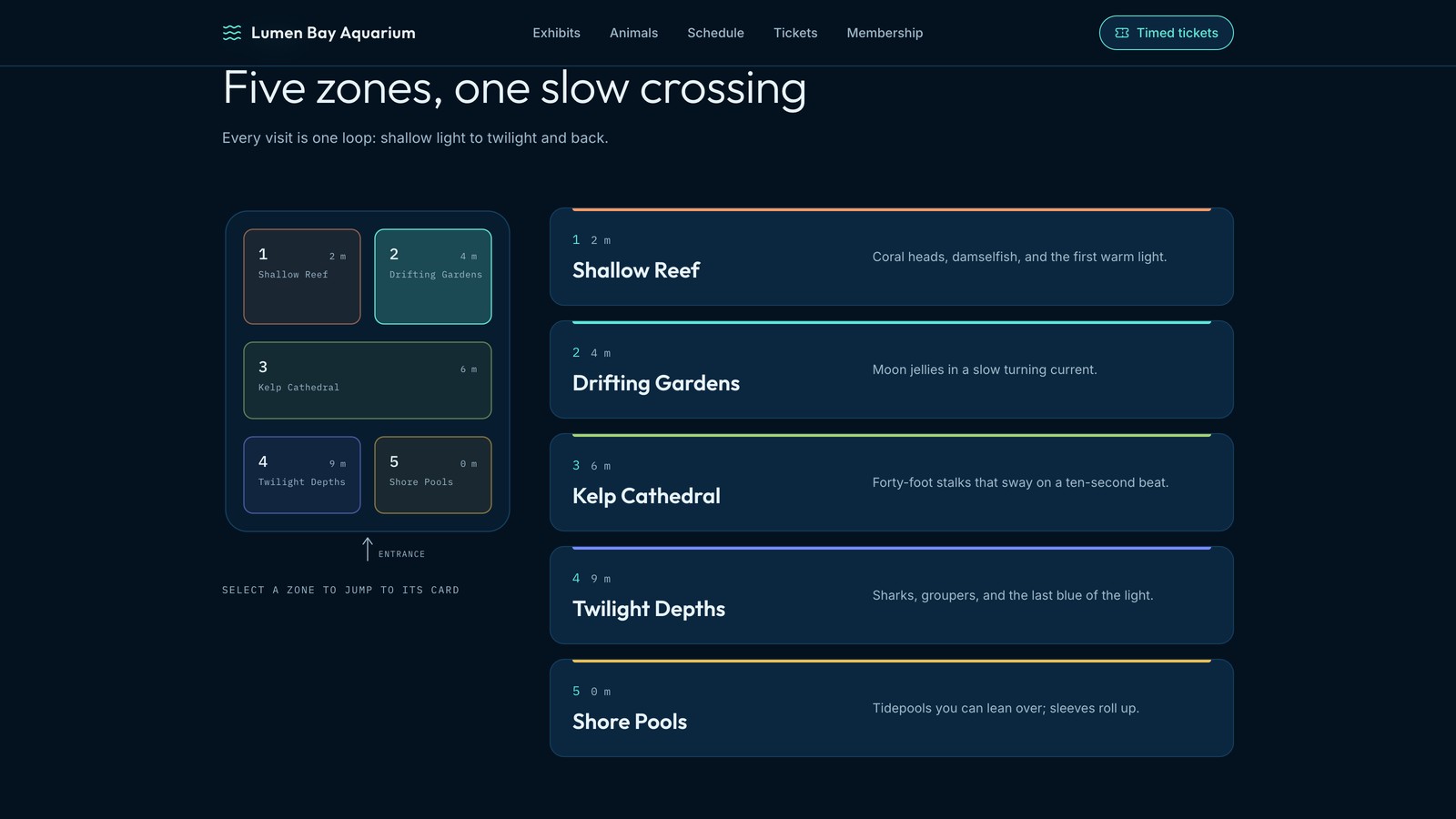
The first prompt asked for a single-page aquarium site with a floor map, animal cards, feeding times, and timed tickets. The hero section came out almost identical to the GLM-5.3 version because the prompt fixed the copy and the image treatment. The floor map was the real test. GLM-5.4 drew five zones, labeled each one with a name and depth, and linked each zone to its card. GLM-5.3 produced five numbered blocks with no labels. The difference is in the generated graphic, not in the surrounding page.
2. Machining site
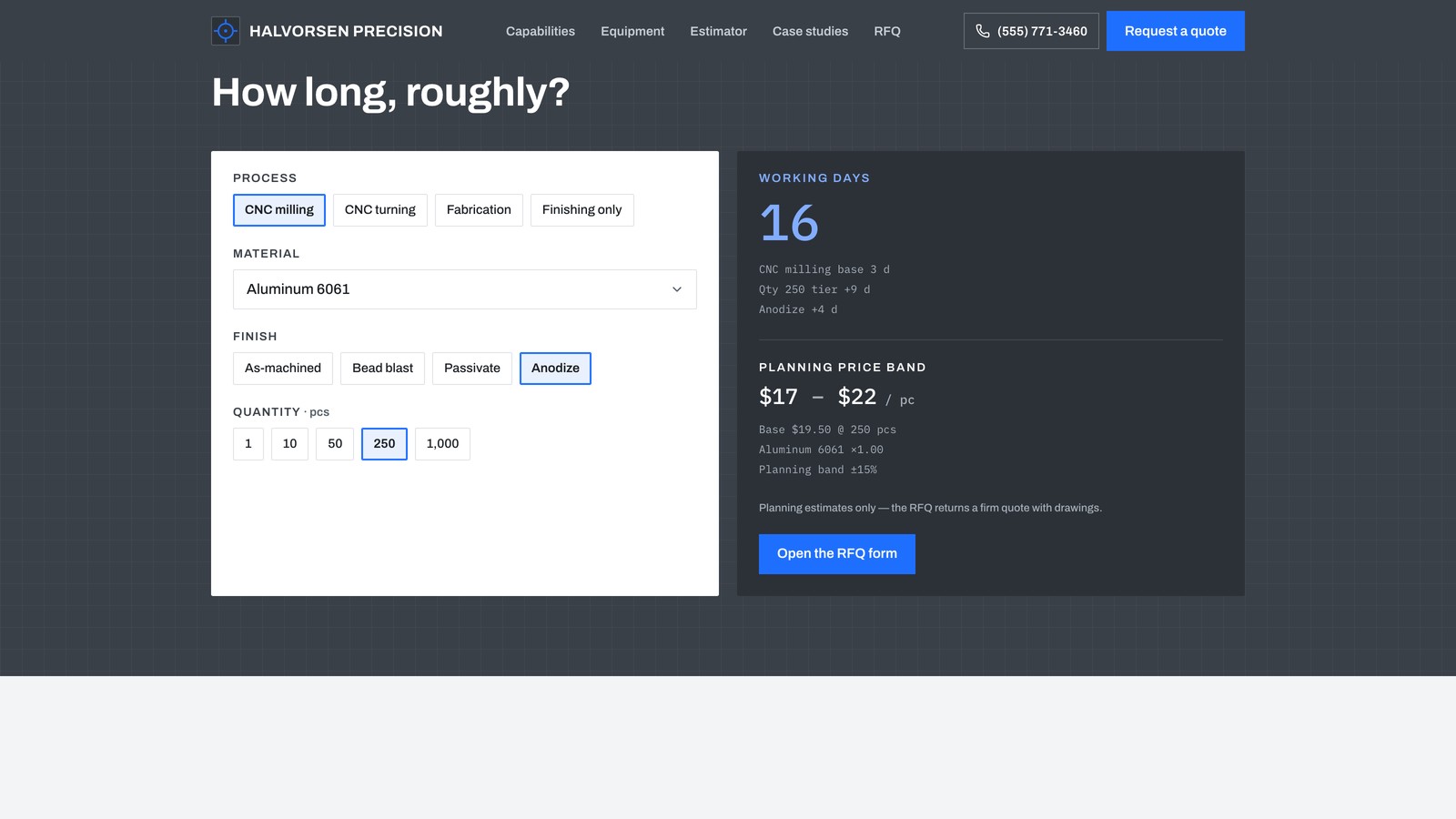
The second prompt was a B2B site for a precision machine shop. The core feature is a quote calculator: pick a process, material, finish, and quantity, then get a lead time and a price. GLM-5.4 returned 16 working days and a $17 to $22 per-part band, with a line-by-line breakdown of the calculation. I had run the same prompt on Kimi K3.1 Pro and GLM-5.3. The three versions were structurally almost identical. At this level of detail, the prompt does more work than the model.
3. Illustrator portfolio
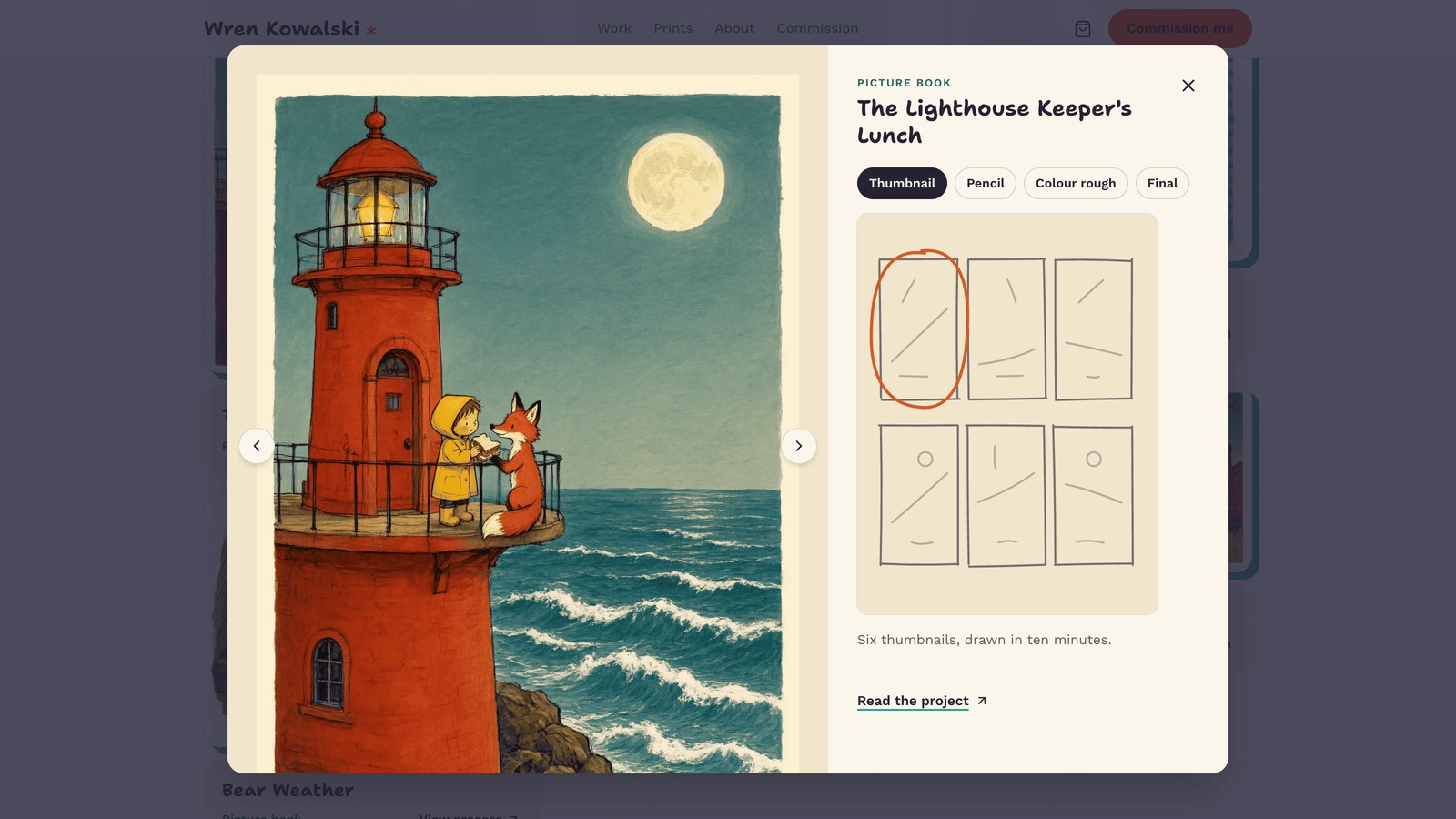
The third prompt added commerce. The site needed a portfolio, a process view, and a shop for signed prints. GLM-5.4's hero used a handwritten headline, a gouache lighthouse, and an underline that landed under the right word. Kimi's version put the underline under the wrong line. The stronger difference was the process modal. GLM-5.4 drew six thumbnail sketches in code and circled the chosen frame in red. Kimi used a handful of house-and-mountain placeholders. The cart also worked, including a free-shipping progress bar. This was a clear win for GLM-5.4.
4. Email client
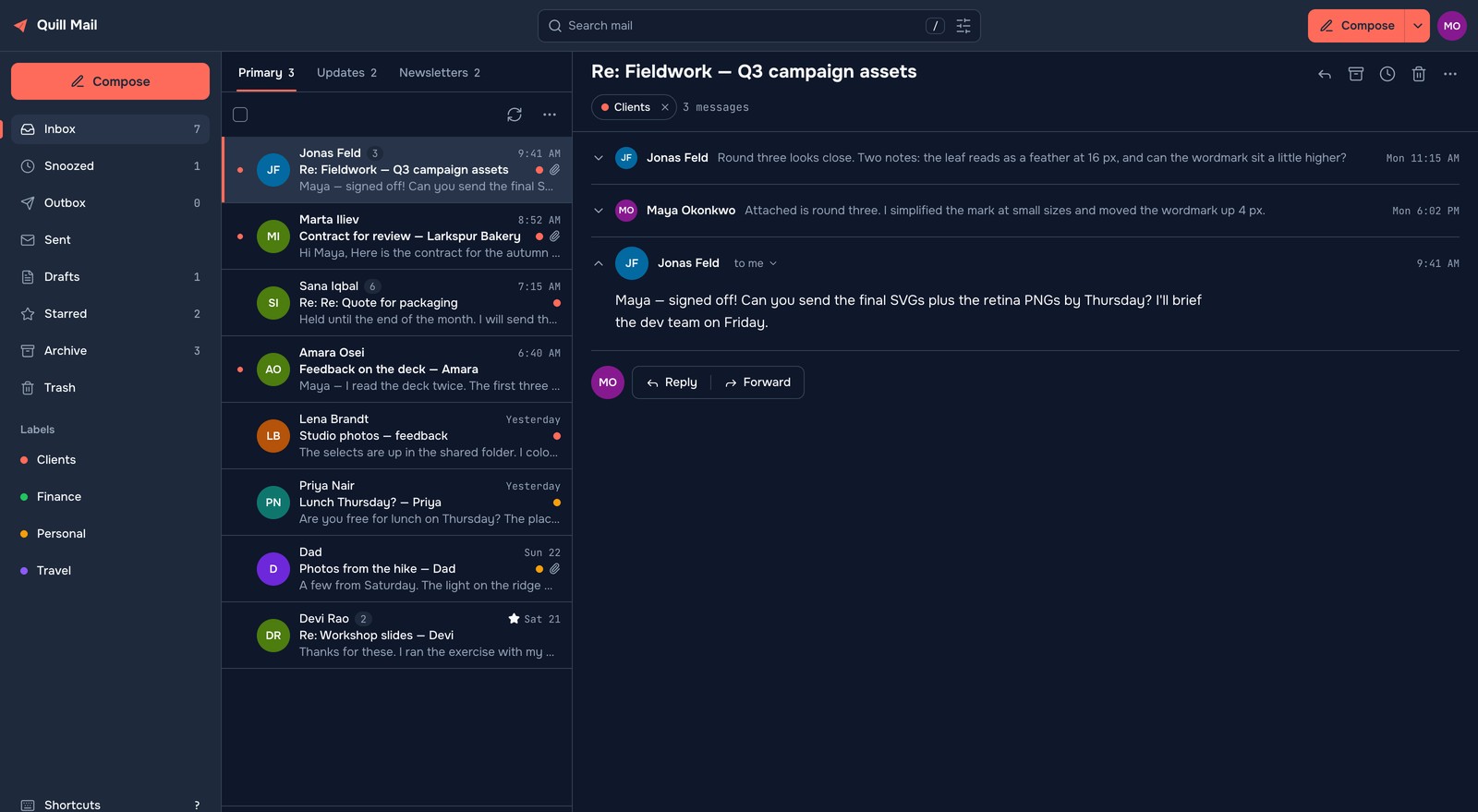
The fourth prompt asked for a three-column email client with folders, labels, threaded conversations, search, and keyboard shortcuts. GLM-5.4 produced a working app. Search filtered the list as I typed, and the reading pane kept the thread together. The bug showed up in compose: pressing C opened the window and also inserted a "c" in the recipient field. I reproduced it several times. Kimi's version did not have the bug and showed attachment cards in the reading pane. This one goes to Kimi.
5. Flight simulator
The fifth prompt was a low-poly flight simulator built with Three.js. GLM-5.4 produced a playable scene with a seaplane, a dusk-to-day light transition, ocean, clouds, rings, and a radar. The aircraft was the weak point. The wings and struts were messy, and the silhouette did not read as a specific plane. GPT-6.2 Sol returned a recognizable high-wing seaplane with floats and a more layered island. Gemini 4 Neon had better sunset lighting. GLM-5.4 can build the scene, but it struggles when it has to invent a 3D object from scratch.

6. Solar system
The last prompt asked for an interactive 3D solar system with a true-scale toggle, a guided tour, and a distance table. This is where GLM-5.4 looked strongest. True-scale mode shrank the planets to dots and kept the relative distances. The tour flew to Mercury and rendered its craters procedurally. The final table used a 12-inch beach ball as the Sun: Earth became a peppercorn 107 feet away, and Neptune sat more than half a mile out. I had run the same prompt on Claude Opus 5.5. The two versions were almost indistinguishable at the true-scale view. When the brief is precise, GLM-5.4 can match a top model.
Scorecard
| Test | GLM-5.4 result | Verdict |
|---|---|---|
| Aquarium site | Labeled, linked floor map | Better than GLM-5.3 |
| Machining site | Working quote calculator | Tied with Kimi K3.1 Pro and GLM-5.3 |
| Illustrator portfolio | Six-frame process modal, working cart | Better than Kimi K3.1 Pro |
| Email client | Working app, compose shortcut bug | Behind Kimi K3.1 Pro |
| Flight simulator | Playable scene, rough aircraft model | Behind GPT-6.2 Sol and Gemini 4 Neon |
| Solar system | True-scale view, guided tour, distance table | Tied with Claude Opus 5.5 |
Who should use it
GLM-5.4 is a real step up from GLM-5.3. On well-specified web pages, apps, and 3D scenes, it is close to the best models I tested, and it beat Kimi on the portfolio case. The gap appears when the model has to invent 3D geometry or recover from an ambiguous interaction. The 2T to 3T claim did not show up in these six builds. What showed up was a strong implementation model with a slow, unreliable service around it.
If you already pay for a GLM Coding Plan, switch to GLM-5.4 for page and 3D work when you can wait. Avoid the weekday afternoon peak, roughly 2 p.m. to 6 p.m. China time. If you are buying a plan for the first time, wait for capacity to catch up. A Max subscription at 1,078 yuan a month is hard to justify when half of your tool calls are rejected at peak.
The API is still closed, so this is a coding-plan story for now. The Loop Transformer is the most interesting thing Zhipu has shipped this year. The serving layer is what needs the next release.
GLM-5.4 is coding-plan only for now. SiAPI.ai lists the GLM-5.3 family and the rest of the coding catalog with per-token prices.
Compare current coding models on SiAPI.ai or check coding-plan pricing.