
GLM-5.4: +10% Compute, Aiming At 2T–3T Model Performance
Published · 7 min read
GLM-5.4 is a 750B model built on a 78-layer stack. Zhipu runs the middle 28 layers twice per forward pass for about 10% more training compute, and aims at 2T–3T-class performance. A 30B controlled test shows large gains at the same parameter count, but the 750B flagship's full benchmark table has not been published.
In this article
Zhipu released GLM-5.4 on 23 November. The launch post leads with 750B parameters and a claim that the model reaches the intelligence level of 2T–3T models. The architecture is the part worth reading closely.
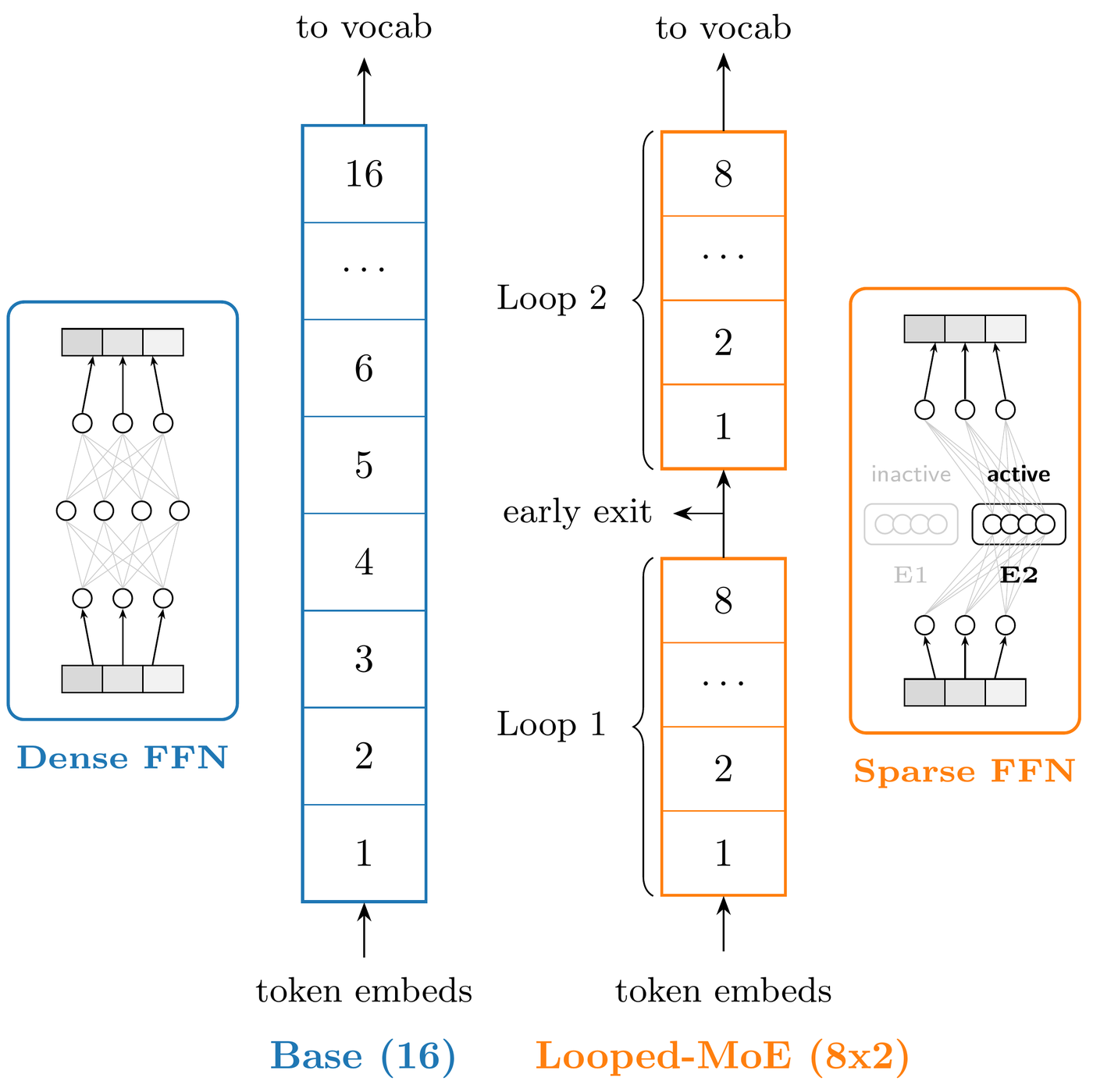
A standard transformer buys depth with parameters: more layers, more width, more experts. GLM-5.4 takes a different route. The base stack has 78 layers. The middle 28 are shared, and the model runs them twice in the same forward pass. The weights do not change between passes. The hidden state does.
A loop in the middle of the stack
That detail matters. The second pass is not a copy of the first. It starts from the state the first pass produced, then refines it. Zhipu describes the first pass as building global context with conservative writes, and the second as opening the gate to finish the job. Per-token gates decide how much each pass writes, with harder tokens getting a larger step on the first pass. The result is an effective depth of 106 layer applications from a 78-layer parameter budget.
The idea is old. Universal Transformer explored weight-shared layer reuse in 2018. What is new here is the size and the engineering around it. A naive loop is expensive: a second pass means more compute, more KV cache, and more attention work. Zhipu makes three changes to keep those costs in check.
- Gated progressive updates. Repeated writes can destabilize training. Per-token gates set the write size for each pass. The first pass writes conservatively; the second pass opens up and refines. Hard tokens get a larger step early.
- Hybrid KV cache. The second pass reuses the sparse KV cache from the first. It keeps only a sliding window of extra state, so the loop does not need a second full cache.
- Sparse index reuse. The second pass reuses the attention index built in the first. There is no second retrieval pass and no extra index cost.
Zhipu says the loop adds about 10% training compute in its 30B controlled test. That number is what the three fixes buy. A loop that doubled the cost of every token would be a research demo. A loop that adds 10% is a product decision.

A 30B ablation, not a 750B benchmark
The strongest evidence Zhipu has published is a controlled comparison at 30B. It is also narrower than the headline.
Zhipu took a 30B model and compared the same model with and without the loop. At that scale, looping raised AIME25 from 19.17% to 30.42% and GPQA-Diamond from 47.58% to 56.26%. Average output length fell 10–14% on the same benchmarks. Training compute rose by about 10%.
That is a clean result. It shows that, at fixed parameter count, the loop produces a better model on these tests. It does not show that a 750B looped model matches a 2T–3T dense model. Those are different experiments. The first holds parameters constant and changes depth. The second changes scale by a factor of three or four.
Zhipu has not published a full benchmark table for the 750B flagship. The 2T–3T claim is therefore an estimate, not a measured equivalence. There is a plausible mechanism behind it: more serial depth can help with multi-step reasoning, and the 30B test shows that the mechanism works at small scale. The jump from “same parameters, more depth” to “one-third the parameters, same intelligence” still needs the flagship on the same evaluation. Until then, the claim is a hypothesis with a good mechanism, not a result.

Close on a private board, costly in tokens
Third-party numbers put GLM-5.4 in the right neighborhood. They do not settle the argument.
In AICodeKing's private evaluation, GLM-5.4 scored 33.2, against 33.6 for GPT-6.2 Astra and 34.7 for Opus 5.5. That is within 5% of Opus and 0.4 points behind Astra. The model also took first place among open models on KingBench 4, with a 1.56% tool-call failure rate and 66% retry recovery. Those are solid agent numbers, especially for an open model.
The catch is the reasoning bill. Zhipu says GLM-5.4 can fall into long reasoning runs on difficult tasks. Outputs are shorter on the benchmarks, but shorter outputs do not mean cheaper requests. If the model spends more tokens thinking before it writes, the total token count can rise. The cost moves from parameter storage to inference time.
For a coding agent, that trade is task-dependent. A 40-step tool loop that finishes in one pass can be cheaper than a 30-step loop with three retries. The useful metric is tokens and wall-clock time per completed task, plus the retry rate. Output-token count on its own misses the reasoning bill. Benchmark the workflow, not the prompt.

Looping and sparsity are complementary
Looping and sparse routing solve different parts of the same scaling problem.
DeepSeek's MoE line increases total parameters while activating a small slice per token. Qwen's line focuses on how much capability each activated parameter buys. Zhipu's loop adds serial depth at a fixed parameter count. In the research literature, these are treated as complementary axes: recurrence increases depth at fixed parameters, while sparse routing increases capacity at fixed activated compute.
One scaling study reports about 3x activated-parameter efficiency from sparsity and about 2x total-parameter efficiency from recurrence on reasoning tasks. A separate Looped-MoE study finds that dense looped models do not beat standard transformers at scale, but looped MoE models do. The reason is the router: it can send the same physical layer to different experts on each pass, which restores some of the expressiveness lost by sharing weights.
Zhipu has not said whether the 28 looped layers in GLM-5.4 use MoE routing internally. That detail matters. If the loop is combined with sparse experts, the architecture is more than a depth trick. If it is not, the loop still works, but the scaling story is narrower.
Generalized coding needs more than a demo
GLM-5.4 adds visual understanding and uses code as the output layer for tasks beyond software: video rendering, 3D scene construction, and robotic-arm modeling. Zhipu's demos include a music video drawn entirely in frontend code, an interactive 3D birdwatching scene built from math and GLSL shaders with no external models or textures, and a six-axis robotic arm modeled and animated in FreeCAD.
These are good demos because they stress long causal chains. A rendered frame, a 3D scene, and a robot motion all require the model to keep a consistent world state across many steps. That is the kind of task where extra serial depth should help, if it helps at all.
The evidence is still demo-level. A generated 3D scene can look convincing and fail a simple geometry check. A rendered video can be visually coherent and still be a poor test of planning. What would make generalized coding credible is a public suite of multi-step tasks with a cost per completed task and a failure taxonomy. Until then, treat it as a direction, not a measured capability.
What developers should test
- Long tool traces. Run the workflow you already know is fragile. A model can look strong on a one-shot benchmark and lose the thread after 30 calls.
- Reasoning tokens per success. Shorter answers are not cheaper if the model burns more tokens before it starts writing.
- Time to completion. Measure wall-clock time and retries, not the first-token latency alone.
GLM-5.4 is available through Zhipu's Coding Plan and the ZCode, Trae, WorkBuddy and Qoder clients. API access is pending a safety review, and the weights are promised for later release. If you evaluate it, run the tasks you already know are hard: long tool traces, retries after failed calls, and jobs where the model has to keep a state across dozens of steps. Log reasoning tokens, output tokens, time to completion, and the retry rate. That will tell you more than a composite score.
The loop is a real architectural bet. The 30B evidence supports it. The 2T–3T comparison is still a projection. The gap between those two statements is where the next round of public benchmarks will be decided.
Put the loop on your own workload.
Composite scores are a starting point. The useful test is your own agent trace: tool calls, retries, and the tokens spent before a task is done.