
GLM-5.4 Demo Deep Dive: 3D Ski Run, Earth Engine And Reconstructions
Published · 6 min read
GLM-5.4 is live in GLM Coding Plan. Its main architectural change is a Loop Transformer: one block of layers runs more than once per token, so the model adds depth through repeated compute rather than another stack of unique weights. The launch demos are unusually concrete. A prompt produced a playable Mont Blanc ski run, a custom Earth engine, a 1.2 km reconstruction of a Nanjing memorial, a tangram game, and a hardware dashboard written from a manual. The builds show long-horizon execution and visual judgment. They also show the cost, which is time.
In this article
GLM-5.4 arrives about three months after GLM-5.3 and is available in GLM Coding Plan from launch. Zhipu's pitch centers on how the model spends compute: the same block of layers runs more than once, and the extra passes buy reasoning depth. The release also lists vision as a new capability. The demos below are builds from text prompts, so they do not test image understanding.
More passes, same weights
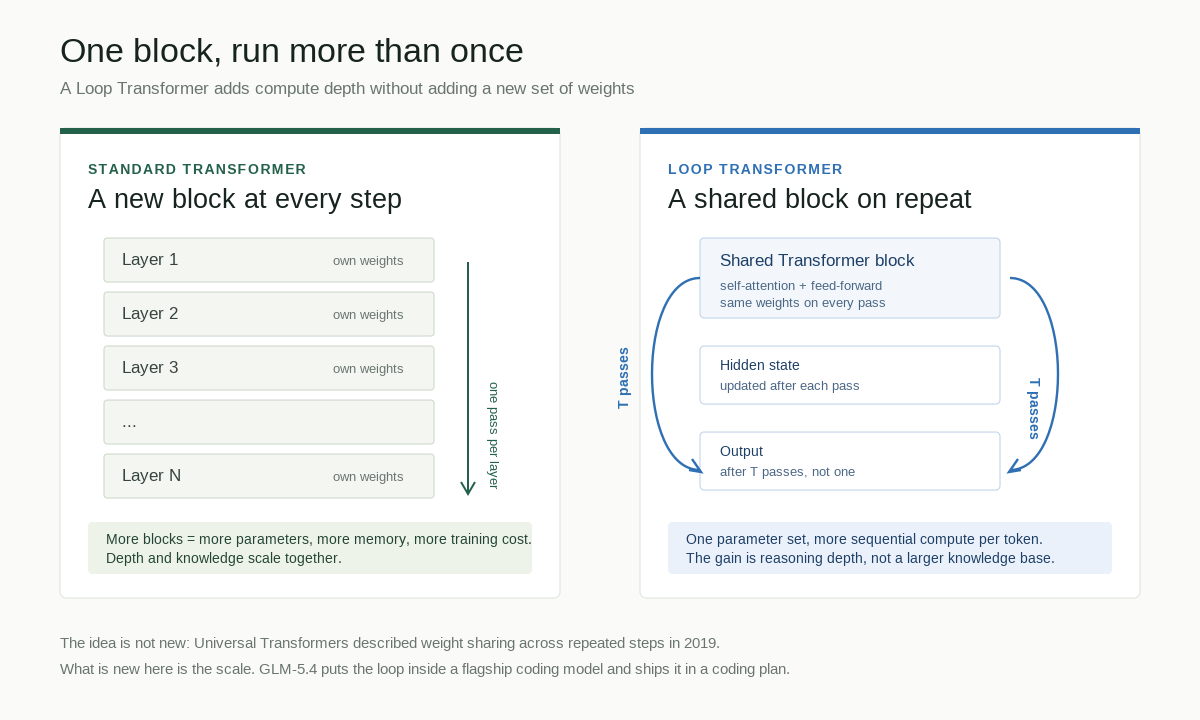
A standard transformer gives every layer its own weights and runs each layer once. A looped transformer reuses a block. The same weights run T times, and the hidden state is updated after each pass. The loop adds sequential computation per token without adding a new set of weights.
GLM-5.4 applies this at flagship scale. The release calls it the first publicly described use in a model of this size. The idea is older: Universal Transformers described weight sharing across repeated steps in 2019, and later work mapped the limits. Repeated compute can help on some reasoning tasks. It does not add facts. Gains shrink as the number of passes grows, and the loop depth used in training constrains what extra passes can do at inference.
That framing matters for reading the demos. The model is not recalling more of the world. It is getting more passes to work on the same token.
What the demos show
Mont Blanc, playable
The Mont Blanc demo is the most complete. The prompt asks for a playable 3D ski game on real elevation data, with snow that keeps tracks, avalanches on steep slopes, and audio synthesized in code. The build pulled elevation and map data for Mont Blanc and the Chamonix valley, placed nine start points at real altitudes, and added physics, snow deformation, avalanche logic, sound, and automated checks. The recorded run holds 1080p at 60 fps, and the first-person view reaches 131 km/h without leaving the mountain.
That is a lot of systems in one artifact. It is also a curated run. The build had hours, a written plan, and the ability to inspect its own screenshots and correct course. One intermediate version had good terrain and a black sky. The model traced the problem, fixed it, and rechecked the frame.
A paper garden
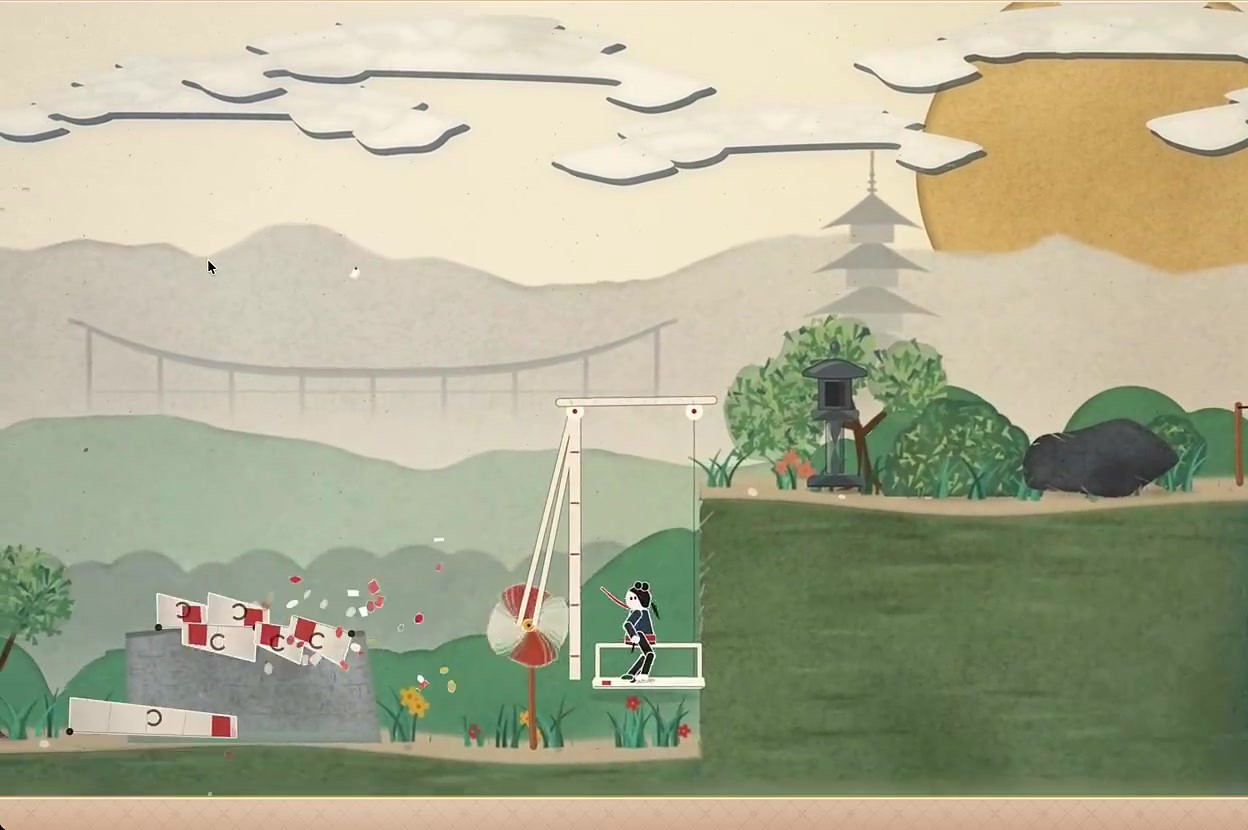
The paper garden tests art direction. It borrows the look of a hand-cut side-scroller: paper edges, a flat sun, limited colors, and a character that moves through layered scenery. The demo runs 2:39 and reads as a game rather than a technical sample. The renderer matters less than the art direction holding together across a long build.
An Earth engine
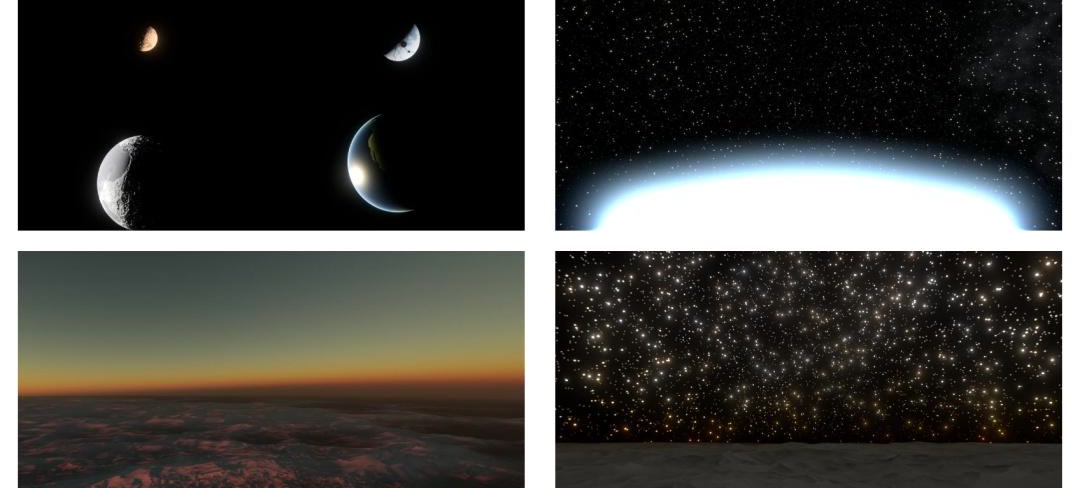
The Earth engine goes after scale. The build uses no stock 3D library. Terrain, atmosphere, sun and moon positions, and three satellites with their own craters are written from scratch. The camera starts in lunar orbit, descends through the atmosphere, and reaches the ground without a loading screen. The four frames below show the range: moons in deep space, a bright atmospheric limb, sunrise over dark terrain, and a star field above a surface.
Yuhuatai at 1.2 km
The Yuhuatai reconstruction is the most local of the set. It rebuilds a 1.2 km memorial axis in Nanjing from real coordinates: north gate, monument, reflecting pool, memorial hall, south gate, and the trees around them. Most of the time went into terrain and vegetation. The two animations show the reflecting pool approach and the aerial view over the memorial axis.
Seven pieces, one solver
The tangram game is smaller and more exact. Seven pieces can be dragged, rotated, and flipped. Each finished silhouette becomes an animal that moves. The build includes an exact-cover solver that checks every shape as a true union of the seven pieces, and the interface is fully in English. It shows the model treating a visual task as a geometry problem instead of a styling exercise.
One more demo runs on hardware. A stock dashboard runs on a Waveshare board, switches orientation with a level sensor, and accepts voice queries. The build started from a development manual and shipped in one pass. The interface is in Chinese, so it is not pictured here.
Across the set, the same working style shows up: plan the build, split work into parallel branches, generate assets procedurally, check the result with screenshots, and keep going for hours.
The bill is time
The same behavior that makes these builds possible makes the model slow. The notes describe long planning phases, repeated review of backend details, and runs measured in hours. One build took 3 hours 32 minutes. Another spent hours on terrain and trees alone. The model is stable over that span, which is the hard part. It is also hard to sit through.
For a coding plan, that trade is easier to accept. Billing follows the plan rather than the token, so a long build does not produce a surprise bill. For API use, measure cost per finished task, not tokens per second. This is not a model for inline autocomplete or quick chat turns.
Where it fits
The demos point to work that is visual, long, and verifiable. 3D scenes, front-end builds, geometry-heavy games, and multi-hour refactors with a screenshot or test at the end are the natural fits. The model is good at building from primitives when no library does the job.
It is a poor fit for latency-sensitive interfaces, for tasks that need fresh facts without tools, and for quick one-shot answers. The demos are also curated. They show what the model can do with time and supervision, not what it does on every run. Review the output the way you would review a contractor's first draft.
Compare coding plans and API pricing before you queue a multi-hour run.
The short version
GLM-5.4's looped layers are a real architectural change, and the trade is simple: more inference-time depth for more latency. The launch demos are more useful than a benchmark table because they show the shape of the work the model is good at: long builds, visual output, and a verifiable end state. If that is your workload, it is worth a test. If your workload is a blinking cursor in a chat box, it is not.