
Opus 5.5 Is Priced Per Token. GLM-5.3 Is Priced Per Turn, Half Off-Peak.
Published · 6 min read
Claude Opus 5.5 is priced per token and runs inside Claude's product stack, with native browsing and computer use. GLM-5.3 is a 1M-token text endpoint billed per turn on a credit plan, with off-peak calls at half the standard rate. The split is the billing unit and the finish line: a deliverable in a product stack, or an answer inside a long API thread.
In this article
Two centers of gravity
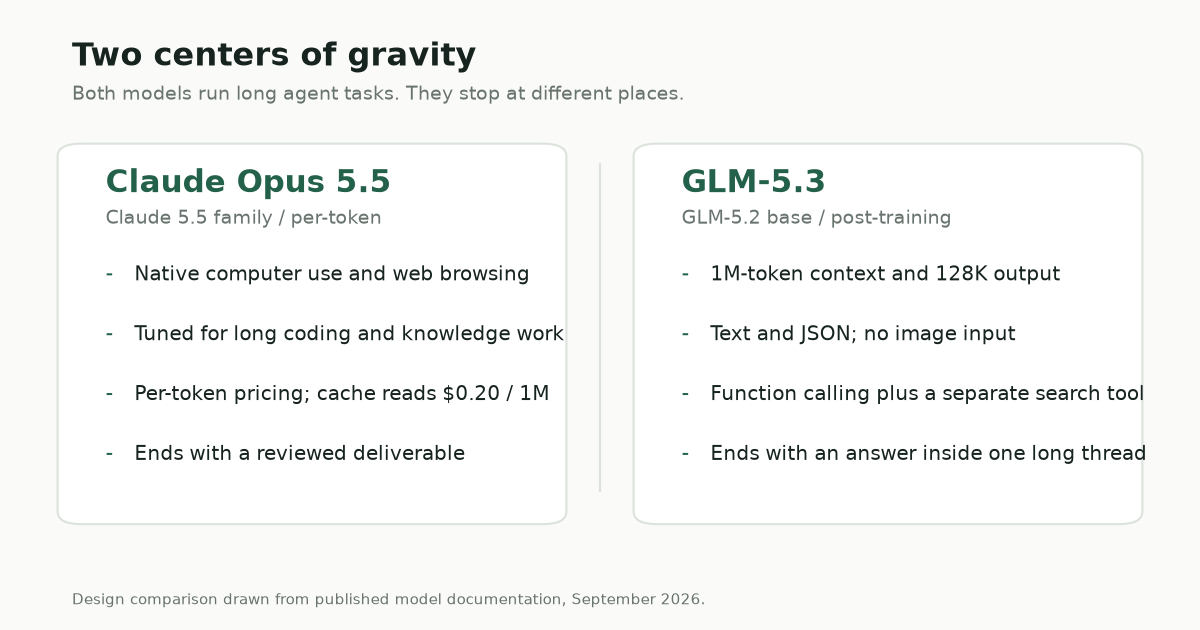
Claude Opus 5.5 arrived on September 22, 2026. It is the first model in Anthropic's Claude 5.5 family, positioned close to Claude Fable 5.1 and 40% cheaper to run than Opus 5 on typical workloads. GLM-5.3 is Z.ai's current flagship for software engineering and agent work. It shares its base model with GLM-5.2; the gains come from post-training.
Both can hold a long task, call tools, and write code. The useful difference is where each run ends. Opus 5.5 is built to finish inside a product surface: Claude apps, Claude Code, or the Claude Platform, with web browsing and computer use in the same environment. GLM-5.3 is built to keep a text thread open: a large context window, a reasoning stream the caller carries forward, and an API that fits into someone else's agent loop.
What Opus 5.5 is built around
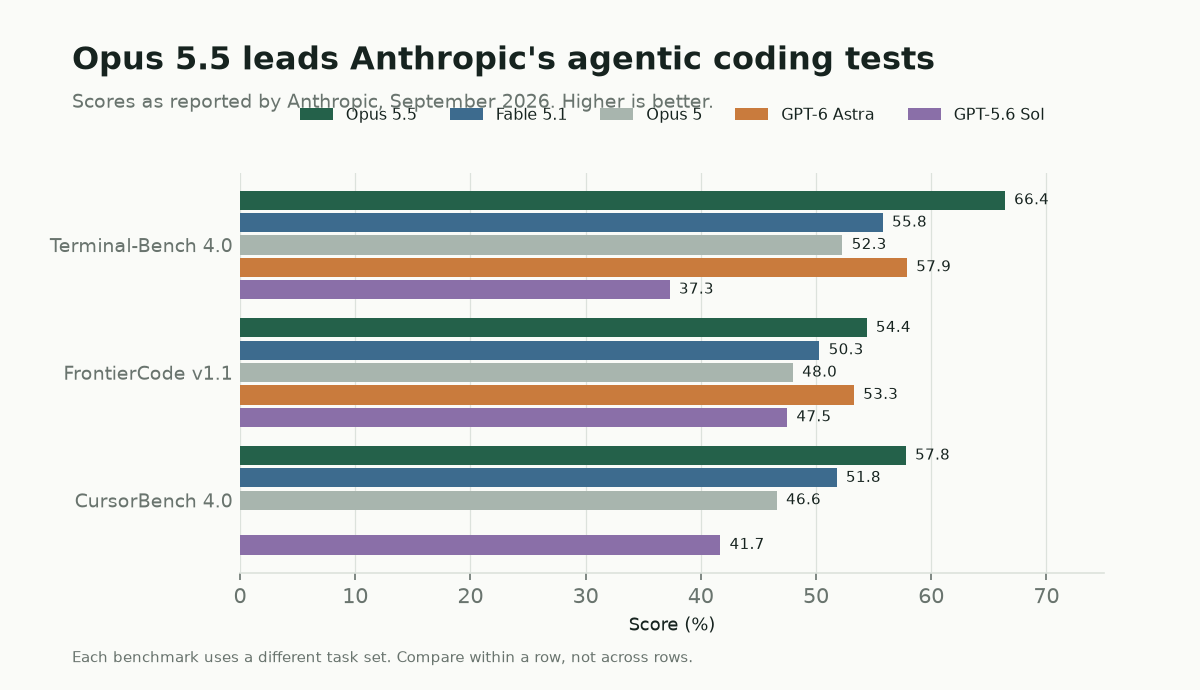
Anthropic's launch material is about long professional work and token efficiency. Opus 5.5 scores 66.4% on Terminal-Bench 4.0, 54.4% on FrontierCode v1.1, and 57.8% on CursorBench 4.0. It also reaches 1846 Elo on GDPval-AA v2.1, 40.0% on AutomationBench, 67.7% on Humanity's Last Exam with tools, 81.8% on OSWorld 2.1, and 89.0% on Chartography with tools.
Input is $4 per million tokens and output is $20, 20% below Opus 5. Cache reads are $0.20, 60% lower. Anthropic says the model uses fewer tokens per task as well, for a 40% drop in typical workload cost, and generates output more than 30% faster. A fast mode priced at $8 input and $40 output runs up to 2.5x faster.
Anthropic's examples follow the same theme: a 680,000-line code migration finished in under a day, and a 200,000-line audit took under three hours where Opus 5 needed more than 20. The model ships with an action classifier, an auditable sandbox, and code review for agent work.
What GLM-5.3 is built around
Z.ai's framing is the request path. GLM-5.3 takes text only. Context is 1M tokens and output tops out at 128K. Thinking is always on, with low, high, and max effort levels and max as the default. Interleaved thinking lets the model reason between tool calls and after each tool result. Preserved thinking keeps earlier reasoning in context when the caller returns the full, unmodified reasoning content; it is on by default on the Coding Plan endpoint.
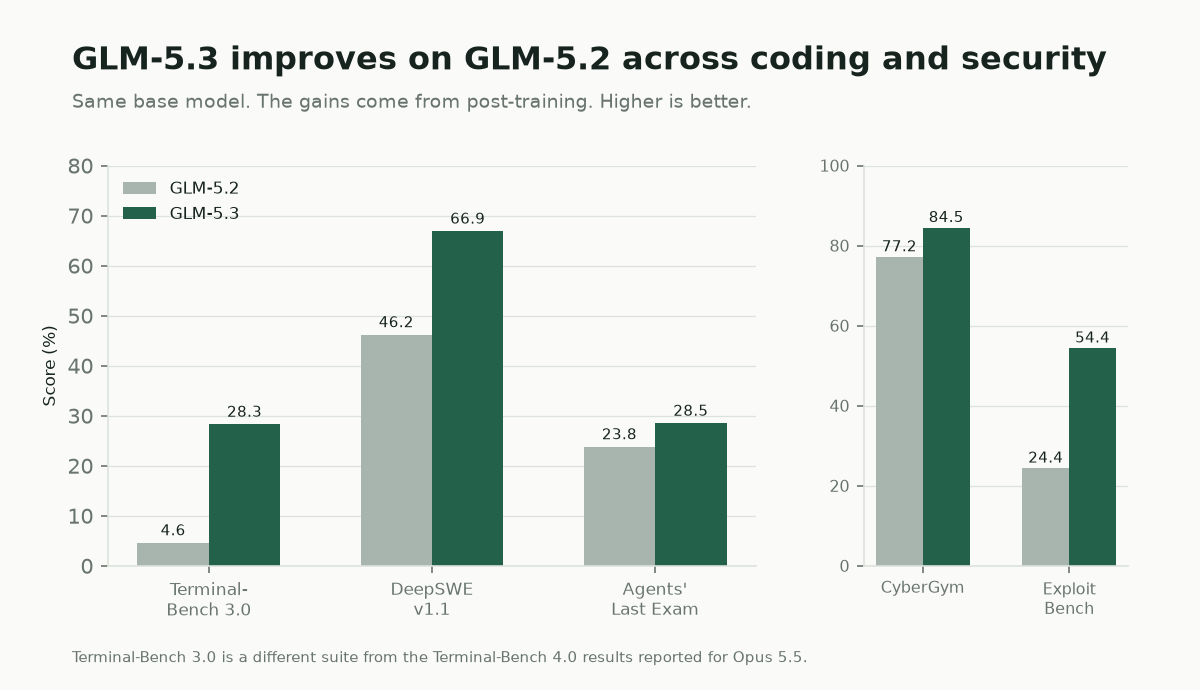
Published gains over GLM-5.2 are large: Terminal-Bench 3.0 rises from 4.6 to 28.3, DeepSWE v1.1 from 46.2 to 66.9, and Agents' Last Exam from 23.8 to 28.5. CyberGym rises from 77.2% to 84.5%, ExploitBench from 24.4% to 54.4%, and Z.ai reports 2,436 vulnerabilities across 269 projects in real-world testing.
Z.ai's internal Code Bench adds a second view: accuracy against output tokens. At Max effort, GLM-5.3 reaches 34.5% at about 75,000 output tokens per task. GLM-5.2 reaches 23.4% at about 96,000. At High effort, GLM-5.3 reaches 31.4% at about 50,000 tokens, against 29.5% for Claude Opus 4.8 at about 120,000.
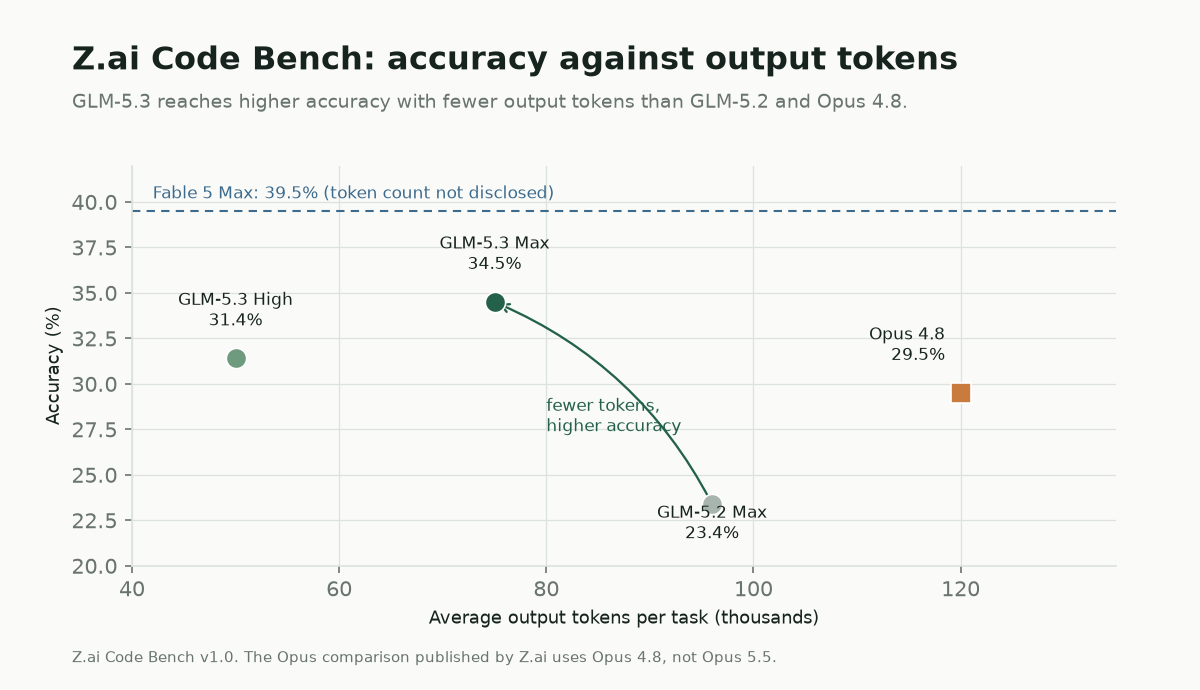
One detail changes how the numbers should be read: the public suites are not the same. GLM-5.3's Terminal-Bench number is from version 3.0. Opus 5.5's is from version 4.0. The Code Bench comparison uses Opus 4.8, not Opus 5.5.
Native browsing against a tool loop you own
Opus 5.5 lives inside Claude's agent surface. The product and platform include web browsing, computer use, and tool use, and Anthropic tested prompt injection across those settings. For teams already working in Claude Code or the Claude Platform, the orchestration, sandbox, and action classifier come with the model. The trade is less control over the loop and a bill tied to Anthropic's per-token prices.
GLM-5.3 takes the other route. The model exposes function calling in OpenAI's schema, with tool_choice currently limited to auto and tool_stream for streaming arguments. The application executes every function and returns the result with the matching tool_call_id. Web access is a platform service rather than model behavior: Z.ai offers a Web Search API, Web Search in Chat, and an MCP server, with results from its own engine plus Sogou and Quark. Responses can include a web_search field when a search tool returns results.
The same model can be reached through OpenAI Chat Completions, OpenAI Responses, or Anthropic Messages endpoints, which matters when a product already has one of those clients wired in.
Two billing units
Opus 5.5 is priced per token and sold through Anthropic's platform and the major clouds. The unit is the request: input, output, cache read, cache write, and a separate fast mode. The price cuts make long agent runs cheaper, but cost still scales with tokens, including the thinking tokens a hard task produces.
GLM-5.3 is sold through a credit-based Coding Plan. Z.ai does not list a per-token price on the model page. Off-peak calls consume 50% of standard credits, and a repeated prefix of roughly 500 tokens or more bills at about half the normal input rate. The unit is the turn: a long fixed prefix with many short questions is the shape this pricing rewards.
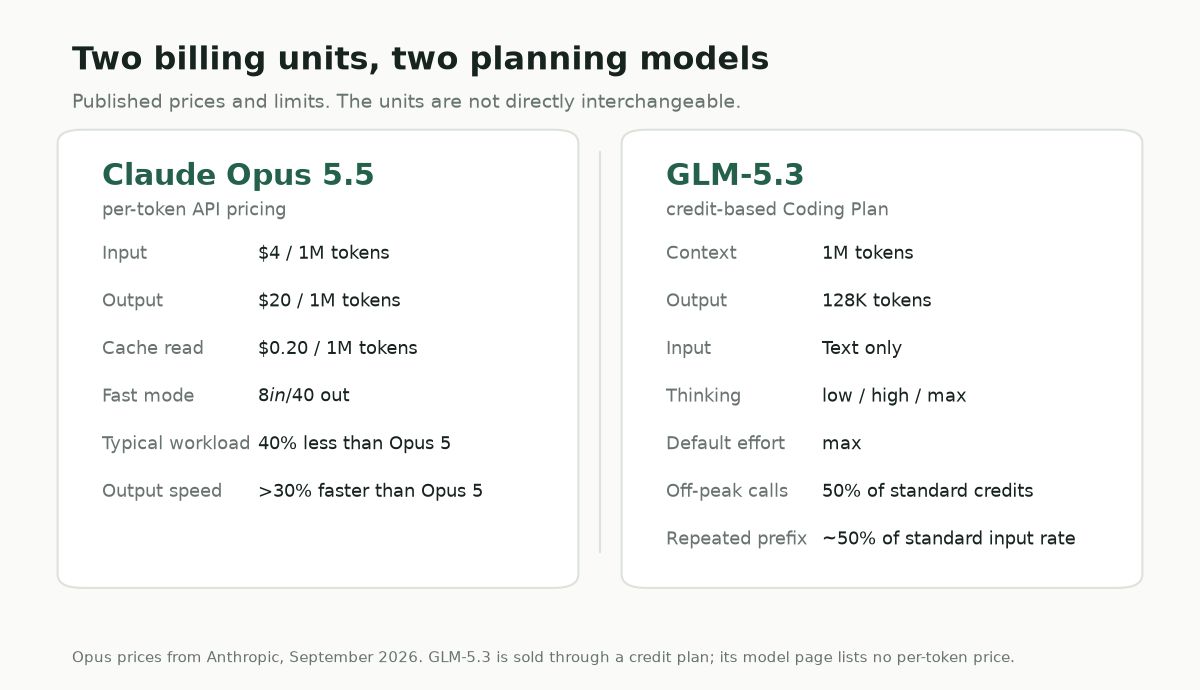
The two units answer different planning questions. A team that bills by finished artifact can estimate cost per task. A team that runs one long thread can estimate cost per turn. Neither number transfers cleanly to the other.
If your work is one long text prefix with many follow-up questions, GLM-5.3 is built for that shape. SiAPI.ai lists it on a recurring Coding Plan, so one key covers GLM and the other models in a mixed stack.
Current terms are on the GLM-5.3 plan page.
Where each design lands
Opus 5.5 fits work that runs inside Claude's environment and ends with something a person can review: a migration branch, an audit report, or a computer-use session. Its native browsing and computer use remove a layer of wiring. The model still needs a reviewer; Anthropic's own safety notes describe why.
GLM-5.3 fits work that stays in text or JSON and keeps the same context: repository-scale review, long document sets, structured extraction, and products that already speak OpenAI or Anthropic protocols. The 1M window and prefix cache do most of the work when the material is large and the questions are many. Text-only input rules out any job that starts with an image.
There is overlap. Both models run agents, call tools, and work for hours. The difference is the finish line: a deliverable inside a product stack, or an answer inside a conversation that still has its history.
| Workload | Design center | Why |
|---|---|---|
| Long autonomous coding in Claude Code | Opus 5.5 | Native harness, computer use, and long-run examples. |
| Computer-use and knowledge-work deliverables | Opus 5.5 | OSWorld, GDPval, and Chartography results. |
| Repository review and long contract sets | GLM-5.3 | 1M-token context and a prefix cache for repeated material. |
| Structured extraction at scale | GLM-5.3 | Text and JSON output across three protocol endpoints. |
| Products already on OpenAI or Anthropic protocols | GLM-5.3 | Drop-in endpoints while the caller keeps the loop. |
| Image-first tasks | Opus 5.5 | GLM-5.3 accepts text input only. |