
Two 1M-Context Reasoning Models: GLM-5.3 Against Kimi K3.1 Pro
Published · 7 min read
Both models take a million-token prompt and always reason. Kimi K3.1 Pro wins the published tests: 46 against 32 on the Artificial Analysis Intelligence Index v5, and 65.7% on Terminal-Bench 4.0. GLM-5.3 wins the price list: $1.20 input and $4.00 output per million tokens, at 9 Coding Plan points against Kimi's 15. At a 90% cache hit rate, Kimi's cheaper cached input flips the per-turn input cost. Choose Kimi for benchmark headroom and terminal-heavy work, GLM for cheap output and long text threads.
In this article

GLM-5.3 arrived on August 14, 2026. Kimi K3.1 Pro followed on October 23, and Moonshot released the weights in early November. Both are flagship models with a one-million-token context, always-on reasoning, and a price per million tokens that looks reasonable until you put it next to the other one.
Direct comparisons are thin. This one puts them side by side, with the benchmark caveats and the cache math that the spec sheets leave out.
Two flagships, one spec sheet
The spec sheets are close enough that the first decision is not about specs. Both take 1M tokens. Both reason on every request. Both accept low, high, or max effort and default to max. Both return reasoning_content, and both ask you to send that content back unchanged if you want preserved thinking. GLM caps output at 128K tokens. Kimi's model reference does not state a maximum output.
| Item | GLM-5.3 | Kimi K3.1 Pro |
|---|---|---|
| Vendor | Z.ai | Moonshot AI |
| Release | August 14, 2026 | October 23, 2026 |
| API model ID | glm-5.3 | kimi-k3.1-pro |
| Context | 1M tokens | 1,048,576 tokens |
| Maximum output | 128K tokens | Not stated |
| Input | Text only | Image input not listed |
| Reasoning | Always on; low / high / max; default max | Always on; low / high / max; default max |
| Reasoning returned | reasoning_content | reasoning_content |
| Faster tier | None | kimi-k3.1-pro-highspeed, 2-3x |
| Weights | API only | 2.8T sparse MoE, open weights |
| SiAPI.ai input | $1.20 / 1M | $1.667 / 1M |
| SiAPI.ai cached input | $0.50 / 1M | $0.333 / 1M |
| SiAPI.ai output | $4.00 / 1M | $6.667 / 1M |
| Coding Plan points | 9 per token | 15 per token |
The bigger differences sit outside the spec sheet: benchmark scores, open weights, a faster tier, and the price per plan point. Each one changes the decision for a different kind of work.
Kimi wins the published tests
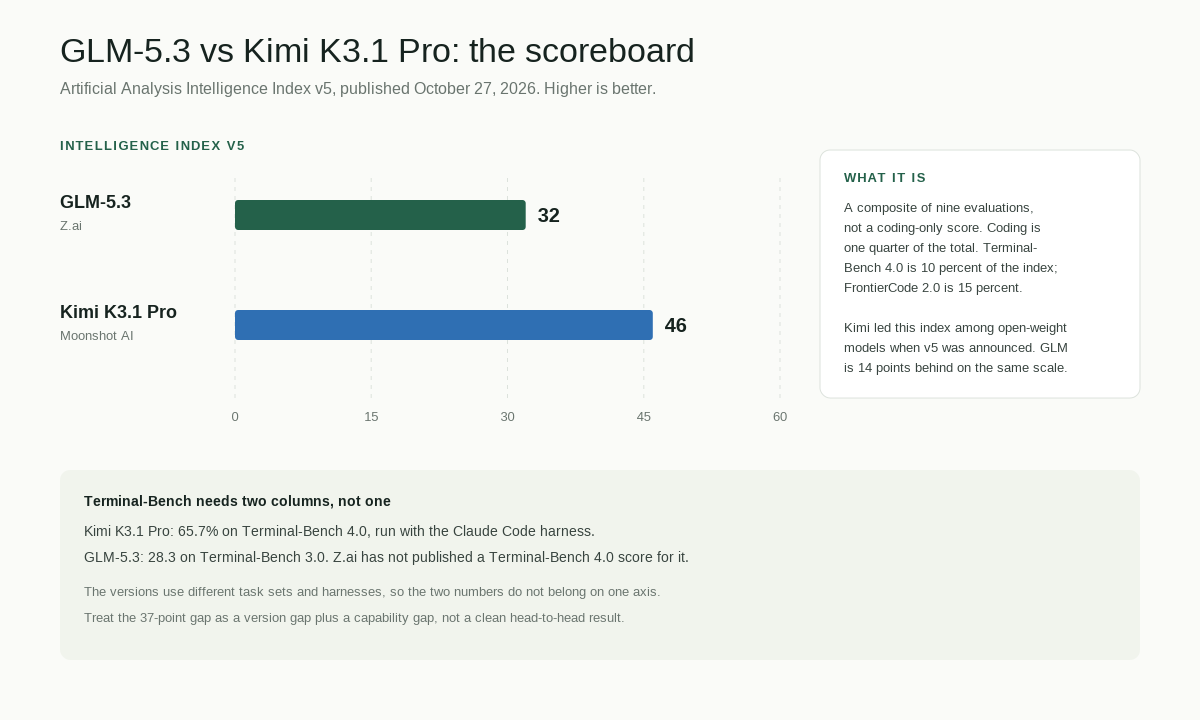
Artificial Analysis published Intelligence Index v5 on October 27. Kimi scores 46. GLM-5.3 scores 32. That is the cleanest third-party number in this comparison. It is also a composite: coding is one quarter of the total, Terminal-Bench 4.0 is 10 percent, and the rest comes from knowledge work, science, and general reasoning. A 14-point gap does not mean Kimi is 44% better at your job. It means Kimi did better across the nine tests AA chose.
Terminal-Bench needs more care. Kimi scores 65.7% on Terminal-Bench 4.0, run with the Claude Code harness at max effort. GLM's published terminal score is 28.3 on Terminal-Bench 3.0. Z.ai has not published a 4.0 run for GLM-5.3. The two versions use different task sets and harnesses, so subtracting one from the other is not a valid comparison. If you need a Terminal-Bench 4.0 number for GLM, you have to run it yourself.
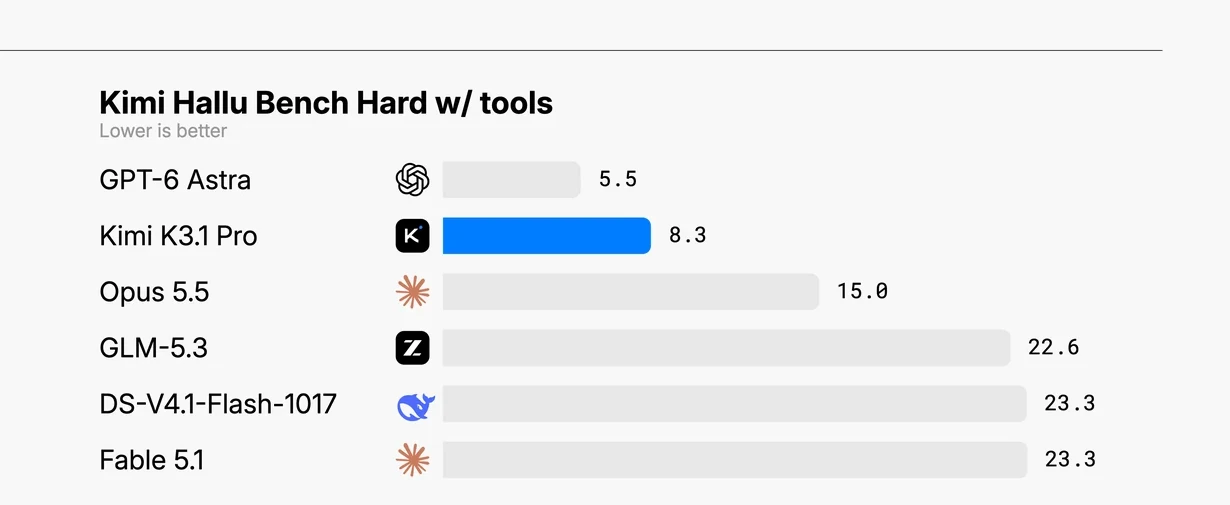
Moonshot also published direct comparisons on its own tests. On Hallu Bench Hard with tools, Kimi's claim-level error rate is 8.3% and GLM's is 22.6%; lower is better. On xdev-bench-hard, Kimi solves 81.0% of problems at pass@3 against GLM's 57.1%. OfficeQA Pro v2 scores 64.4 and 31.1. Frontier Finance is close: 58.6 and 57.5. These are vendor-run results, so read them as directional. The hallucination and xdev gaps are large enough to justify your own test.
The bill: GLM is cheaper on paper
Z.ai lists GLM-5.3 at ¥8 input, ¥2 cached input, and ¥28 output per million tokens. At about ¥7.1 to the dollar, that is roughly $1.13, $0.28, and $3.94. Moonshot lists Kimi K3.1 Pro at ¥13, ¥1.30, and ¥68, or about $1.83, $0.18, and $9.58. Highspeed doubles the input and output rates to ¥26 and ¥136 while the cache rate stays ¥1.30.
On SiAPI.ai's rate card, the same models are $1.20 input, $0.50 cached, and $4.00 output for GLM; $1.667, $0.333, and $6.667 for Kimi. Those are the rates behind the charts in this article.
On a Coding Plan the gap is easier to see. GLM consumes 9 points per token. Kimi consumes 15. On the Pro plan at $29.90 per month with 300M points per week, full weekly use works out to $0.209 per million tokens on GLM and $0.349 on Kimi over 30 days. That is a 67% difference per million plan tokens. The estimate assumes full utilization; your mix of input, output, and cache will move the number.
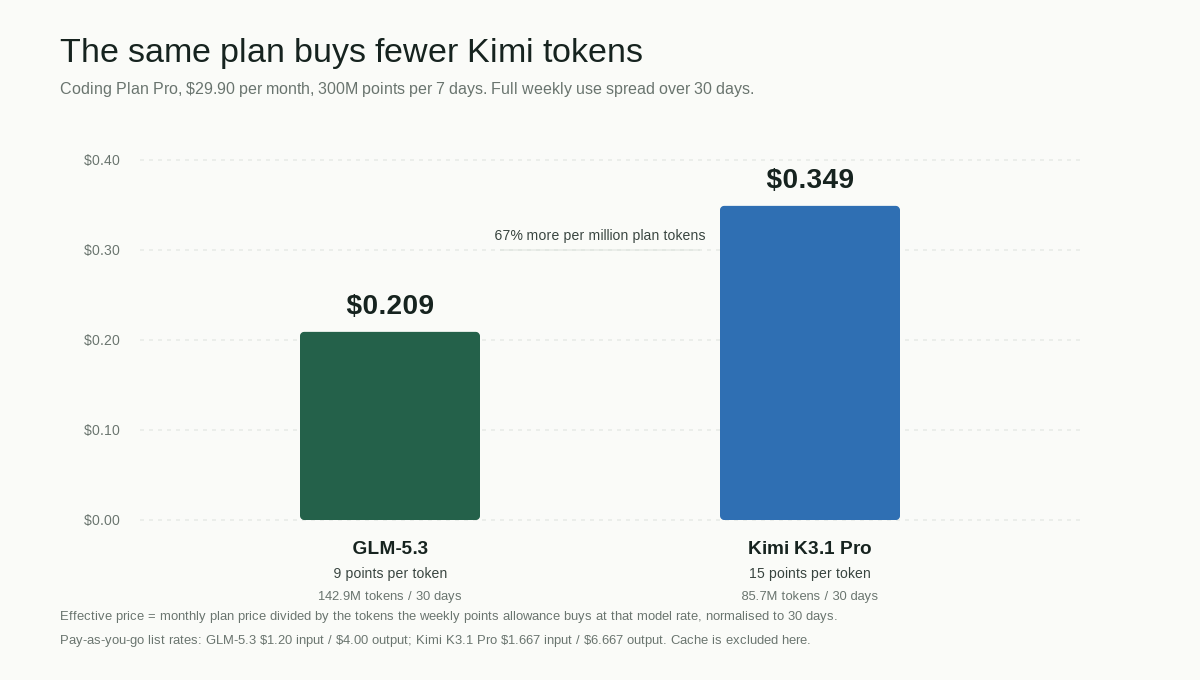
Kimi's output rate is 67% higher than GLM's. Its fresh input rate is 39% higher. The plan-point gap is the same 67%, because both models draw on the same weekly allowance.
The 1M window is not the cost driver
At 1M tokens of input with no cache, one turn costs $1.20 on GLM and $1.667 on Kimi. At a 90% cache hit rate, the same turn costs $0.57 on GLM and $0.467 on Kimi. The window size did not change the ranking. The cache rate did.
Kimi's cache price is the reason. Cached input is $0.333 per million on Kimi and $0.50 on GLM. If most of your prompt is a stable prefix, Kimi's input side gets cheaper faster. GLM still wins on output, where it charges $4.00 against $6.667. At 1M context and 90% cache, Kimi's input advantage is about 10 cents per turn. A single 39K-token output erases it, because GLM's output rate is $2.667 per million lower.
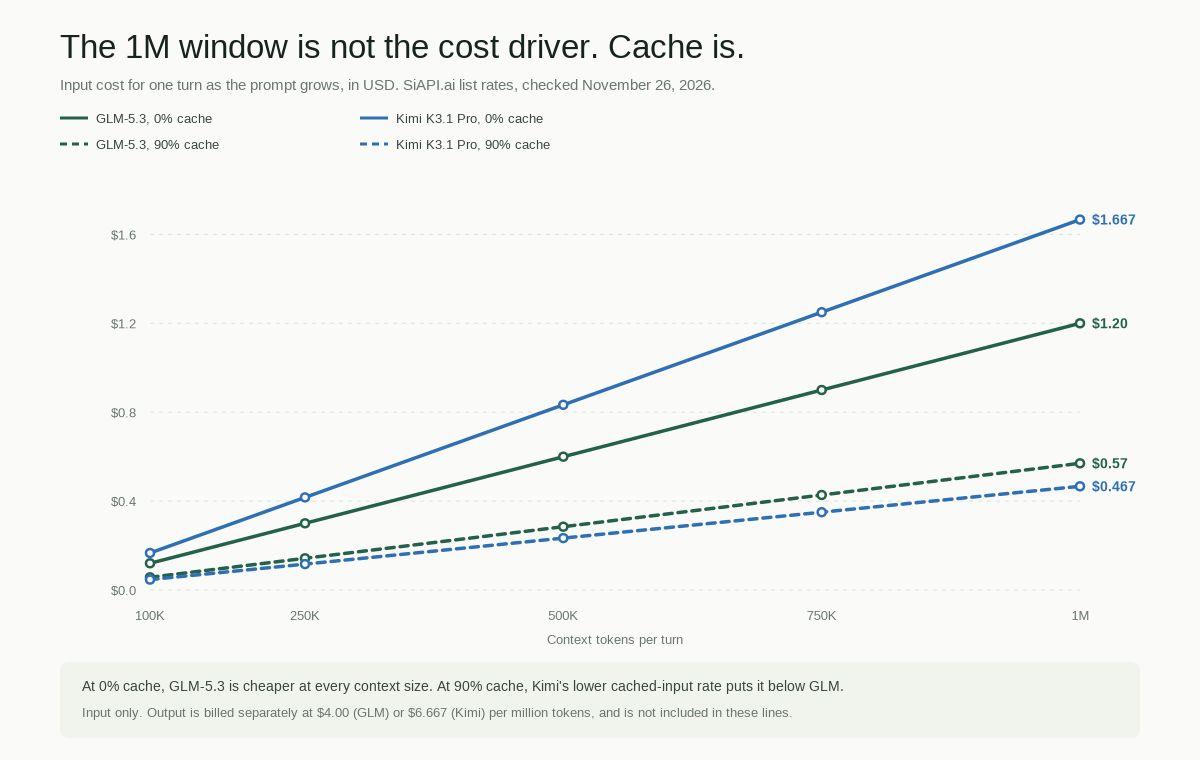
That is the trade in one sentence: Kimi rewards a large repeated prefix with a short answer; GLM rewards a large answer. Long repository review with small patches leans Kimi at high cache. Code generation that writes tens of thousands of tokens leans GLM.
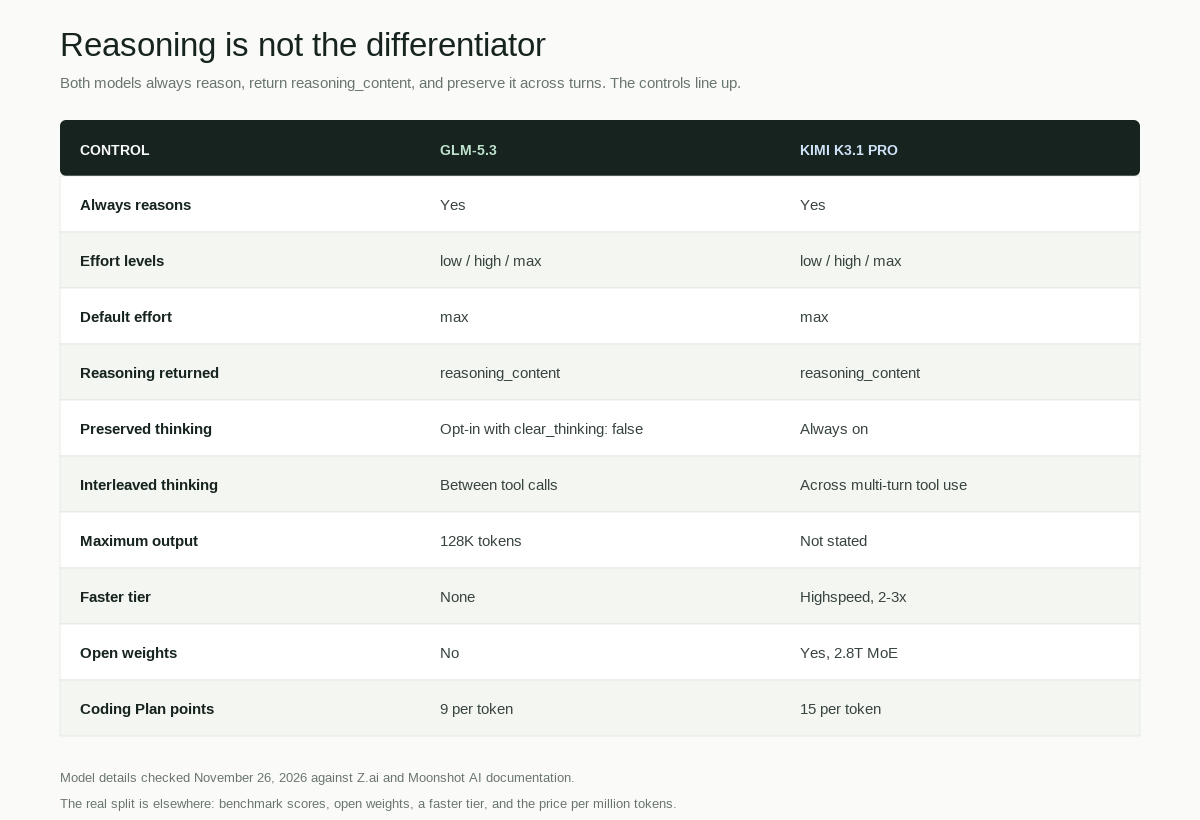
Reasoning controls line up
Both models always reason. You cannot turn thinking off on either one. Both accept low, high, or max effort, and both default to max. Both return reasoning_content, and both require you to resend the full assistant message, including that content, to keep the reasoning in context. GLM exposes interleaved thinking between tool calls. Kimi's preserved thinking is always on across multi-turn tool use. GLM's output cap is 128K tokens; Kimi's reference does not state one.
The usual reason to pick one model over another, visible versus hidden thinking, does not apply here. The practical differences are the output cap, the faster tier, and the price. Kimi offers a Highspeed model at 2-3x the speed for 20 plan points and $3.333/$13.333 per million tokens. GLM has no faster tier.
What Kimi's demo shows
Moonshot's walking-simulator clip runs 35 seconds and is worth watching for one reason. The model did not just tune a reward until the body stayed upright. It found a controller fault, then found 36 wrong entries in the shoulder muscle's moment-arm math inside the simulator itself. After repairing the physics, it retrained. The gait held for 11.2 seconds.
That is a long-horizon debugging story, and it is the kind of work the benchmark scores are trying to measure. It is also a vendor demo. It does not prove the model will find the bug in your repository, and the clip does not show the token bill.
Which one to use
Pick Kimi K3.1 Pro if the work is terminal-heavy, the output is hard to check, or a wrong claim is expensive. Long-horizon coding, finance research, and agent runs that need a strong terminal score are its side of the table. Highspeed is there when a pause breaks the workflow. Budget 15 plan points and the higher output rate. The open weights are a real option only if you can serve a 2.8T MoE model at data-center scale.
Pick GLM-5.3 if the work is a long text thread with many short answers, the output volume is high, or you want the lowest plan cost. Repository review, document extraction, and batch jobs with a stable prefix fit its shape. The 1M window and 9-point rate do the work. Accept two limits: text-only input and a 128K output cap.
| Workload | Better fit | Why |
|---|---|---|
| Terminal-heavy coding | Kimi K3.1 Pro | 65.7% on Terminal-Bench 4.0; GLM has no published 4.0 score. |
| Hallucination-sensitive research | Kimi K3.1 Pro | 8.3% vs 22.6% claim-level errors on Moonshot's Hallu Bench Hard. |
| High-volume text threads | GLM-5.3 | 9 vs 15 plan points; $4.00 vs $6.667 output per million. |
| Output-heavy generation | GLM-5.3 | 40% cheaper output; the gap grows with every long answer. |
| Interactive speed | Kimi K3.1 Pro Highspeed | 2-3x output speed, at 20 plan points and double the token rates. |
Test both on the same task before you commit. The benchmark gap is real, but it is vendor-run. The price gap is arithmetic, but it depends on your cache hit rate and output length. A single repository task with your own harness will tell you more than either vendor's table.
SiAPI.ai's Coding Plan covers GLM-5.3 and Kimi K3.1 Pro on the same key and the same points balance. Start with the model that matches the job, then run the same task on the other.
FAQ
Is Kimi K3.1 Pro better than GLM-5.3?
On the published tests, yes. Kimi scores 46 on the Artificial Analysis Intelligence Index v5 against 32 for GLM-5.3, and 65.7% on Terminal-Bench 4.0. GLM-5.3 has no published Terminal-Bench 4.0 score; its 28.3 is on Terminal-Bench 3.0. On price, GLM-5.3 is cheaper per token and per plan point.
Which model is cheaper on a Coding Plan?
GLM-5.3. It consumes 9 points per token against 15 for Kimi K3.1 Pro. On the Pro plan at $29.90 per month with 300M points per week, full weekly use works out to about $0.209 per million tokens for GLM-5.3 and $0.349 for Kimi K3.1 Pro over 30 days.
Do both models support 1M context?
Yes. GLM-5.3 takes 1M tokens. Kimi K3.1 Pro takes 1,048,576 tokens. GLM-5.3 caps output at 128K tokens; Kimi's model reference does not state a maximum output.
Can I see each model's reasoning?
Both models always reason and both return reasoning_content. Both accept low, high, or max effort and default to max. GLM-5.3 supports interleaved thinking between tool calls. Kimi K3.1 Pro keeps preserved thinking on across multi-turn tool use. Neither documentation describes a summary-only mode.
Is Kimi K3.1 Pro open weight?
Yes. Moonshot published weights for a 2.8T-parameter sparse MoE model in early November 2026. Serving it is a data-center project, so a hosted endpoint remains the practical route for most teams.