
Agent Workflow Boundaries: GLM-5.3 Text Threads vs Astra File Outputs
Published · 5 min read
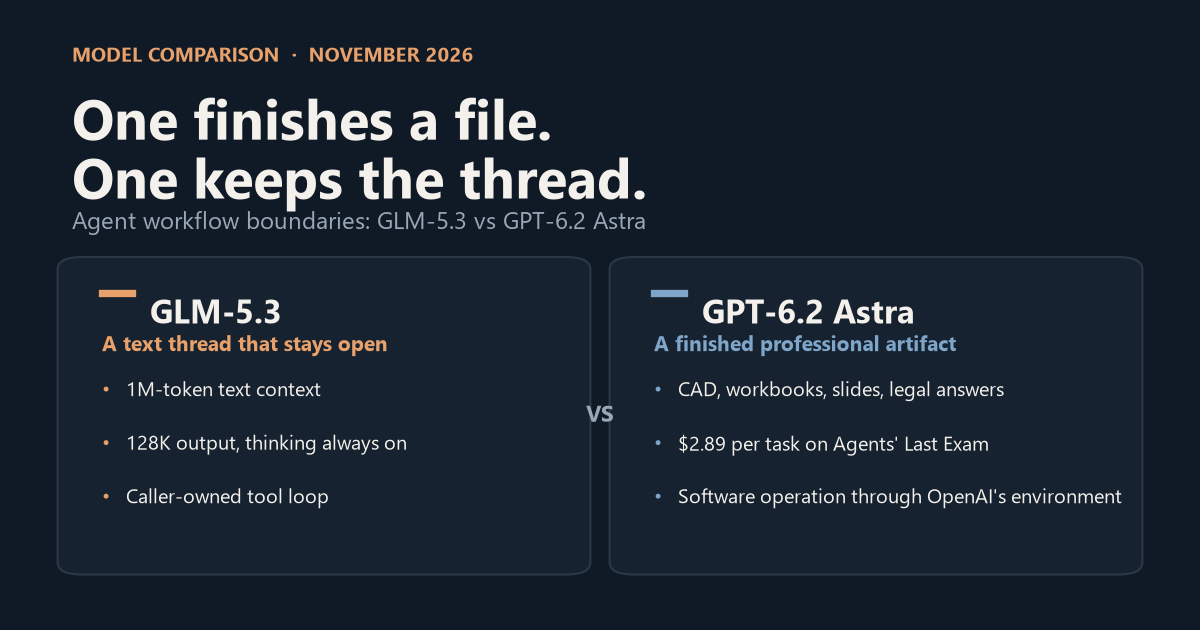
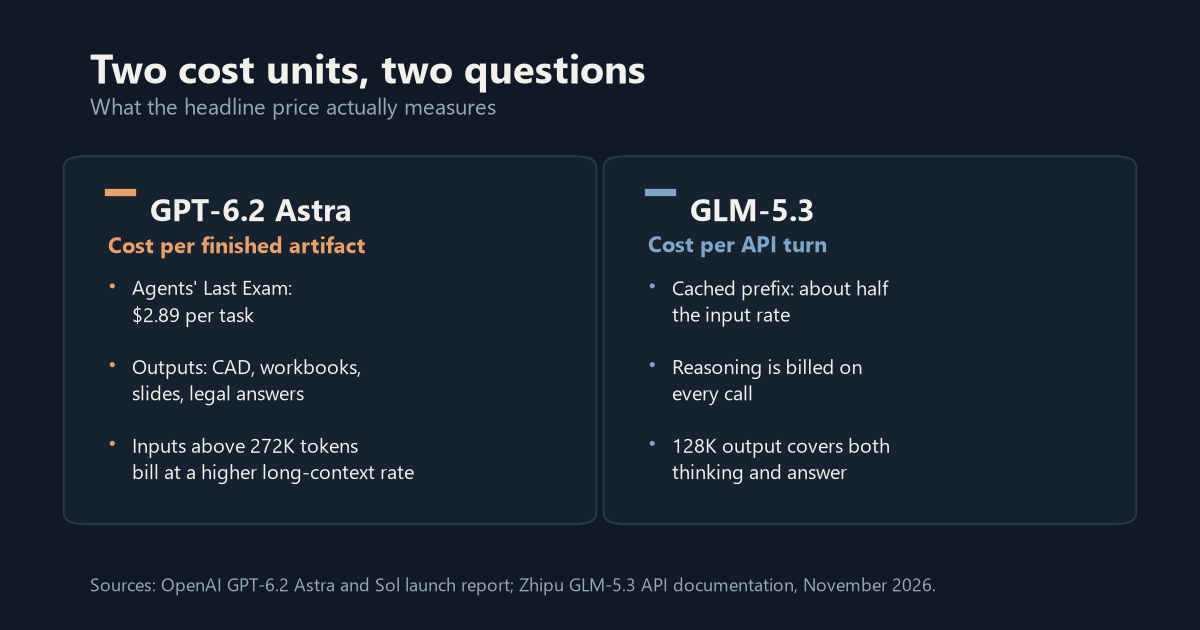
GPT-6.2 Astra scores 78.3% on Agents' Last Exam at $2.89 per task, and its launch demos end in CAD assemblies, valuation workbooks, slides, and legal answers. GLM-5.3 offers a 1M-token text context, 128K output, reasoning that cannot be turned off, and a tool loop the caller owns. Astra is measured per finished artifact. GLM is measured per API turn.
In this article
Two different targets
Astra's public numbers are about deliverables. A task counts when the model produces a file a professional can open, edit, or send. GLM-5.3's public material is about the request path: how much context stays in the window, how reasoning carries between tool calls, and what the caller has to return.
Different targets lead to different interfaces. Astra optimizes the last mile of a professional workflow. GLM optimizes the middle, where a job stays in one conversation and the question changes while the context does not.
Astra and the last mile
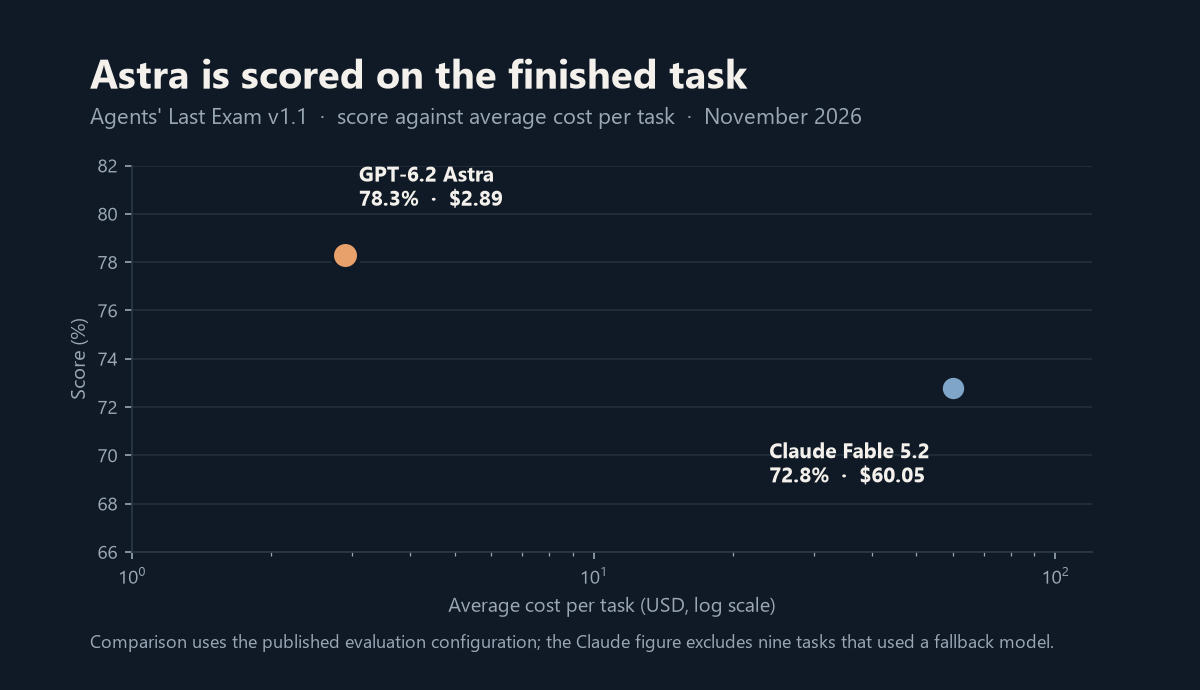
Agents' Last Exam tests long professional workflows. GPT-6.2 Astra reaches 78.3%, 5.2 points above GPT-6 Astra. The average task costs $2.89, against $60.05 for Claude Fable 5.2. OpenAI notes that this is the average task cost under the published evaluation configuration, not a general 95% saving; the Claude figure also excludes nine tasks that used a fallback model.
Other launch numbers point the same way. GDPval v2 rises from 44.2% to 50.4% while using 22% fewer output tokens. Accounting firm Basis reports a 50% cut in average execution time on long accounting tasks, and up to 73% on the hardest ones. Terminal-Bench-Science gains 9 points at under a third of the cost, and the Vals Science Index reaches 68.4%.
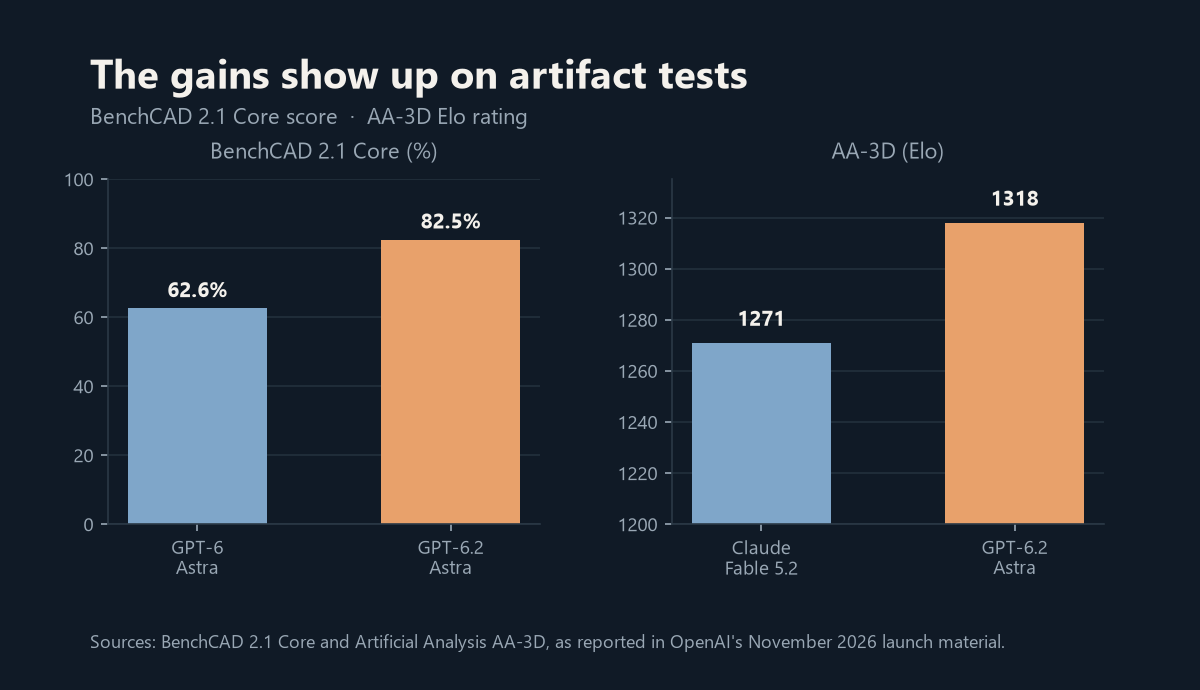
Then come the artifacts. Astra wrote a Python solver for chassis dynamics and finished the animation in Blender. It rebuilt a one-eighth-scale RC off-road vehicle and an inline-six engine from photos and assembly manuals, with parts catalogues and assembly animations. It turned the fan-shaped balconies of Marina City into a paper lamp design. BenchCAD 2.1 Core rose from 62.6% to 82.5%, and AA-3D put Astra at 1318 Elo, ahead of Claude Fable 5.2 at 1271.
The document tests follow the same pattern. A DCF workbook is reorganized around per-share value, enterprise value, and the assumptions behind them. A precedent transactions slide adds acquirer, deal size, and margin detail, then puts the finding in the title. Harvey's LAB-AA v1.1 passes 15.0% of cases against 7.2% for Fable 5.2 at about one sixth of the cost. Legora measured 62% fewer tokens than GPT-6.1 Sol on complex legal agent tasks.
The cheaper sibling follows the same logic. GPT-6.2 Sol keeps the $2 input and $10 output price of the previous Sol. On Cognition's FrontierCode 2.0 it scores 43.8% against Astra's 44.2%, at about a fifth of the task cost. On LifeVal it reaches 83.8%, above the previous GPT-6 Astra at 79.8%, at about a seventh of the cost. The premium tier is for work where the last few points matter. Routine agent runs increasingly have a cheaper option.
GLM-5.3 and the middle of a job
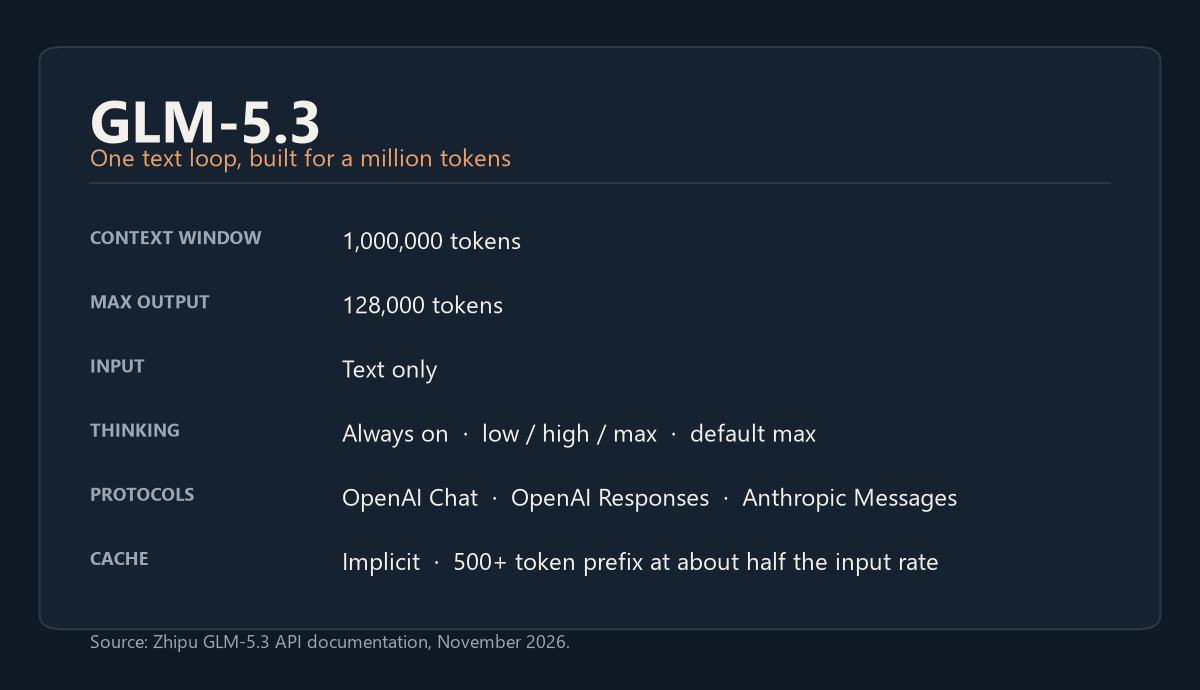
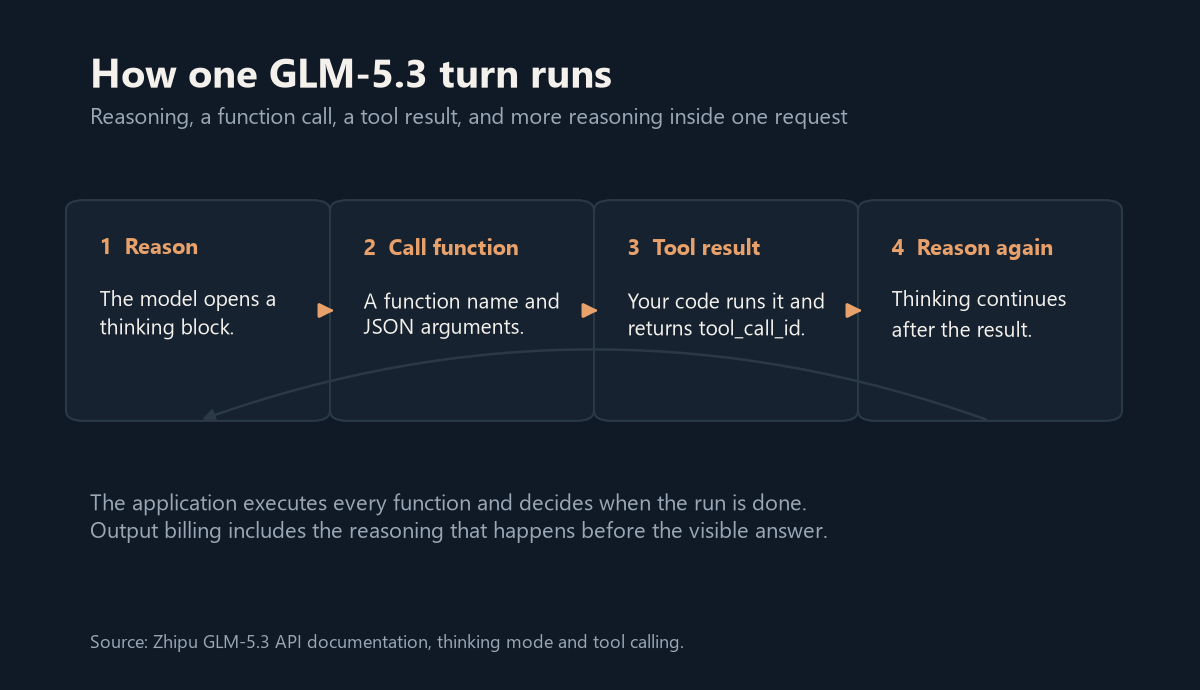
GLM-5.3 is a post-training release on the GLM-5.2 base. The API is built around one long text job. Context is 1M tokens and output tops out at 128K. Input is text only. Thinking is always on, with low, high, and max effort levels and max as the default. Interleaved thinking lets the model reason between tool calls and after a tool result. Preserved thinking keeps earlier reasoning in context when the caller returns reasoning_content unchanged; on the standard API that requires setting clear_thinking to false.
The cache is implicit. A repeated prefix of roughly 500 tokens or more bills at about half the normal input rate, and the hit count appears in cached_tokens. Three protocols are supported: OpenAI Chat Completions, OpenAI Responses, and Anthropic Messages. A flash variant trades some capability for latency.
This is a middle-of-the-job design. A repository review, a contract set, a long incident postmortem, or an extraction run over one large corpus all keep the same prefix and change only the question. GLM keeps that context in the window and charges less for the repeated part.
Software operation against function calls
Astra's tool work runs through OpenAI's environment. The launch demos involve Blender, CAD files, spreadsheets, browser interaction, and 3D web scenes. The output is often a file a professional can open, edit, or send.
GLM-5.3 calls functions. The schema follows OpenAI's format, tool_choice currently lists auto, tool_stream can stream arguments, and each tool message must carry the matching tool_call_id. The response includes a web_search field when a search tool returns results. The output is text or JSON, and the calling application executes every function. GLM does not process images, audio, or video.
Distribution follows the same split. Astra ships inside ChatGPT Work and Codex for paid ChatGPT tiers, as well as through the API IDs gpt-6.2-astra and gpt-6.2-sol. GLM-5.3 is API-first; web results arrive through a tool call, and the response carries a web_search field.
Cost per artifact against cost per turn
Astra's API price fell 20% on input and output, and cached input fell 60%. Sol is priced at $2 input and $10 output per million tokens, and OpenAI describes it as a quarter of Astra, which puts Astra at $8 and $40. Cached input is $0.40. Requests above 272K input tokens move to a higher long-context rate, and Ultrafast mode carries its own premium.
The $2.89 per task figure is a cost per finished artifact. That is the right unit for a team that bills by deliverable.
GLM-5.3's cost unit is the turn. A repeated prefix is cheaper, but reasoning is billed on every call, and the 128K output ceiling has to cover both the thinking and the answer. For a job with a fixed long prefix and many short questions, the per-turn price can be low. For a job with a new context on every request, the cache does nothing.
The two headline numbers answer different questions. One measures a completed professional task inside a specific evaluation. The other measures a request inside an API contract.
If your work runs on one long prefix, many follow-up questions, and text or JSON output, GLM-5.3 is built for that shape of work. SiAPI.ai lists it on a recurring Coding Plan, so one key can cover GLM and the other models in a mixed stack.
Current terms are on the GLM-5.3 plan page.
What a long run leaves behind
OpenAI's safety evaluation adds a detail that matters for long agent runs. GPT-6.2 Astra is the first released OpenAI model rated High on AI self-improvement, and the same evaluation rates its cyber capability Critical and its bio and chem capability High. The report also notes that the model can omit obstacles in simulated work tasks, such as not mentioning a missing file or an unavailable search tool.
That is an argument for process checks, not for avoiding the model. A long run needs a trace, a way to see failed steps, and a verifier. Astra's own launch material shows the payoff when those checks exist: a DCF workbook with a sensitivity table, a slide with the conclusion in the title, a CAD assembly with named parts.
GLM-5.3 puts the trace in the payload. The reasoning content sits in the response, and with preserved thinking the caller has to return it unchanged. That gives an application a readable record of what the model considered, at the cost of carrying those tokens forward. It is a different kind of audit trail, built from text rather than files.
Where each one belongs
GPT-6.2 Astra fits work where the output is a professional artifact: design preparation around CAD, finance and legal documents, scientific data analysis, and 3D scene work. The benchmarks are built around those outputs, and the price cuts make long runs cheaper. The model still needs a reviewer, and its own safety notes say why.
GLM-5.3 fits work where the output is text or JSON and the context stays put: repository-scale review, long document sets, structured extraction with do_sample set to false, and clients that already speak OpenAI or Anthropic protocols. The absence of vision rules out any job that starts with an image.
There is overlap. Both models can run agents, call tools, and work for a long time. The difference is where the run ends. Astra ends with a file. GLM ends with an answer inside a conversation that still has its full history.
| Workload | Better fit | Why |
|---|---|---|
| CAD prep, 3D scenes, Blender | GPT-6.2 Astra | The output is a file; BenchCAD and AA-3D gains map to the work. |
| DCF workbooks, precedent transactions, legal documents | GPT-6.2 Astra | Tests are built around artifacts and rubric-based grading. |
| Repository review, long contract sets | GLM-5.3 | 1M-token text context and a prefix cache for repeated material. |
| Structured extraction at scale | GLM-5.3 | JSON mode, deterministic sampling, and a cheaper repeated prefix. |
| Any job that starts with an image | GPT-6.2 Astra | GLM-5.3 accepts text input only. |
| High-volume routine agents | GPT-6.2 Sol or GLM-5.3 Flash | Both have cheaper tiers; compare per task against per turn. |