
Token Pricing vs Task Cost: GLM-5.3 and Gemini 4 Neon
Published · 6 min read
GLM 5.3 keeps one text thread with a 1M-token window and reasoning that cannot be switched off, and it leaves the agent loop in your code. Gemini 4 Neon spends fewer, longer turns and hands parts of the job to cheaper Hydrogen subagents inside Google Antigravity. Per million tokens GLM 5.3 costs $1.20 in and $4.00 out against $3.00 and $15.00 for Neon, but Google reports $6.86 per finished coding task for Neon, so the per-token gap is not the per-task gap.
In this article
GLM 5.3 is a post-training release from Zhipu. The base model stayed the same as GLM 5.2, and the gains come from longer, more realistic training tasks. Gemini 4 Neon is the fourth model in Google's Gemini 4 family, announced on 18 November 2026, and it arrives with an orchestration layer already attached.
Put the spec sheets side by side and they look similar. Look at how a request is built, and the two products start to separate.
Two ways to make a model better at agent work
Zhipu did not change the architecture. The GLM 5.3 release notes put the work in synthetic task environments: production-like setups with clusters, storage, internal documents, code and experiment results, plus a reviewer that tries to complete each task and a verifier that scores it. The model is trained to keep going across many steps. Nothing about that training requires a new runtime, and Zhipu did not ship one.
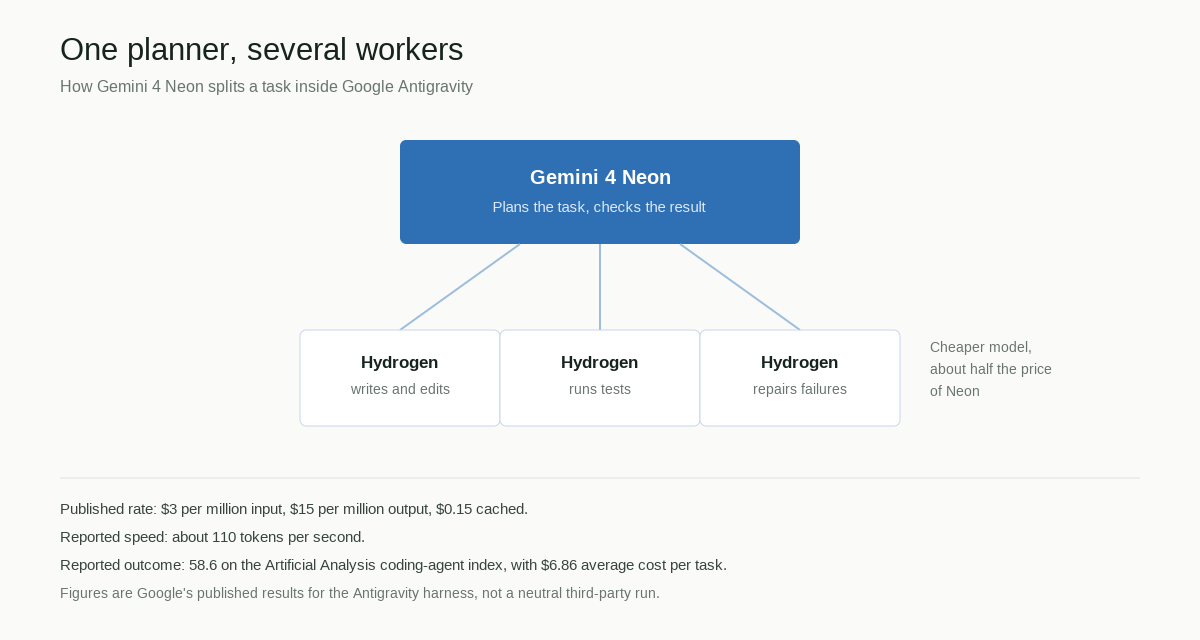
Google took the opposite route. Neon's pitch is a division of labor rather than a single stronger model. Inside Antigravity, Neon can take a large task, break it up, and hand the parts to parallel Hydrogen subagents. Hydrogen is the lightest model in the family and costs roughly half of Neon. The launch numbers reflect that setup: 61 on the Artificial Analysis Intelligence Index at extended thinking, 58.6 on the coding-agent index, and about 110 output tokens per second.
So one model gets better at holding a long thread, and the other gets better at handing work out. Both are reasonable answers to the same question, and they produce different request formats.
Token price says one thing, task cost says another
On a per-token basis GLM 5.3 is the cheaper model by a wide margin on input and output, while Neon's cache reads are far cheaper. The published rates look like this:
| Rate | GLM 5.3 | GLM 5.3 Flash | Gemini 4 Neon |
|---|---|---|---|
| Input | $1.20 | $0.135 | $3.00 |
| Cached input | $0.50 | $0.045 | $0.15 |
| Output | $4.00 | $0.45 | $15.00 |
| Context window | 1M tokens | 1M tokens | 1M tokens |
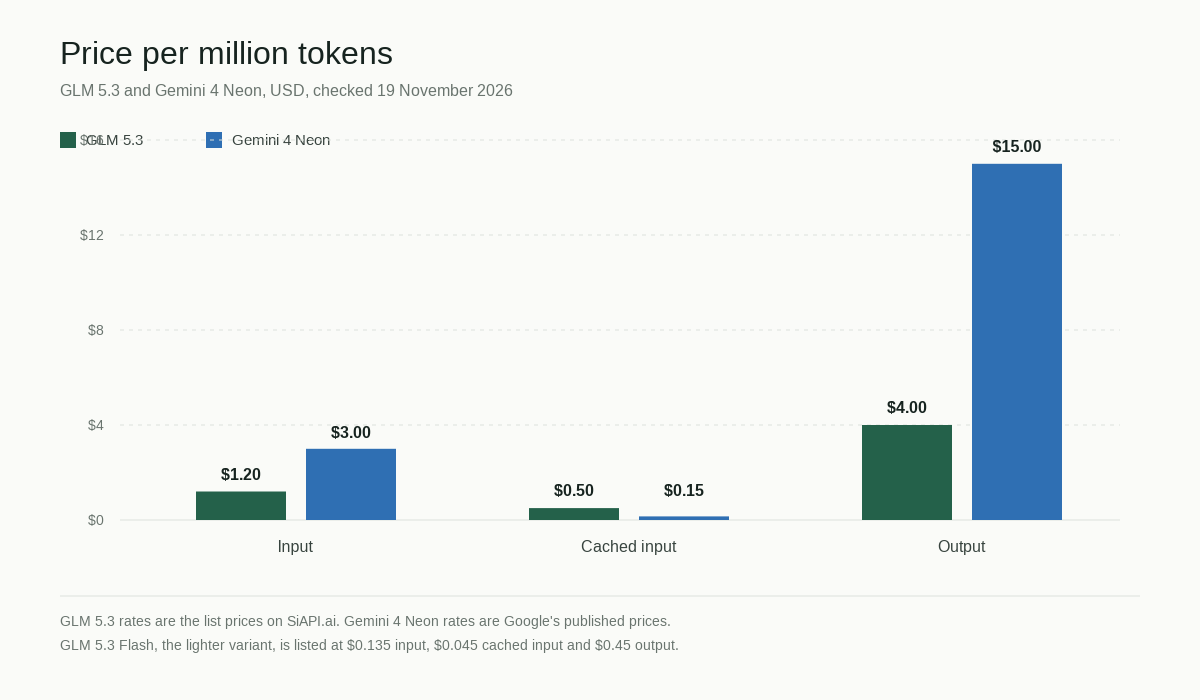
Those rates are not the whole bill. Google reports an average of $6.86 per coding task for Neon in its own harness, against $12.61 for Claude Opus 5.5 and $15.47 for Claude Fable 5.2. A cheaper model per token that needs more turns, or that runs inside a coordination layer, can still cost more per finished task. Zhipu publishes no equivalent per-task figure, so there is no honest number to set against $6.86.
The practical read: Neon is built to spend fewer, longer turns and to push cheap work downwards. GLM 5.3 is built to make each turn affordable, including the reasoning tokens inside it.
Thinking is a request field on one model and a product feature on the other
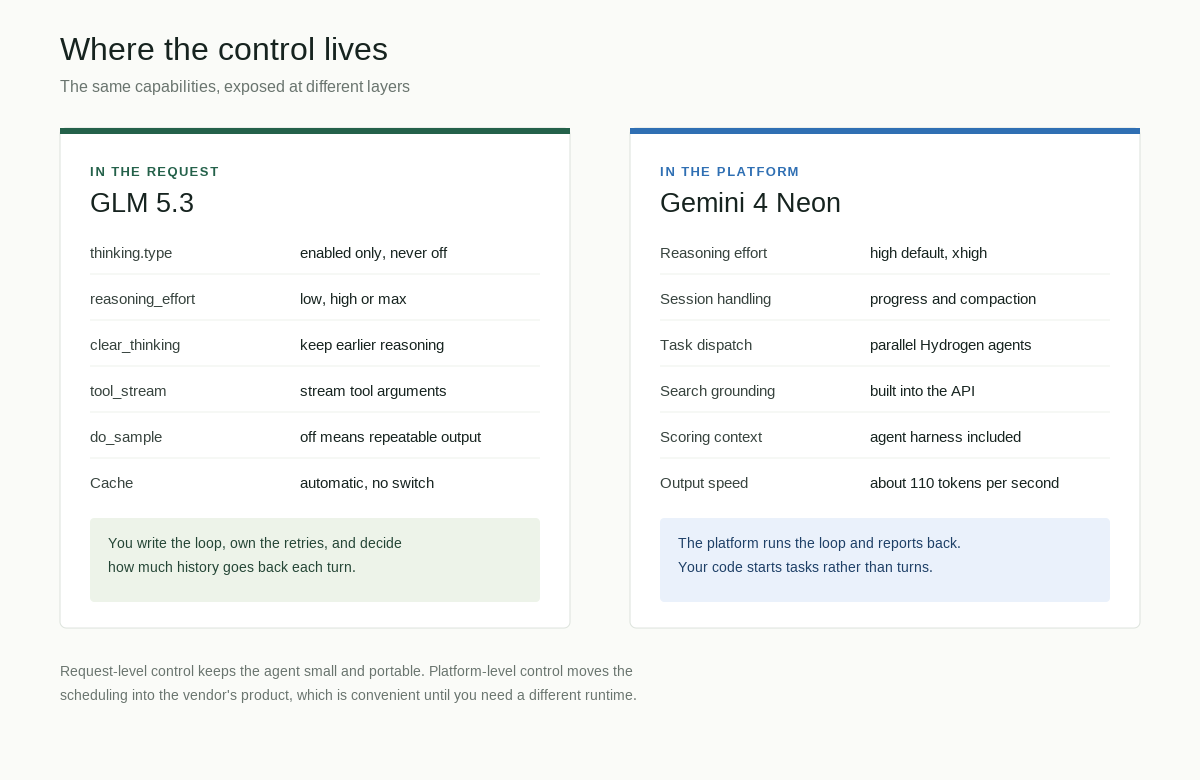
GLM 5.3 does not allow you to turn reasoning off. Requests must send thinking.type: "enabled", and a request that passes disabled fails outright. Effort has three settings, low, high and max, with max as the default. Output tokens include the reasoning, so max_tokens has to cover both the thinking and the visible answer.
Two behaviors matter for multi-step work. Interleaved thinking is on by default, which lets the model reason between tool calls and after a tool result arrives. Preserved thinking, enabled with clear_thinking: false, keeps earlier reasoning in the context so the next turn can build on it. It is on by default on the Coding Plan endpoint and off on the standard API endpoint, which is the sort of detail that changes behavior after a migration.
One hard rule comes with it: the reasoning_content you send back must match what the model produced. Reordering or trimming the text lowers both answer quality and cache hits.
Neon exposes a smaller dial, high by default with xhigh for deeper runs. The rest of the thinking work is handled by the environment. Antigravity reports progress during long sessions and compacts context when it fills, which is the part a team would otherwise build itself.
Native tools and search, built in both cases but not at the same level
GLM 5.3 uses OpenAI-style function calling. Tools are declared in the request, tool_choice currently lists only auto, and every tool result needs a matching tool_call_id placed after the assistant message that requested it. tool_stream returns tool arguments incrementally when you want to show progress in a UI. The response object carries a web_search field when the search tool returns results, so the model can use live pages inside the same loop.
The trade-offs are explicit. There is no strict json_schema mode, so structured output relies on json_object plus field instructions in the system message and a local check afterwards. Text is the only input modality. Retries, permissions and history management stay in your code, which is the point of the design.
Neon's tool handling sits one level up. Google Search grounding and code execution are part of the Gemini API rather than something you assemble, and the public benchmark numbers are produced inside agent products: second on the Arena agent leaderboard, 56.3% on Zapier's automation benchmark, 90.5% on SEC-bench Pro. The coding-agent score uses the Antigravity CLI. Used this way, Neon starts a task and reads a result; the platform decides how many turns and which subagents are involved.
Which workload each design suits
GLM 5.3 fits work that stays inside one text thread and one codebase. Repository-scale review, long document analysis, batch extraction with do_sample: false for repeatable results, and migration from an existing OpenAI or Anthropic client all play to its strengths. Its implicit cache also rewards a stable prefix: a long system prompt or fixed rule set of 500 tokens or more can cut input cost roughly in half on repeat calls. The lighter GLM 5.3 Flash variant covers high-volume, lower-complexity traffic at a fraction of the price.
Gemini 4 Neon fits work that can be split and checked in parallel, especially when the team already lives in Google's stack. Long autonomous coding sessions, multi-branch refactors, visual and 3D generation, and research that needs fresh web results mid-task are the intended uses. The honest limit is that Opus 5.5 still leads on Terminal-bench 4.1 and FrontierCode 2.0, so the hardest single-file problems may belong on another model.
Neither design is a general upgrade over the other. One keeps the intelligence in a single controllable conversation. The other moves coordination into the product and charges for it in a different currency.
If your workload is a long text loop with a stable prefix, GLM 5.3 runs it at $1.20 per million input tokens, and a recurring plan keeps it alongside the rest of a mixed model stack under one key.