
A Carbon Session Runs for Days. A GLM-5.3 Loop Stops When Your Code Says So.
Published · 5 min read
GLM-5.3 is a text model that keeps the agent loop in your code: you set the thinking effort, declare the tools, and pay $1.20 per million input tokens. Gemini 4 Carbon is a multimodal model that runs long sessions inside Google's own products and costs $2 per million input tokens during its introductory period. One sells control at the request level. The other sells finished work at the product level.
In this article
Zhipu released GLM-5.3 on 14 August 2026. The base model is the same one used in GLM-5.2, and the gain comes from post-training on longer, more realistic tasks. Google announced Gemini 4 Carbon on 28 October 2026 and opened it to general availability on 11 November. Carbon builds on Gemini 4 Argon and targets long-horizon engineering, cybersecurity and scientific research.
The spec sheets overlap more than they differ. Both take around a million tokens of context, both run multi-step tool loops, and both post strong coding and security scores. The useful difference is where the loop runs and who is responsible for it.
A model you drive versus a session you hand off
GLM-5.3 is a single text thread with a 1M-token window and a 128K output limit. Reasoning cannot be switched off. Requests must send thinking.type: "enabled", and effort takes three values: low, high and max, with max as the default. Output tokens include the reasoning, so max_tokens has to cover both the thinking and the visible answer.
Two behaviours matter once tools enter the picture. Interleaved thinking lets the model reason between tool calls and after each result arrives. Preserved thinking, set with clear_thinking: false, keeps earlier reasoning in context for the next turn. It is on by default on the Coding Plan endpoint and off on the standard API endpoint.
Carbon goes the other way. Google's description is about sessions, not requests: Carbon is built to run for days, work through dead ends, and finish multi-step engineering tasks such as root-causing and patching subtle bugs across large codebases. Input can be text, image, audio or video, and the context budget covers input and output together at 1M tokens. In practice you start a task in Antigravity or the Gemini app and read a result.
That difference shows up in the API. A GLM-5.3 integration is a loop you write: send a request, read the tool call, run the tool, send the result back. A Carbon integration is closer to a job submission, with the platform deciding how many turns and which internal steps are involved.
Benchmark scores, read against the harness
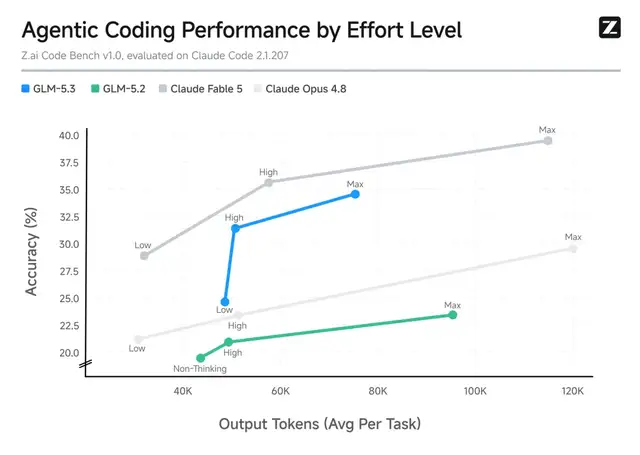
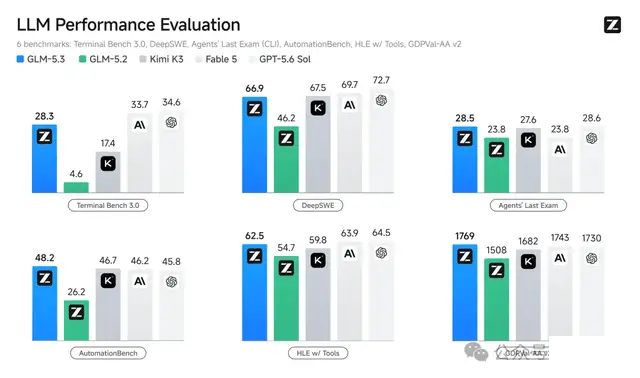
Zhipu reports Terminal-Bench 3.0 at 28.3, up from 4.6 on GLM-5.2, plus DeepSWE v1.1 at 66.9, Agents' Last Exam at 28.5, AutomationBench at 48.2 and CyberGym at 84.5. Google reports Artificial Analysis Intelligence Index v5.0 at 59, Terminal-Bench 4.0 at 65.2, Terminal-Bench-Science at 64.8, GraphWalks at 96.2 across 256K to 1M context, and Agents' Last Exam at 77.4.
Terminal-Bench 3.0 and 4.0 are different suites, so the 28.3 and 65.2 figures describe different tests rather than the same test at two points in time. Treat each vendor's set as evidence of its own model, and compare the two only where a third party ran both.
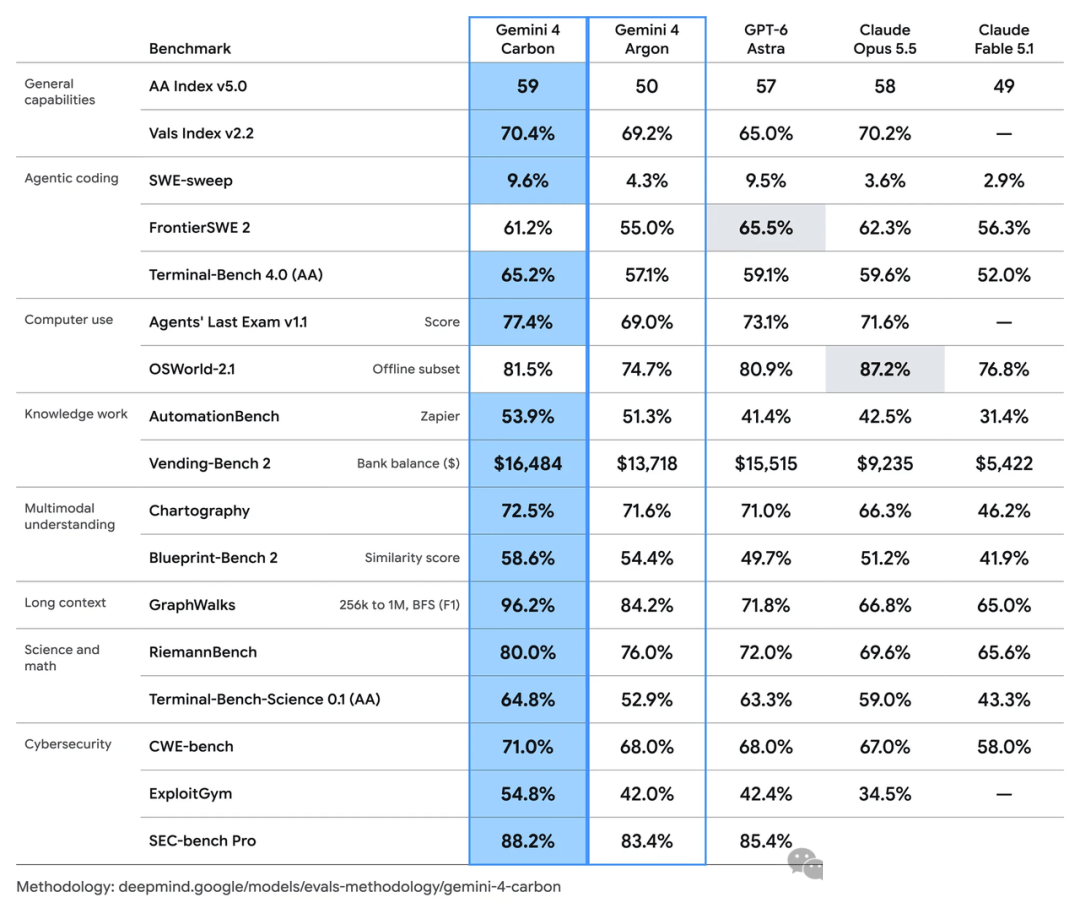
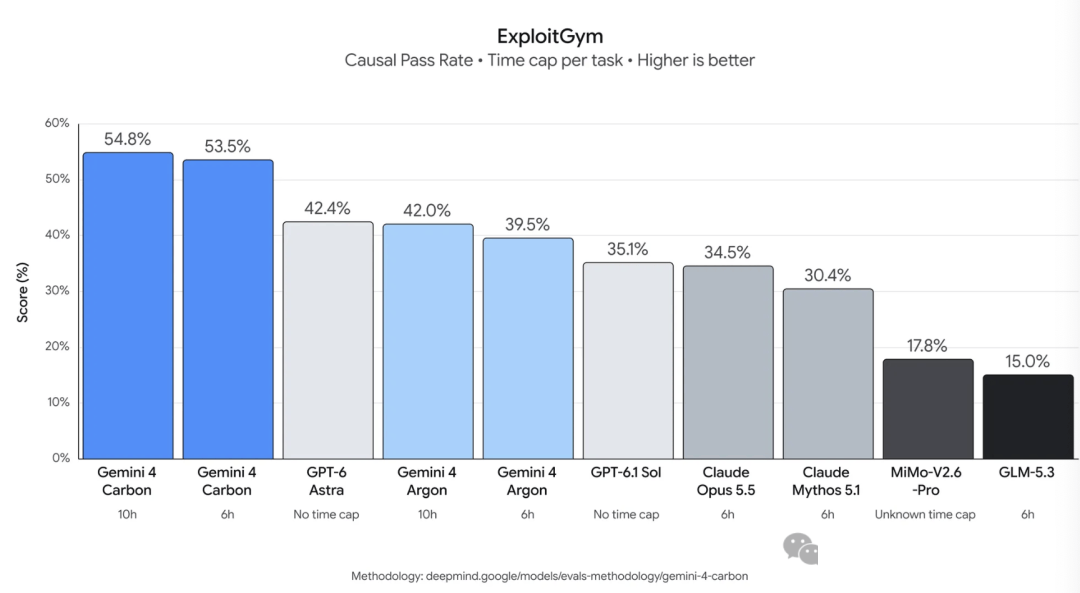
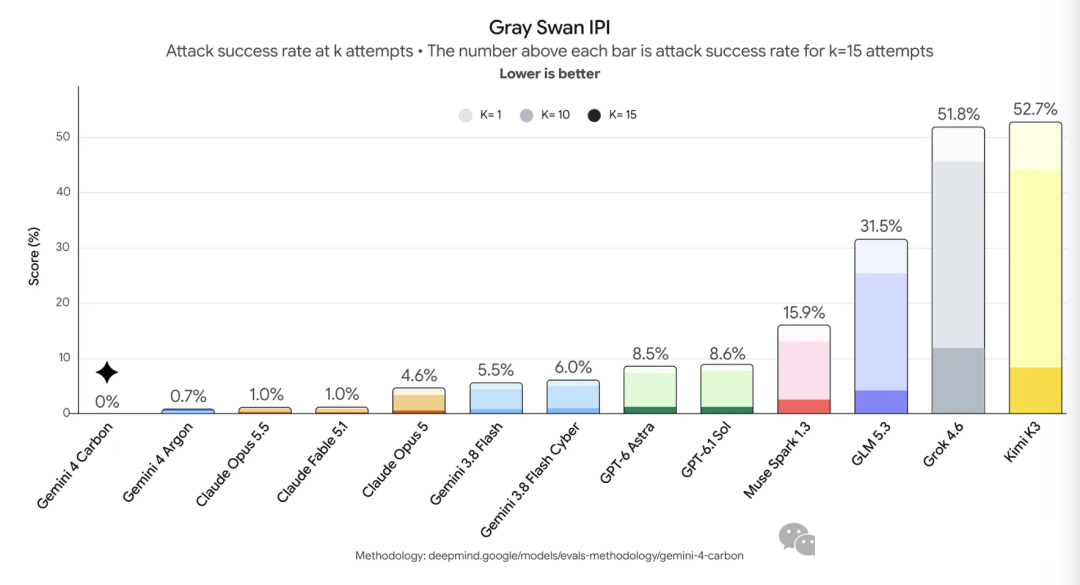
Two charts do place both models on the same axis. In Google's ExploitGym chart Carbon leads at 54.8%, and GLM-5.3 sits lower in the same figure. In the Gray Swan prompt-injection test, Carbon records a 0% attack success rate. These are the closest thing to a shared scoreboard, and they cover security work rather than general coding.
Tools and web access sit at different layers
GLM-5.3 uses OpenAI-style function calling. Tools are declared in the request, tool_choice currently accepts auto, and every tool result needs a matching tool_call_id after the assistant message that requested it. tool_stream returns tool arguments incrementally for progress displays. When the search tool returns pages, the response carries a web_search field, so live results stay inside the same loop. The API also speaks the OpenAI Chat Completions, OpenAI Responses and Anthropic Messages protocols, which keeps migration small.
The trade-offs are stated plainly in the docs. There is no strict json_schema mode, so structured output relies on json_object plus field instructions and a local check. Text is the only input modality. Retries, permissions and conversation history stay in your code.
Carbon builds search and code execution into the Gemini API instead of asking you to assemble them. Google Search grounding and code execution are platform features, and the agent products run the loop on your behalf. The model card notes occasional slowness, timeouts and higher token use at deeper thinking levels, which is the cost side of handing over the session.
Price, cache and access
Per-token rates favour GLM-5.3 by a wide margin. Carbon's cache read is the cheaper of the two, which matters because agent loops resend context on every turn.
| Item | GLM-5.3 | Gemini 4 Carbon |
|---|---|---|
| Input | $1.20 | $2.00 until 30 Nov, then $4.00 |
| Cached input | $0.50 | $0.10 until 30 Nov, then $0.20 |
| Output | $4.00 | $10.00 until 30 Nov, then $20.00 |
| Context | 1M in / 128K out | 1M combined |
| Input types | Text | Text, image, audio, video |
| Access | Public API | AI Studio, Gemini app, API, Antigravity |
GLM-5.3 also caches implicitly: a repeated prefix of roughly 500 tokens or more bills at about half the standard input rate, reported through cached_tokens. For a fixed system prompt or rule set, that turns into a steady discount on repeat calls.
Access is the other half of the cost. Carbon arrived first for a subset of cyber defenders and trusted partners, then reached general availability; Gemini 4 Carbon's cybersecurity results were produced under that programme. GLM-5.3 is a public API with no comparable gate.
Which workload fits which design
GLM-5.3 suits work that stays inside one text thread and one codebase. Repository-scale review, long document analysis, batch extraction with do_sample: false for repeatable output, and migration from an existing OpenAI or Anthropic client all line up with its strengths. A stable prefix and a fixed tool schema also extract more value from the cache.
Gemini 4 Carbon suits work that can run unattended for hours and benefits from more than text. Long autonomous coding sessions, security analysis over large codebases, research that mixes papers, screenshots and audio, and tasks the platform can check before returning all fit the session model.
The two products solve the same problem at different points. GLM-5.3 gives you a controllable conversation and leaves coordination to your code. Carbon gives you a session and takes coordination into the product. Neither is a general upgrade over the other; the difference is where you want to keep the loop.
GLM-5.3 is available through the SiAPI.ai multi-model plan at $1.20 per million input tokens, under the same key as the other models you already call.