
With GLM-5.3 You Can Read Every Reasoning Step. With Fable 5.2, You Read the Result.
Published · 6 min read
GLM-5.3 is a text-only model with a 1M-token window, always-on reasoning and OpenAI-style tool calling. Your application runs the loop. Claude Fable 5.2 is Anthropic's flagship for coding and long-running agents, with server-side search, computer use and subagent coordination inside the platform. GLM-5.3 lists at about $1.13 per million input tokens and $3.94 output. Fable 5.2 lists at $8 and $40. The choice turns on where you want control and how much of the loop you want to own.
In this article
One long thread, or many workers
GLM-5.3 is built around a single text conversation. The context window is 1M tokens, output tops out at 128K, and input is text only. Thinking cannot be switched off: the API accepts thinking.type: "enabled", and a request that sends disabled fails. Effort runs low, high or max, with max as the default.
Two behaviors matter for agent work. Interleaved thinking lets the model reason between tool calls and after a tool result arrives. Preserved thinking, enabled with clear_thinking: false, keeps earlier reasoning in the context. The reasoning_content sent back must match what the model produced; trimming or reordering it lowers answer quality and cache hits.
Fable 5.2 is described in terms of scope rather than a single thread. Anthropic's launch material covers multi-day work, ambiguous tasks, self-checking code, and coordination across many subagents. One reported run used more than 1,000 subagents and 170 reviewer agents. The model is positioned for coding, long-running agents, scientific research, data analysis, financial work, and 3D or hardware design. Anthropic does not publish a context-window or max-output number on the launch page.
That is the first design split. GLM-5.3 makes one thread deep and inspectable. Fable 5.2 makes many threads cooperate.
Token price against cache price
The two rate cards look far apart until cache reads enter the picture. GLM-5.3 lists at ¥8 per million input tokens and ¥28 output, about $1.13 and $3.94 at ¥7.1 per dollar. Cached input is ¥2. Fable 5.2 lists at $8 input and $40 output, down from $10 and $50 for Fable 5.1, with cache reads at $0.20 and a fast mode at $16 and $80.
| Dimension | GLM-5.3 | Claude Fable 5.2 |
|---|---|---|
| API model ID | glm-5.3 | claude-fable-5-2 |
| Input | ¥8 (~$1.13) | $8.00 |
| Output | ¥28 (~$3.94) | $40.00 |
| Cached input | ¥2 (~$0.28) | $0.20 |
| Context window | 1M tokens | Not listed on the launch page |
| Maximum output | 128K tokens | Not listed on the launch page |
| Thinking control | Always on; low / high / max | High and Xhigh in published runs |
| Input modality | Text only | Not stated on the launch page |
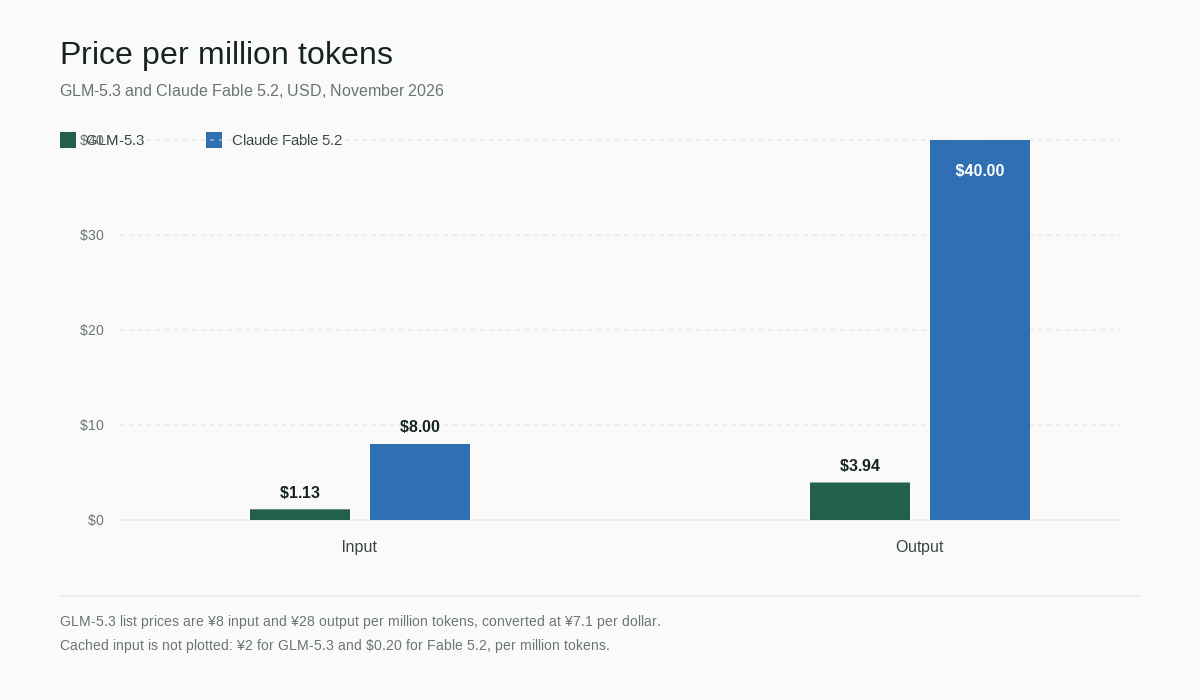
The practical read is about reuse. A stable prefix of several thousand tokens makes GLM-5.3's implicit cache do real work, and the 1M window means less chunking in front of the model. A Claude workflow that resends a large document or codebase gets cache reads at $0.20, the lowest line on either card. Fresh reasoning tokens are still billed at the full rate on both models, and GLM-5.3 charges for thinking on every call because the mode cannot be disabled.
Fable 5.2's fast mode doubles the input and output rates. US-only inference carries a 1.1x multiplier. Those options change the bill without changing the design.
If your work looks like a long text loop, test GLM-5.3 on a coding plan. A stable prefix, a large repository and many repeat calls are the pattern its cache and 1M window were built for.
How each model reaches the web
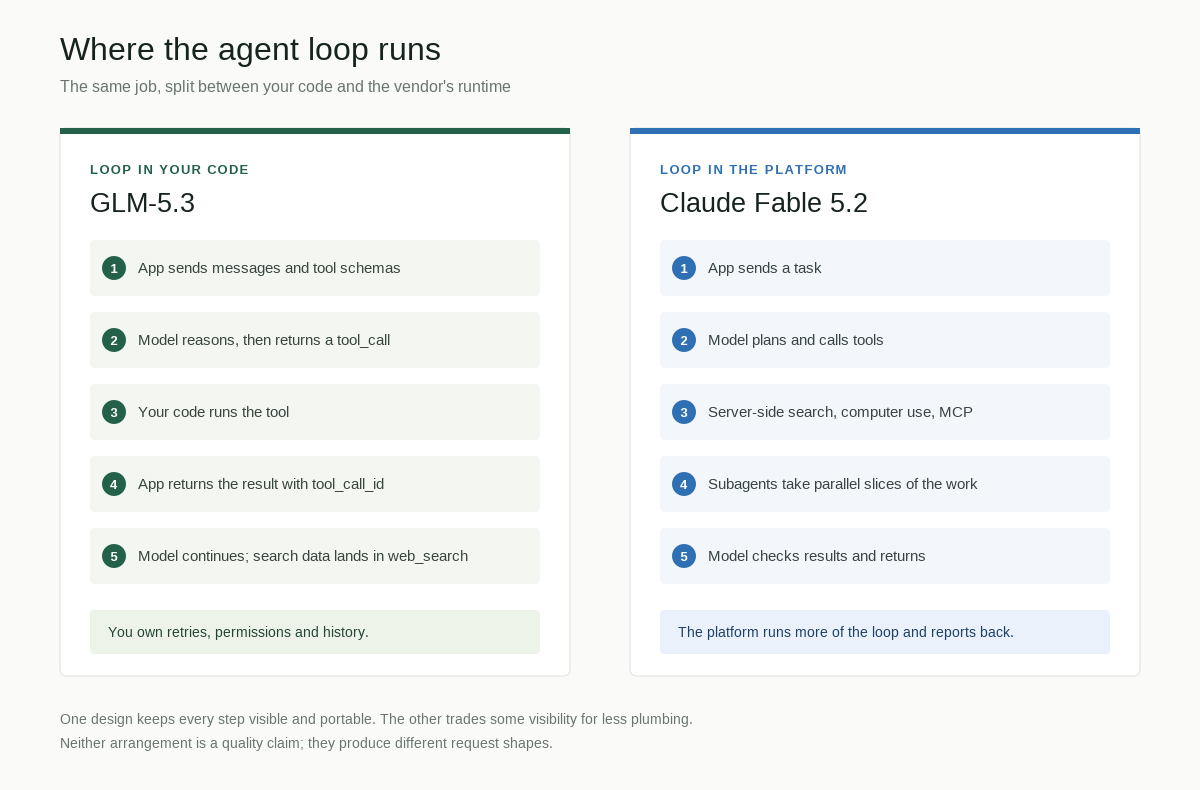
GLM-5.3 follows the OpenAI function-calling shape. Tools are declared in the request with a JSON schema. tool_choice currently lists auto. Every tool result must carry the matching tool_call_id after the assistant message that requested it. tool_stream returns tool arguments incrementally, and a response carries a web_search field when a search tool returns results. The GLM Coding Plan adds MCP tools for web search, page reading and repository lookup.
In this arrangement, your code executes the tool and decides what the model sees next. Permissions, retries and history trimming stay in the application. The trade is a clear trace: every call, result and reasoning step is visible, and the same request can run through an OpenAI or Anthropic-compatible client.
Fable 5.2 sits a layer higher. Anthropic's platform supplies server-side web search with citations, a computer-use tool, and an MCP connector. The launch material reports 89.3% on OSWorld 2.1 for computer use and 82.1% on WANDR for agentic search. It also describes orchestrations with more than 1,000 subagents and 170 reviewers checking the output.
That arrangement removes plumbing. It also moves scheduling into Anthropic's runtime. Your application starts a task and reads a result more often than it walks a turn-by-turn loop.
The benchmarks that overlap
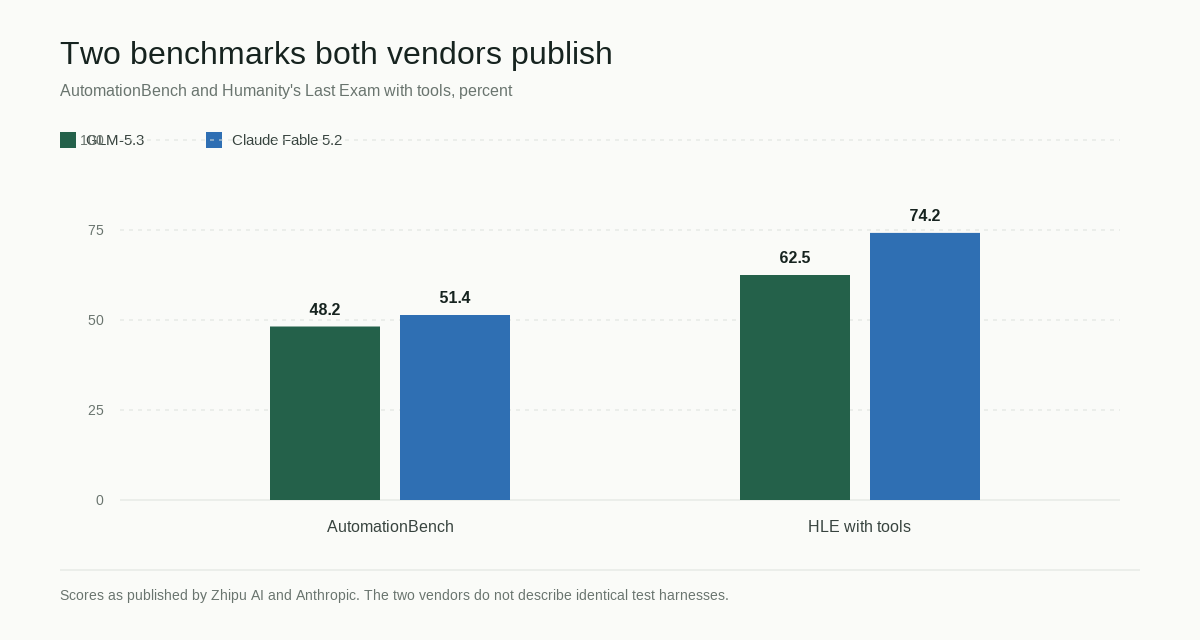
The two vendors publish different suites. AutomationBench and Humanity's Last Exam with tools are the two rows that appear on both sides. Fable 5.2 leads both: 51.4 against 48.2 on AutomationBench, and 74.2 against 62.5 on HLE with tools.
Each model also reports numbers the other does not. GLM-5.3 posts 28.3 on Terminal-Bench 3.0, 66.9 on DeepSWE v1.1, 78.1 on FrontierSWE, 84.5 on CyberGym, 54.4 on ExploitBench, 73.0 on Toolathlon and 28.5 on Agents' Last Exam. Fable 5.2 posts 49.1 on FrontierCode 2.0 at Xhigh effort, 69.9 on FrontierSWE v2, 74.6 on Terminal-Bench-Science 0.1, 41.3 on the Remote Labor Index, 66.1 on AA-Briefcase and 73.4 on Chartography without tools.
The two FrontierSWE rows are different versions, so they do not belong in the same column. The same caution applies to the terminal benchmarks: Terminal-Bench 3.0 and Terminal-Bench-Science 0.1 test different task sets. Two shared tests show a direction. They do not rank the models across every workload.
Which workload each design suits
GLM-5.3 fits work that stays inside one text thread and one codebase. Repository-scale review, long document analysis, batch extraction with do_sample: false for repeatable output, and migration from an existing OpenAI or Anthropic client all play to its shape. The implicit cache rewards a stable prefix, and the 1M window removes some retrieval layers. The limits are equally clear: text is the only input, thinking is always charged, and the application owns the tool loop.
Fable 5.2 fits work that can be split, delegated and checked. Ambiguous multi-day tasks, parallel subagents, computer use, security and science workflows, and financial or 3D analysis are the intended uses. Teams already on the Claude Platform, AWS, Google Cloud or Microsoft Foundry have the shortest setup path. Cache reads are cheap for repeated context, and the platform handles more of the scheduling.
Neither model is a general upgrade over the other. One sells a long, inspectable thread at a low unit price. The other sells a managed runtime with coordination built in.