
GLM-5.3 Uses Fewer Output Tokens For Higher Coding Accuracy
Published · 5 min read
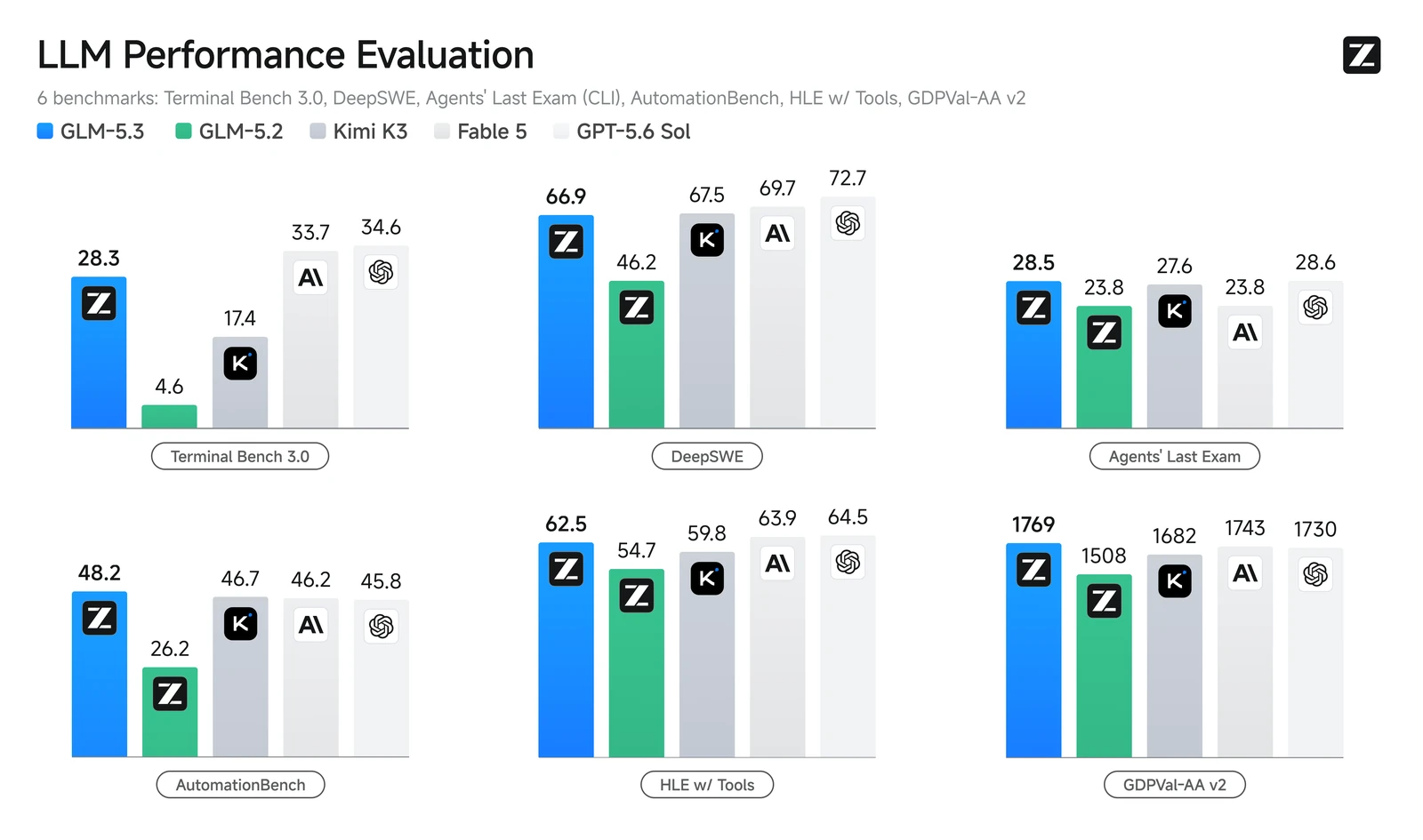
GLM-5.3 uses the same base model as GLM-5.2, and Z.ai says every gain comes from post-training. Terminal-Bench 3.0 moves from 4.6 to 28.3, DeepSWE v1.1 from 46.2 to 66.9, and Agents' Last Exam from 23.8 to 28.5. The same training lifted vulnerability discovery to 84.5% on CyberGym. The API takes 1M tokens of context, returns up to 128K tokens, and runs thinking at low, high or max with no off switch. The weights are due two weeks after launch.
In this article
Post-training, not a bigger base
Z.ai is unusually direct about what changed. GLM-5.3 sits on the GLM-5.2 base model, and the company says the whole improvement comes from post-training. The past month went into task environments: more of them, more varied, and more compute spent training inside them.
That matters if you are deciding whether to switch. This is not a new architecture with a fresh set of failure modes. It is the same checkpoint lineage pushed harder on long jobs. Z.ai calls it the most capable open-weights model for coding, with a 50% gain over GLM-5.2 on Z.ai Code Bench, an internal benchmark built around realistic developer tasks.
The open-weights label needs a date attached. The weights are not available at launch. Z.ai says it will publish them two weeks later, after safety evaluation and hardening. Until then, access is through the API, and the model card is a promise rather than a download.
Three benchmarks, one direction
The three public comparisons are easy to read, and they all move the same way.
| Benchmark | GLM-5.2 | GLM-5.3 | Change |
|---|---|---|---|
| Terminal-Bench 3.0 | 4.6 | 28.3 | +23.7 |
| DeepSWE v1.1 | 46.2 | 66.9 | +20.7 |
| Agents' Last Exam | 23.8 | 28.5 | +4.7 |
Terminal-Bench 3.0 is the largest jump, which is also the least surprising one. The benchmark drops an agent into a terminal with a real task and scores the artifact it leaves behind. The 4.6 starting point shows how hard that was for the previous model; the 28.3 is roughly a six-fold improvement on a test that measures completed work rather than a single answer.
Two caveats sit next to those numbers. Z.ai ran the evaluations with the Claude Code harness at max reasoning effort, and the Agents' Last Exam run used a 1M-token context window. Those are generous settings. They show what the model does when it has room, not what a small-context deployment will see.
Fewer output tokens for the same task
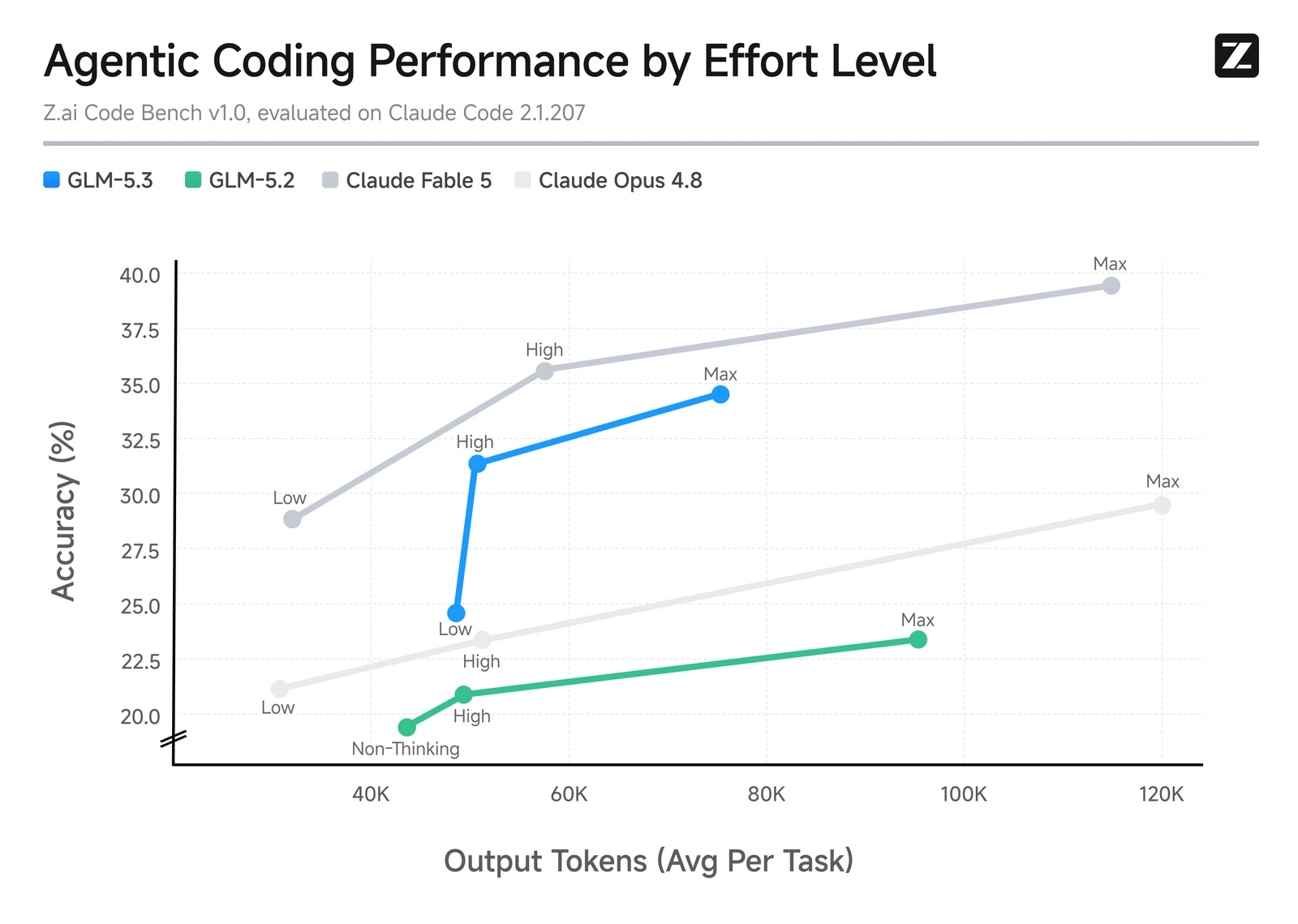
Raw accuracy is only half of the cost story. Z.ai's internal Code Bench also tracks output tokens per task, and the chart shows the newer model reaching higher accuracy with fewer of them. At max effort, GLM-5.3 reaches 34.5% at roughly 75K output tokens per task. GLM-5.2 reaches 23.4% at 96K. At high effort, GLM-5.3 reaches 31.4% at around 50K tokens, which edges past Claude Opus 4.8 at 29.5% and 120K.
Claude Fable 5 still leads at max effort with 39.5%, so this is not a clean win over everything. The useful claim is narrower: GLM-5.3 gets closer to the frontier while spending less output per task. Because reasoning tokens are billed as output on most providers, that difference adds up over a long agent run.
It is a private benchmark, which cuts two ways. Contamination from public test sets is less likely, and outside teams cannot inspect the tasks. Treat the shape of the curve as the signal and the exact percentages as Z.ai's own.
For a two-run cost test on the same effort curve, see the hands-on API test.
Security came along for the ride
Z.ai added vulnerability discovery data and environments to the post-training mix. What surprised the team was how fast the capability kept growing as training scaled. The model did not stop at spotting isolated bugs. It began planning across the stages of an exploit chain.
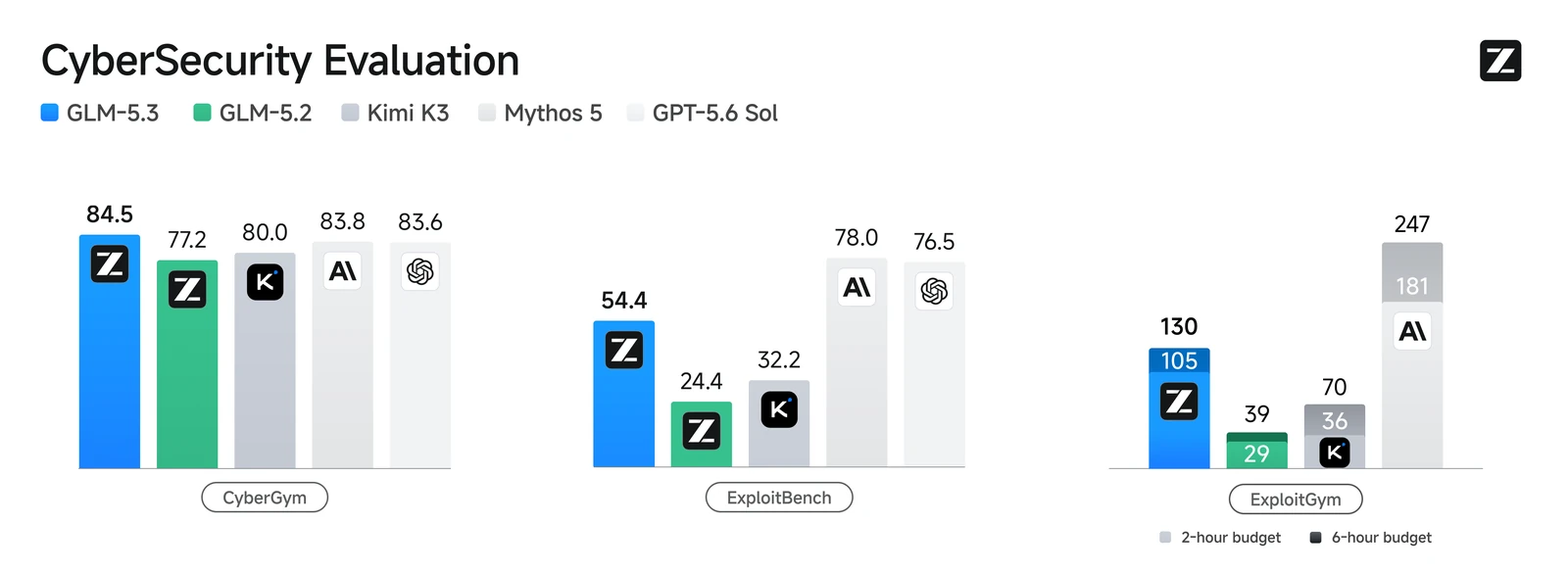
On CyberGym, which starts from source code and asks the model to find and confirm bugs by triggering them, GLM-5.3 scores 84.5%, up from 77.2% and ahead of Mythos 5 at 83.8% and GPT-5.6 Sol at 83.6%. On ExploitBench, which needs deeper reasoning about real vulnerabilities, it reaches 54.4%, more than double its predecessor's 24.4%. Mythos 5 at 78.0% and GPT-5.6 Sol at 76.5% remain well ahead. On ExploitGym it completes 105 tasks within a two-hour budget and 130 within six hours, against 29 and 39 for GLM-5.2. Mythos 5 completes 181 and 247.
The pattern holds across all three. The further up the exploitation chain a test sits, the larger the gain over GLM-5.2, and the wider the remaining gap to closed models. Z.ai says capability is growing fastest in the place where it is furthest behind.
The real-world figure is the one to remember. Working with security teams in China, and after expert review and deduplication, the model identified 2,436 vulnerabilities across 269 projects, including 1,097 medium-to-high severity issues. The oldest dated back roughly four decades. Findings are tracked in a public disclosure ledger that records the project, the severity, a CVE where one exists, and how long the flaw stayed in the code.
Thinking is no longer optional
Thinking is now a fixed part of every request. GLM-5.3 accepts low, high and max effort, defaults to max, and rejects thinking.type: "disabled". The migration note is worth reading before changing a model ID: set the type to enabled and drop the effort to low first, or the request fails. For coding work, Z.ai recommends max.
Everything else in the contract fits the long-job story. Z.ai lists a 1M-token context window and a 128K output ceiling, and the endpoint keeps the OpenAI-style chat shape, so an existing client usually needs a base URL and a model ID rather than a rewrite. Input is text only. Screenshot-driven work is out.
One practical detail: with thinking always on, the output ceiling has to cover the reasoning and the answer. A tight max_tokens can produce an empty response with a finish_reason of length. Leave headroom.
The part nobody wants to pay for
Open weights sound like the cheap route until the hardware bill arrives. A model in this class needs multiple GPUs, enough memory for a long context, and a serving stack someone has to keep alive. For a solo developer or a small team testing an idea, that is a large fixed cost before the first request.
Going direct to the native API adds its own friction. Developers outside China deal with a separate account, a separate billing setup, and a client configuration that has to be repeated for every provider in the stack. None of it is hard. It is just work that does not ship anything.
A gateway removes that layer. SiAPI.ai exposes GLM-5.3 behind one key and one OpenAI- or Anthropic-compatible endpoint, with the model listed on a recurring plan. Quota for the billing period sits in the console, so you can measure what a long agent run consumes before moving to a larger plan. It is a lighter way to test the fit than renting GPUs or wiring a second provider account.
The full model is available on a recurring plan. Create a key in the console, check the token quota, and point an existing OpenAI- or Anthropic-compatible client at the endpoint. The model page also links the setup walkthroughs for common coding agents: GLM-5.3 plan details.