
GLM-5.3 Flash Caches a Million Tokens for 3 Cents. On Qwen3.8 Flash, That Prefix Bills at Full Price.
Published · 5 min read
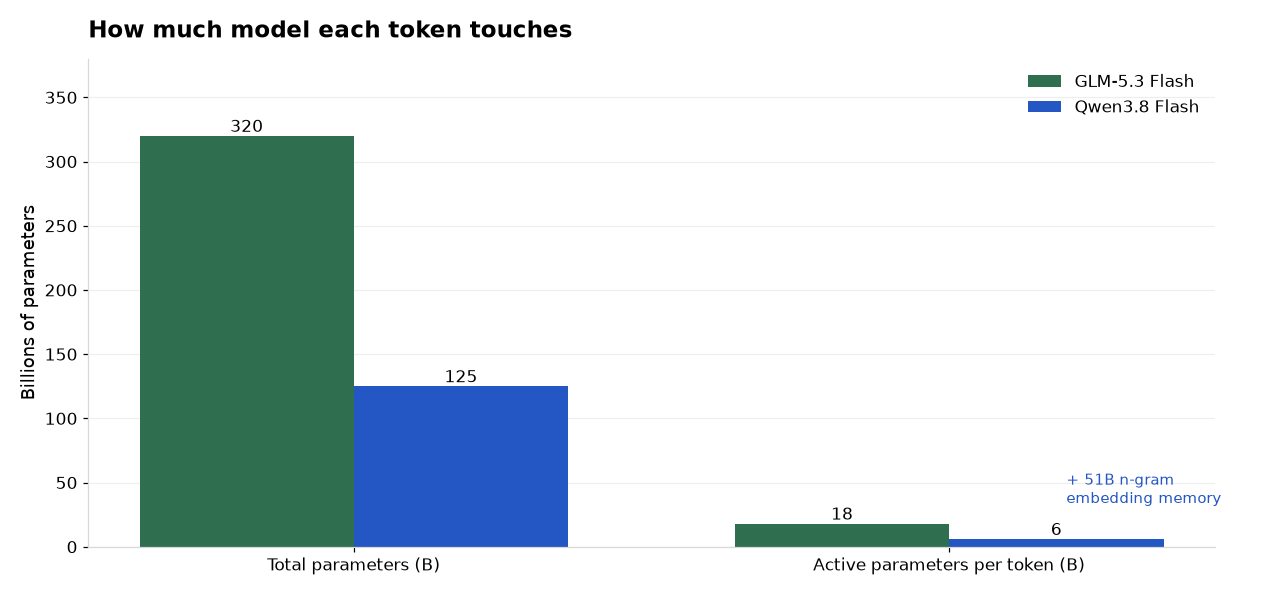
GLM-5.3 Flash activates 18B of its 320B parameters per token; Qwen3.8 Flash activates 6B of 125B and adds a 51B n-gram embedding memory. On the only four benchmarks both vendors published, GLM leads all four, and rows that appear on just one table do not compare. The sharper difference is billing: Together AI lists GLM's cached input at $0.03 per million tokens and lists no cached rate for Qwen.
In this article

Two sparse machines, one price tag
GLM-5.3 Flash is a 320B-parameter mixture-of-experts model that activates 18B of them per token. Z.ai built it on a hybrid of linear and sparse attention with a native vision encoder in front, and reports 3.0x less attention compute and 4.4x less KV cache than the full GLM-5.3. That is where the price comes from: one tenth of GLM-5.3, cut in half again during the launch discount.
Qwen3.8 Flash goes sparser. Of its 125B parameters, 6B activate per token, and a separate 51B n-gram embedding memory sits beside the weights. Three of every four layers compress the history into a fixed-size state with Gated DeltaNet. The fourth reads the whole sequence through Qwen Sparse Attention. Training ran at a native 262K context, and the served window is 1M tokens.
The input menus overlap almost exactly. Both take images, video, and text, and GLM adds files. Both answer in text. Both hold a 1M-token window, with maximum outputs of 128K on GLM and 131K on Qwen. On Together AI, which hosts both models, input costs $0.15 per million tokens either way.
The four benchmarks they share
Vendor benchmark tables agree on four tests. Together AI publishes both tables on its model pages, and the four shared rows are the only direct overlap between them.
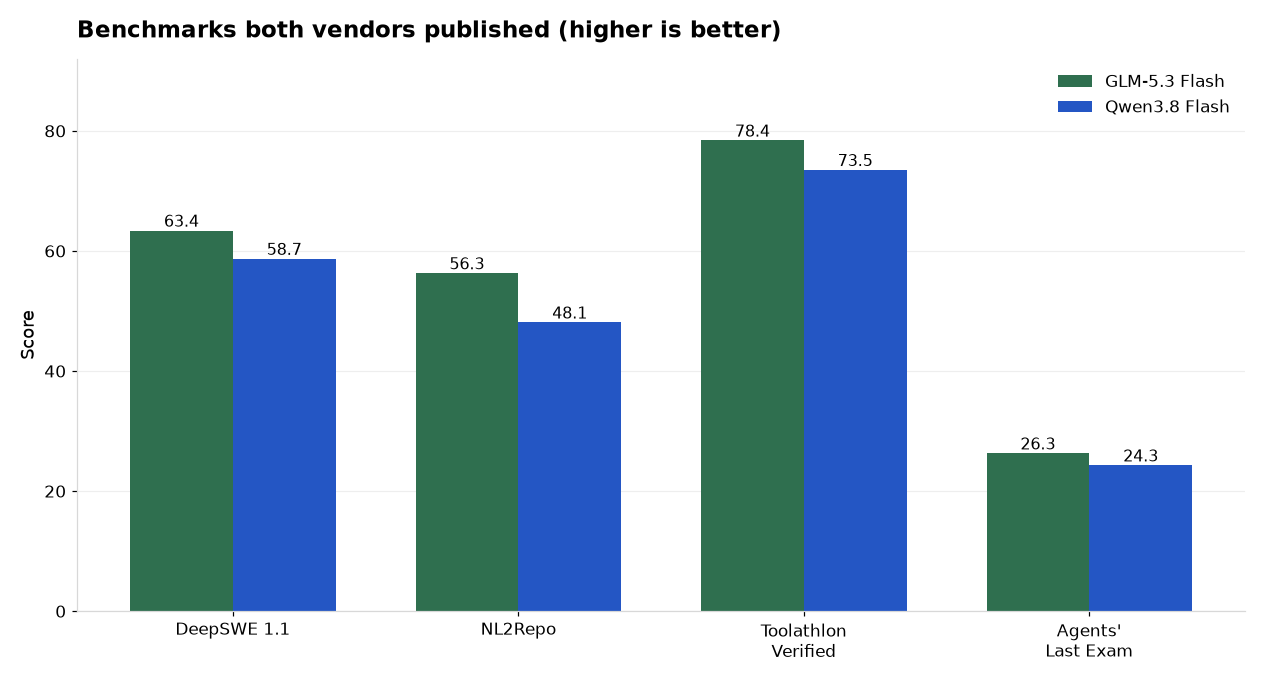
The margins run from 2 points on Agents' Last Exam to 8.2 on NL2Repo, a repository-generation task. Toolathlon Verified, which checks whether a model can drive real tools end to end, shows the same order at 78.4 against 73.5.
Outside the shared set, each vendor highlights different strengths, and those numbers are not head-to-head. Each table carries rows the other model never ran, so a score on one page can have no counterpart on the other. Qwen's table leads with GPQA Diamond at 91.7, LiveCodeBench v6 at 91.9, and MathVision at 90.6. GLM's table leads with Terminal-Bench 2.1 at 84.3, MMVU at 80.5, and Humanity's Last Exam with tools at 55.3. Read those as each model's home turf rather than a ranking between the two.
One caveat covers the whole section. These are vendor-reported runs, and the harness details behind each score are not published side by side. Treat the gaps as direction, not as a measured delta.
The bill
The sticker prices are nearly identical, and the difference hides in the third row.
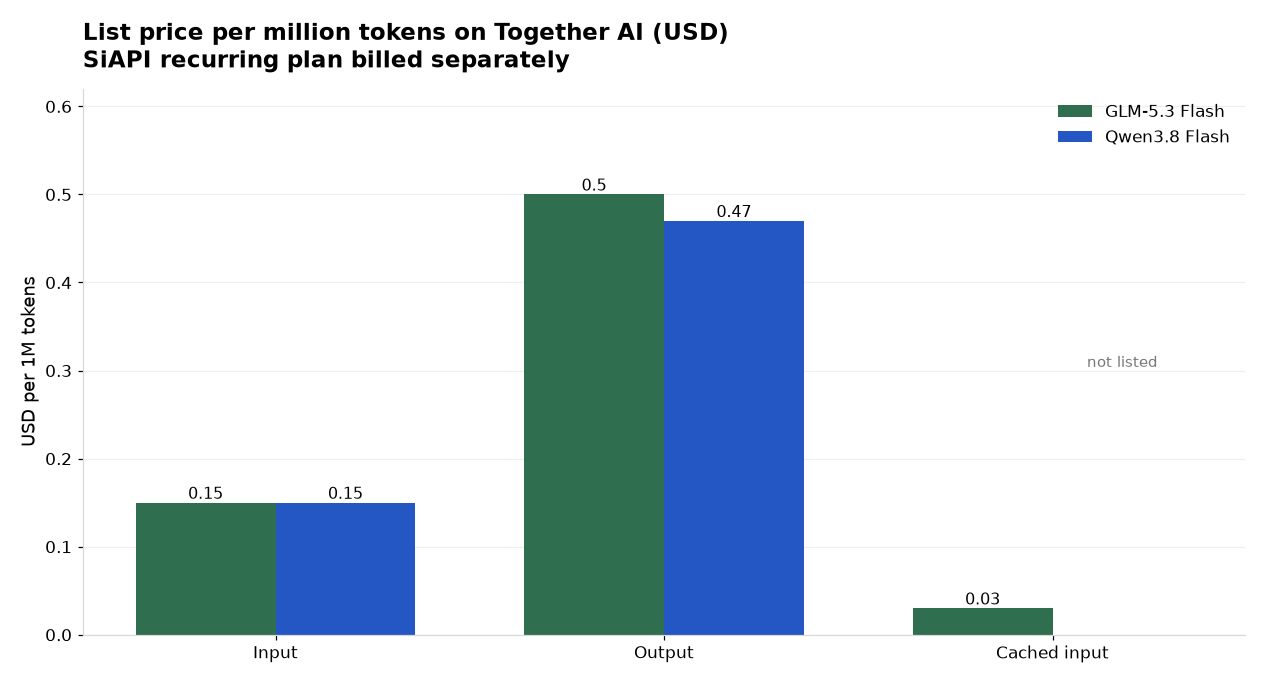
Output tokens cost $0.50 per million on GLM and $0.47 on Qwen, a 6% gap that only shows up at volume. The real asymmetry is caching. Together AI lists GLM's cached input at $0.03 per million, one fifth of the fresh-input price, and lists no cached rate for Qwen. An agent that resends the same long prefix on every turn pays the cached rate on GLM and the full rate on Qwen.
Two price sheets sit behind those numbers, and they should not be blended. The 3 cents is Together AI's list price for hosted inference. Z.ai quotes its direct rate as a fraction of GLM-5.3 instead: one tenth normally, one twentieth inside the launch window. SiAPI.ai sells GLM-5.3 Flash on a recurring plan, which is a third sheet again, and the per-token figures in this section do not apply to it.
A workload that mostly re-reads its own context is the case where the flash tier stops being a compromise. The cached rate is what turns a long prefix from a cost that repeats every turn into a fixed overhead.
Where each one fits
GLM-5.3 Flash suits work that starts as pixels or files and ends as text: document intake, screen and video understanding, long agent sessions where a stable prefix gets cached and reused. Its tool-loop scores and its cached-input rate both point at that shape of traffic.
Qwen3.8 Flash suits work that is heavy on reasoning per token: math and science questions, multilingual code repair, chart and diagram reading. The 6B active path keeps the per-token cost down while the embedding memory carries recall.
| Workload | Better fit | Why |
|---|---|---|
| Image, video, or file intake into text | GLM-5.3 Flash | Native vision encoder plus file input. |
| Long agent sessions with a stable prefix | GLM-5.3 Flash | Cached input at $0.03 per million tokens on Together AI. |
| Tool-driven automation | GLM-5.3 Flash | Higher Toolathlon Verified and Terminal-Bench 2.1 scores. |
| Math and science reasoning | Qwen3.8 Flash | GPQA Diamond 91.7 and MathVision 90.6 on its own table. |
| Multilingual code work | Qwen3.8 Flash | SWE-bench Multilingual 81.0. |
| High-volume output at the lowest rate | Qwen3.8 Flash | $0.47 per million output tokens. |
Neither model is cheaper in every column, and neither wins every benchmark. The four shared tests and the cached-input rate are the two places where the choice actually moves money. Start there, then measure on your own traffic before committing a product to either one.
GLM-5.3 Flash sits on our recurring plan with the other models in the catalog. One key covers it, and the model page lists the current price and limits.
Current terms are on the GLM-5.3 Flash plan page.