
The Input Price Matches to the Cent. GLM-5.3-Flash and MiniMax M3.1 Flash Split on Output and Cache.
Published · 5 min read
Both models take a 1M-token window and both keep thinking switched on. GLM-5.3-Flash puts its budget into long multimodal input and a declared 128K output ceiling, and it documents the tool contract field by field. MiniMax M3.1 Flash puts its budget into speed: 170+ tokens per second at the median, five thinking depths, and a price built around agent tasks. One design protects long turns. The other protects short ones.
In this article
GLM-5.3-Flash is the cheaper member of Zhipu's GLM-5.3 family. It keeps the million-token window and reads video, images, text and files; the reply is text. MiniMax M3.1 Flash shipped on 19 October 2026 as the fast tier of the M3 family, aimed at agent work, coding, computer use and security tasks.
The spec sheets land close together. The differences show up in how each model spends its budget.
One window, two ceilings
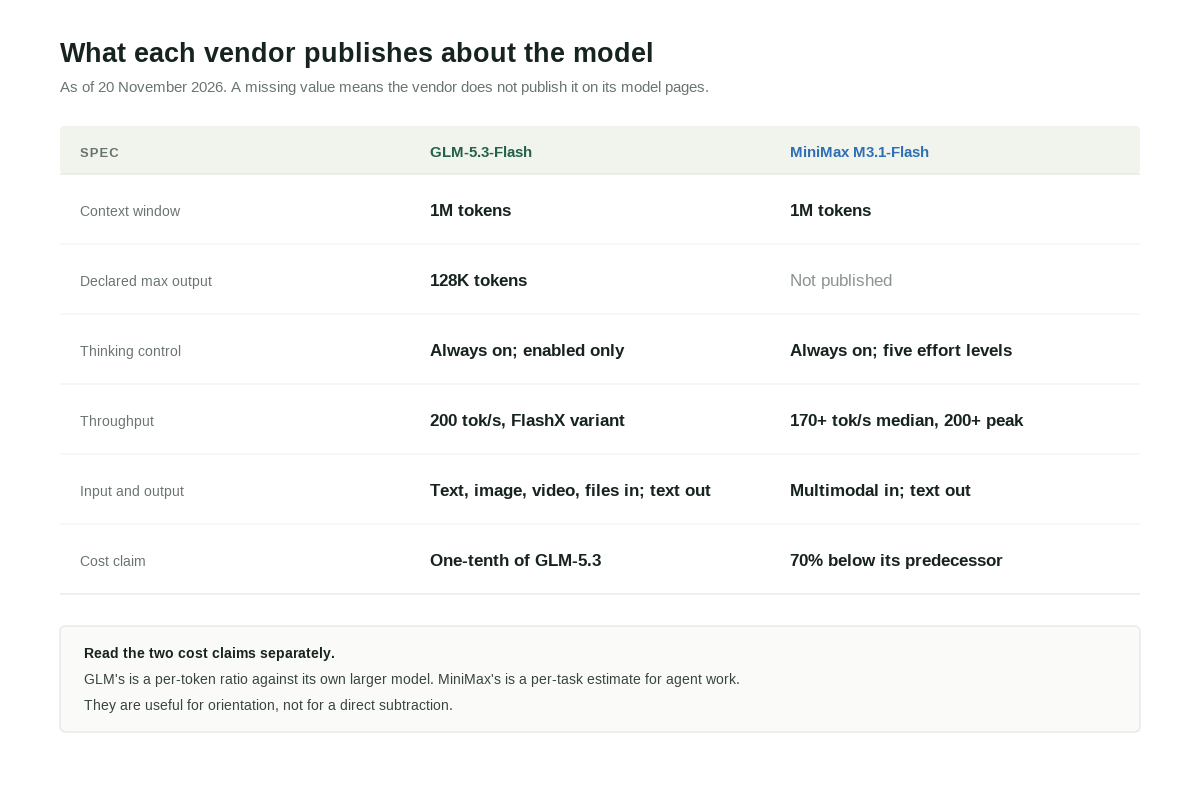
Both models accept 1M tokens of context. Zhipu also publishes a 128K maximum output. MiniMax does not list an output ceiling on its model pages.
That gap matters when the work produces long artifacts. A 128K ceiling covers a large refactor, a full document draft or a long structured extraction in one turn. When a ceiling is not published, you find the limit by hitting it.
The architecture explains part of GLM's choice. GLM-5.3-Flash runs 320B total parameters with 18B active, on a hybrid sparse and linear attention stack. Zhipu says that cuts attention computation by 3.01x and KV-cache size by 4.44x against GLM-5.3. A million-token window gets cheaper to serve when the cache shrinks.
MiniMax does not publish parameter counts for M3.1 Flash. Its announcement leads with throughput instead: 200+ tokens per second at peak, 170+ at the median, and a claim of roughly three times faster inference than the previous model.
Thinking stays on. Only one model gives you a dial
Neither model lets you disable reasoning. GLM-5.3-Flash accepts thinking.type: enabled and rejects a disabled request; Zhipu recommends reasoning_effort: max for the Flash tier. MiniMax is stricter about the switch and looser about the settings: a disabled request returns a 400 error, while effort runs from low through medium, high, xhigh to max, with max as the default.
The practical difference is the number of levers. On GLM-5.3-Flash you tune around a fixed thinking posture: the output ceiling, preserved reasoning through clear_thinking: false, and the cached prefix. On MiniMax you can trade depth per request, which suits a fleet of short calls where a low setting is enough.
Reasoning comes back separately from the visible answer. On the OpenAI-compatible path it is reasoning_content; MiniMax's Anthropic-compatible path returns a thinking block instead.
Tool use, documented from two directions
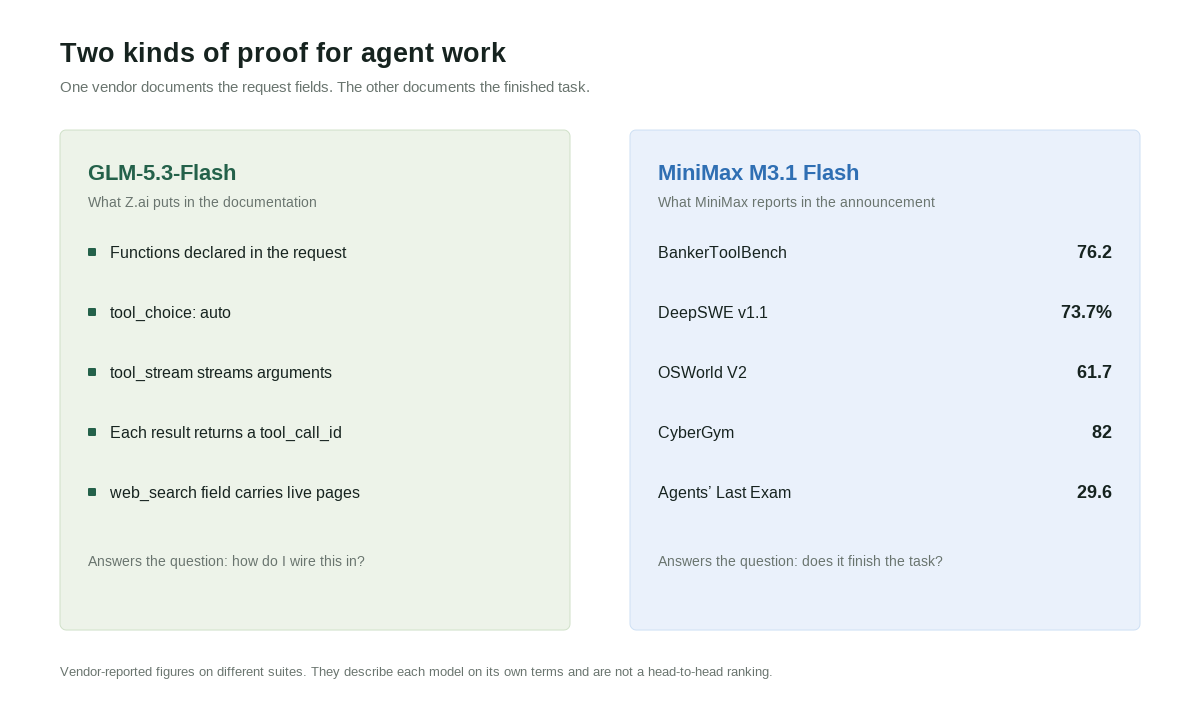
GLM-5.3-Flash uses OpenAI-style function calling. You declare functions in the request, tool_choice currently lists auto, tool_stream sends arguments as they arrive, and every result has to come back with the matching tool_call_id. When a search tool returns pages, the response carries a web_search field, so live results stay in the same loop. Zhipu also ships browser and computer-use agents in ZCode, which is where the model gets exercised on longer jobs.
MiniMax takes a different route to the same claim. Its announcement describes chained tool calls and computer use, then backs them with results: BankerToolBench 76.2, DeepSWE v1.1 73.7%, OSWorld V2 61.7, CyberGym 82, and 29.6 on Agents' Last Exam. The public model pages do not spell out a hosted search field or a tool schema, so integration details come from the API documentation and from testing.
For a builder, the trade is legible. Z.ai's documentation answers wiring questions quickly. MiniMax's numbers answer a different question: how often the model finishes a multi-step task without help.
The price shape
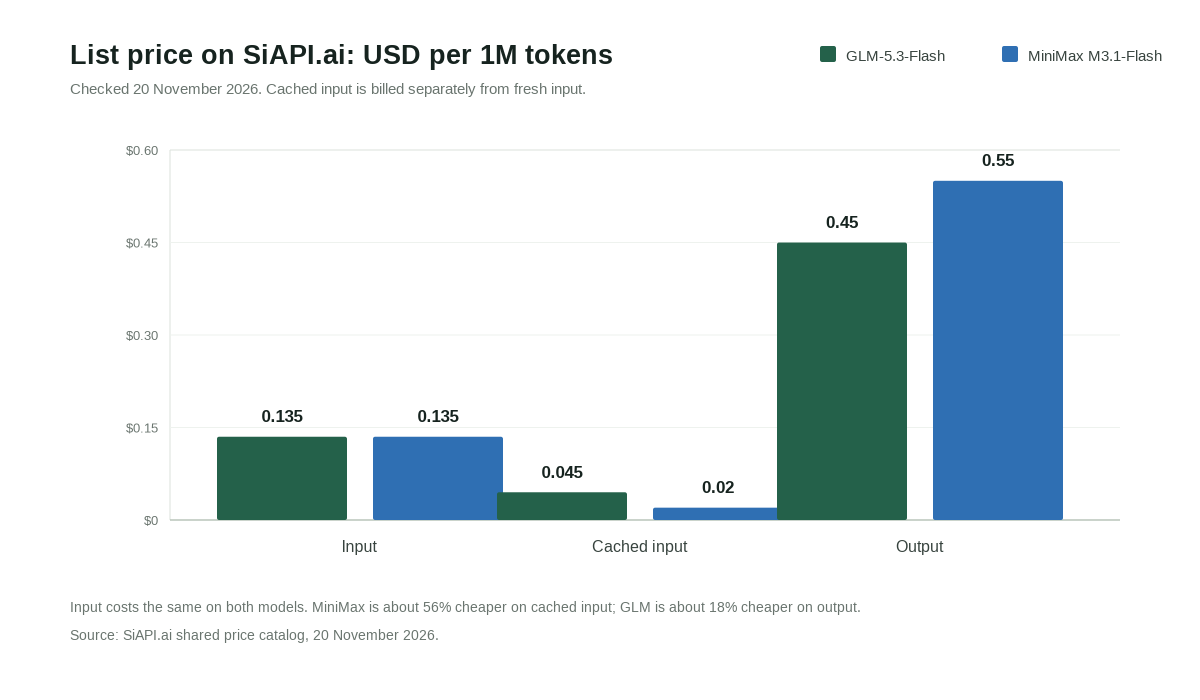
On SiAPI.ai the two models start at the same input rate. The difference sits in cache and output.
| Model | Input | Cached input | Output |
|---|---|---|---|
| GLM-5.3-Flash | $0.135 | $0.045 | $0.45 |
| MiniMax M3.1-Flash | $0.135 | $0.02 | $0.55 |
Vendors frame cost differently. Zhipu prices GLM-5.3-Flash at one-tenth of GLM-5.3, with a limited period at one-twentieth, and gives Coding Plan users three times the usage of GLM-5.3 with off-peak calls at 50% credits. MiniMax says agentic usage costs 70% less than its previous model.
Those claims use different units. One is a token ratio inside a family. The other is a task estimate for agent work. Read together, they imply opposite shapes: GLM is cheaper when cached input and output dominate, MiniMax is cheaper when many short cached turns dominate.
Where each design tends to fit
GLM-5.3-Flash suits workloads with long input and long output in the same call. Code review across a large repository. Video or image analysis followed by a written report. Extraction that has to stay inside one context window. A stable system prompt also earns its keep, because Zhipu's wider GLM-5.3 family bills repeated prefixes at a lower cached rate.
MiniMax M3.1 Flash suits agent loops that make many calls per task. Browser and OS automation, where wall-clock time is visible to the user. High-volume tool routing, where 170 tokens per second keeps queues short. Any pipeline that reasons in cost per finished task rather than cost per token.
Neither model is the general upgrade. The decision is about which budget you protect: a long turn, or many short ones.
If you want to compare them on your own traffic, the GLM-5.3-Flash model page lists current rates and the recurring plan option.