
Half a Cent Apart on Input Price. GLM-5.3-Flash and MiMo-V2.6-Flash Split on Solved Tasks and Small Talk.
Published · 6 min read
Two open-weights budget coding models, released four weeks apart, with spec sheets that nearly overlap: MoE around 300B total parameters, 1M-token context, MIT license, input near $0.14 per million tokens. Patronus AI ran both on the same 20 agentic coding tasks. GLM-5.3-Flash solved all 20 with 13.6% filler in its reasoning prose. MiMo-V2.6-Flash solved 17 with 21.4% filler, about the level of human-written bug reports.
In this article
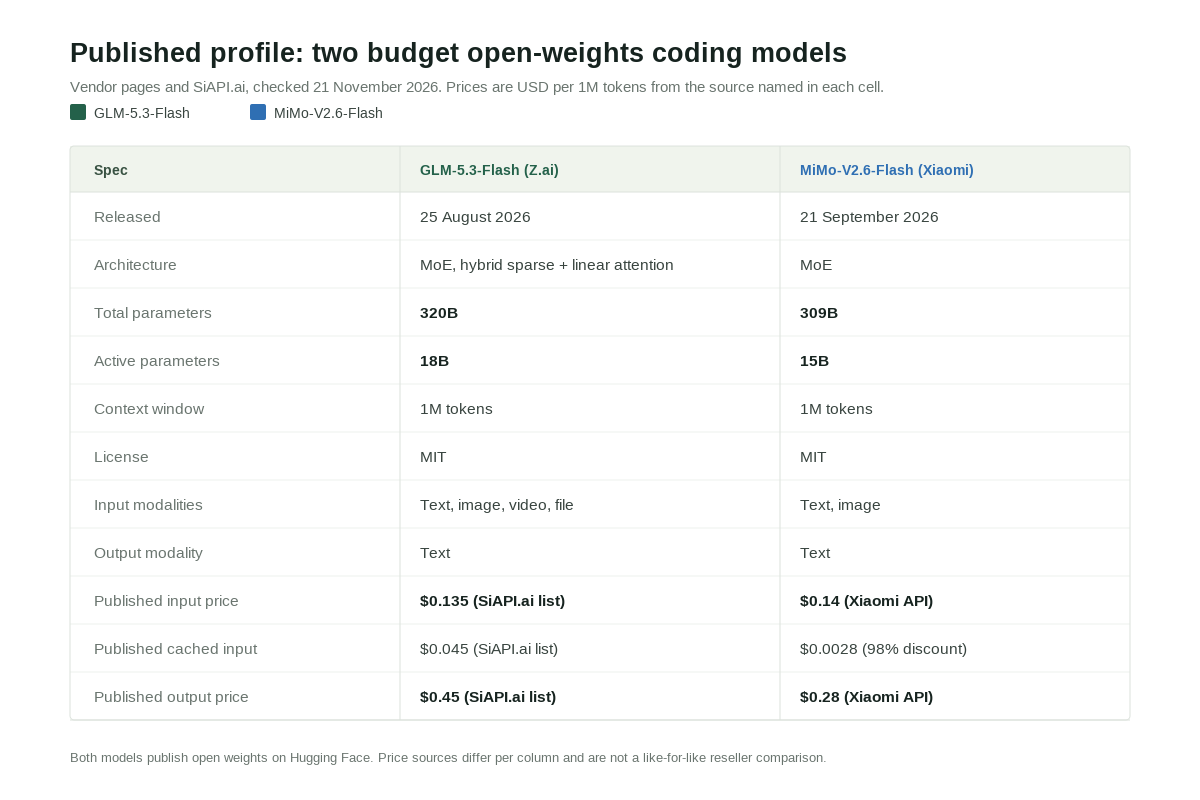
GLM-5.3-Flash and MiMo-V2.6-Flash aim at the same slot in the stack: the cheap, fast, open-weights model you put behind high-volume coding and agent work. Z.ai shipped GLM-5.3-Flash on 25 August 2026. Xiaomi followed with MiMo-V2.6-Flash on 21 September 2026. Both are mixture-of-experts designs in the 300-billion-total-parameter class with 15-18B active, both carry a 1M-token context window, both are MIT licensed, and both accept images alongside text.
On paper this is as close to a coin flip as two model releases get. The separating evidence comes from a single study that ran both models through the same tasks in the same harness.
One harness, 20 tasks, one unusual metric
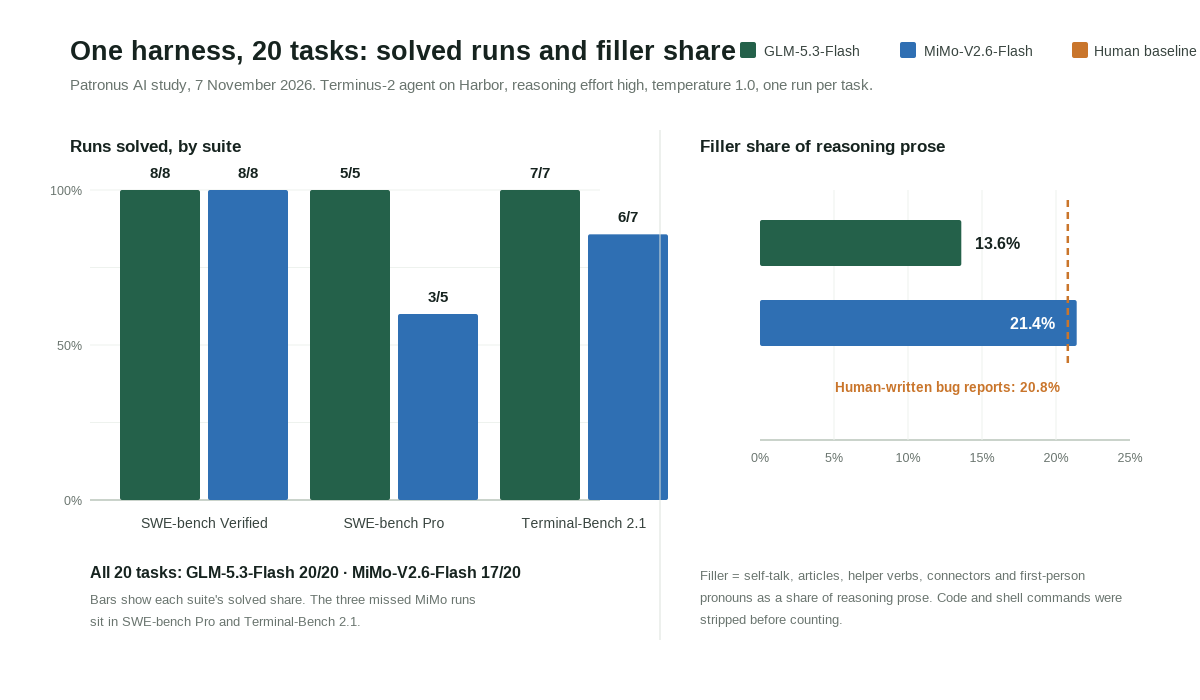
On 7 November 2026, Patronus AI published a study that ran twelve open models through 20 agentic coding tasks: eight from SWE-bench Verified, five from SWE-bench Pro, and seven from Terminal-Bench 2.1. Every model used the same setup, the Terminus-2 agent on Harbor with reasoning effort set to high, temperature 1.0 and a 262K-token context cap. Each model ran each task once.
Alongside the solved counts, the study measured something benchmarks normally ignore: how much of a model's reasoning prose is filler. The team counted five word classes, self-talk, articles, helper verbs, connectors and first-person pronouns, as a share of the reasoning text, after stripping code blocks and shell commands. This is not style policing. In a long agent loop, every padded token is billed, and prose habits are a window into how much a model pays to think.
Solved: 20 of 20 against 17 of 20
GLM-5.3-Flash swept the board. It solved all eight SWE-bench Verified tasks, all five SWE-bench Pro tasks and all seven Terminal-Bench tasks, for 20 of 20 runs.
MiMo-V2.6-Flash solved 17 of 20. It matched GLM on SWE-bench Verified with 8 of 8, then dropped two of five on SWE-bench Pro and one of seven on Terminal-Bench 2.1. All three misses sit in the two harder suites.
The filler gap is wider than the solved gap. GLM-5.3-Flash wrote reasoning prose that was 13.6% filler across the 20 tasks. MiMo-V2.6-Flash came in at 21.4%. The study includes a human reference point that makes the number concrete: bug reports in SWE-bench Verified, written by actual developers, run 20.8% filler. MiMo's reasoning prose reads about as chatty as human writing. GLM's is leaner than both.
Where the extra words live
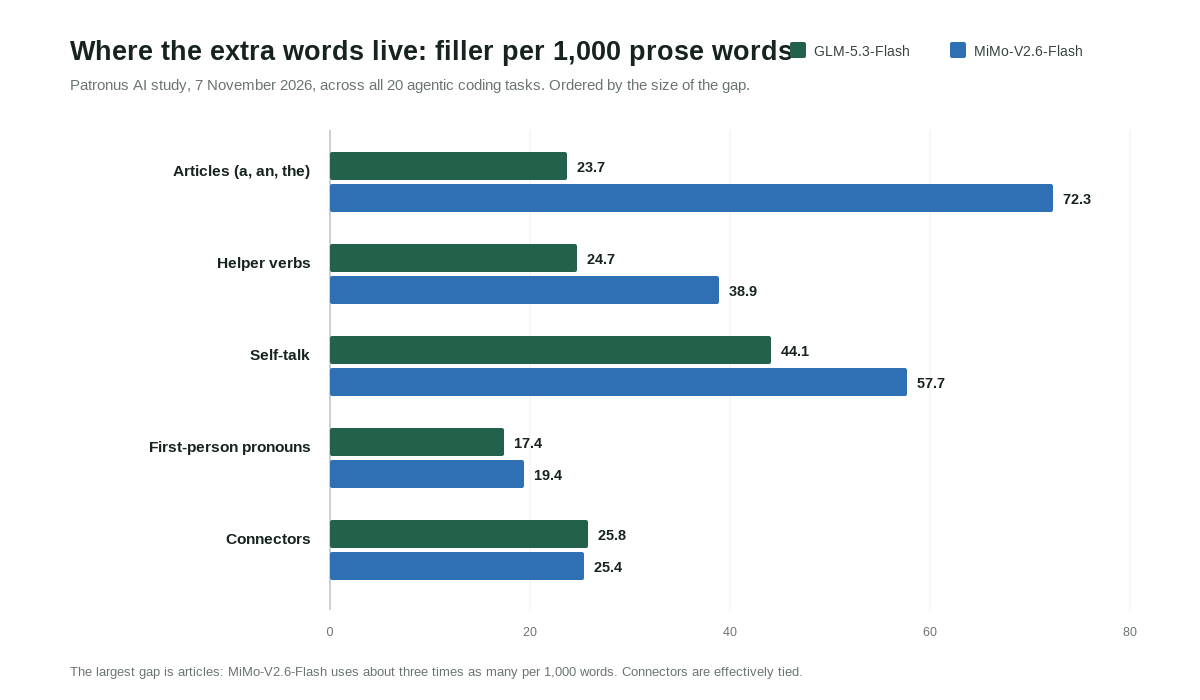
The per-kind breakdown shows the gap is not spread evenly. Per 1,000 words of reasoning prose, the two models came out like this:
- Articles (a, an, the): 23.7 for GLM against 72.3 for MiMo, roughly a 3x gap and the largest of any category.
- Helper verbs: 24.7 against 38.9.
- Self-talk: 44.1 against 57.7.
- First-person pronouns: 17.4 against 19.4.
- Connectors: 25.8 against 25.4, effectively tied.
Both models hedge at about the same rate. MiMo wraps the same work in more grammatical padding. Across the study's three model families, newer releases cut filler by a quarter to a half against their predecessors, and solved counts did not drop, so the padding was not buying performance.
One family also got cheaper while getting terser. GLM-5.3-Flash used a median of 3,075 reasoning tokens per task, 18% below the GLM-5.2 figure in the same harness, and a median of 7,809 output tokens per task, down 4%. The study does not publish per-task token medians for MiMo-V2.6-Flash, so no matching number exists for its reasoning spend.
The price picture
The published rates land in the same bracket, with the input price half a cent apart.
| Rate | GLM-5.3-Flash | MiMo-V2.6-Flash |
|---|---|---|
| Input | $0.135 | $0.14 |
| Cached input | $0.045 | $0.0028 |
| Output | $0.45 | $0.28 |
Token rates only turn into task cost once you know how many tokens a task burns. For GLM-5.3-Flash the study supplies those numbers: a median of 3,075 reasoning plus 7,809 output tokens per task. For MiMo-V2.6-Flash the token medians are not published, so any per-task cost comparison between the two would be a guess. What can be said from the table: MiMo's nominal output rate is lower, its cache discount is deeper, and GLM has the lower published reasoning-token median in this test.
How to read a single-run study
Three limits are worth naming. Each task ran once per model, so one flaky tool call can move a solved count. The 20 tasks sit at the accessible end of agentic coding; across the study's three families, newer models solved 60 of 60 runs against 58 of 60 for older releases. And filler share is a style-and-cost metric, not an intelligence score. The study's own conclusion is that terser wording did not reduce quality, and in one family it reduced cost.
No vendor-published benchmark scores appear in this article. Every number above comes from one harness, one settings block and one test window, which is more than most model-versus-model content can offer.
What each model suits
Both models are MIT licensed with public weights, so self-hosting is on the table for either, and both hold a 1M-token window for long repository context. On this test, GLM-5.3-Flash is the steadier pick for long agent loops where every reasoning token is billed: a clean sweep of solved runs, the lower filler share, and a published reasoning-token median below its own predecessor. MiMo-V2.6-Flash stays competitive, it matched GLM on SWE-bench Verified, and its lower published output rate suits short loops with heavy visible output. For hard multi-file tasks like the SWE-bench Pro and Terminal-Bench runs it missed, the evidence here favors starting with GLM.
Put GLM-5.3-Flash against your own workload. On SiAPI.ai it draws from shared Coding Plan points at 1 point per token, or runs pay-as-you-go under the same API key, with current rates and the recurring plan listed on the model page.