
The Same Batch Job Costs $20 on GLM-5.3-Flash and $450 on Gemini 4 Neon.
Published · 5 min read
GLM-5.3-Flash costs $0.15 per million input tokens and $0.50 per million output tokens. Gemini 4 Neon costs $3 and $15. Both take a 1M-token context. Neon leads nine of ten benchmarks in DataLearner's table and wins the coding rows by a wide margin. Flash wins the chart-reading row. The larger design difference is where tools run: Z.ai keeps the tool loop in your client, while Google runs search, Python and URL fetching inside the API.
In this article
These are both current models with a million-token window, but they are not built for the same buyer. Flash is the cheap member of Zhipu's GLM-5 line, priced to be called often. Neon is Google's newest Gemini 4 model, positioned just behind the larger, slower models in that family. The useful comparison is not which one is better. It is what each price buys, and what shape of request each API expects.
Two models, two price tiers
GLM-5.3-Flash shipped on 26 August 2026. DataLearner lists it at 320B total parameters, with a 1M-token context, 128K of output and image input. Z.ai prices it at roughly one tenth of GLM-5.3. The design goal shows in the rate card: a model strong enough for everyday work, cheap enough to run on every file, page or ticket.
Gemini 4 Neon shipped on 18 November 2026 as the fourth model in the Gemini 4 family. It has the same 1M-token context and takes text, image, audio and video input. Google places it just below its largest models rather than at the bottom of the range. It is a fast model in the premium tier, not a budget model.
One is tuned to make each call cost almost nothing. The other is tuned to do more per call. That difference runs through every number below.
Benchmarks: a wide lead, one row where Flash holds
DataLearner lists ten evaluations that both models have run. Neon leads nine of them.
| Benchmark | GLM-5.3-Flash | Gemini 4 Neon |
|---|---|---|
| Terminal-Bench 4.0 | 41.80 | 61.62 |
| Terminal-Bench 4.1 | 36.97 | 65.20 |
| FrontierCode 2.0 | 14.18 | 46.20 |
| SWE-sweep | 0.72 | 12.80 |
| Vibe Code Bench v1.1 | 30.76 | 93.70 |
| AA Intelligence Index v5.0.1 | 27.80 | 61.40 |
| Vals Index v2.2 | 50.86 | 70.87 |
| Tax Agent Bench | 31.55 | 54.89 |
| Legal Research Bench | 45.19 | 56.25 |
| Chartography | 78.00 | 73.50 |
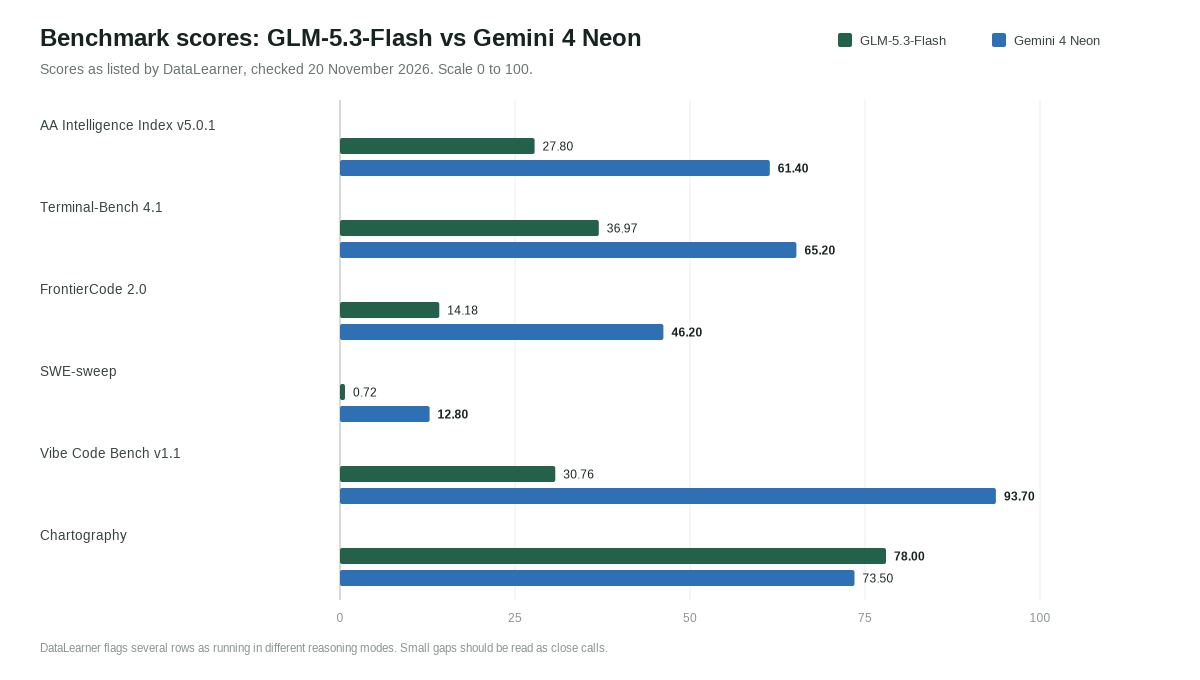
The largest gaps are on code and agent work. Vibe Code Bench v1.1 goes 93.70 to 30.76. FrontierCode 2.0 goes 46.20 to 14.18. The Artificial Analysis index, which folds several evaluations into one score, reads 61.40 against 27.80.
The picture changes on chart reading. Chartography is the one row Flash wins, 78.00 to 73.50. Legal Research Bench is the closest of the task rows, an 11-point gap rather than a 30-point one. A 320B model sold at a fraction of the price is not going to match a frontier model on long agentic coding. On reading a chart or a page, the distance is small enough that price decides.
DataLearner flags several rows as running in different reasoning modes, so small gaps are close calls and large ones are the real signal. Every score in this article comes from that single table, which keeps the two columns consistent.
What a request costs
Input costs 20 times more on Neon, output 30 times, and cached reads five times.
| Rate | GLM-5.3-Flash | Gemini 4 Neon |
|---|---|---|
| Input | $0.15 | $3.00 |
| Cached input | $0.03 | $0.15 |
| Output | $0.50 | $15.00 |
| Context window | 1M tokens | 1M tokens |
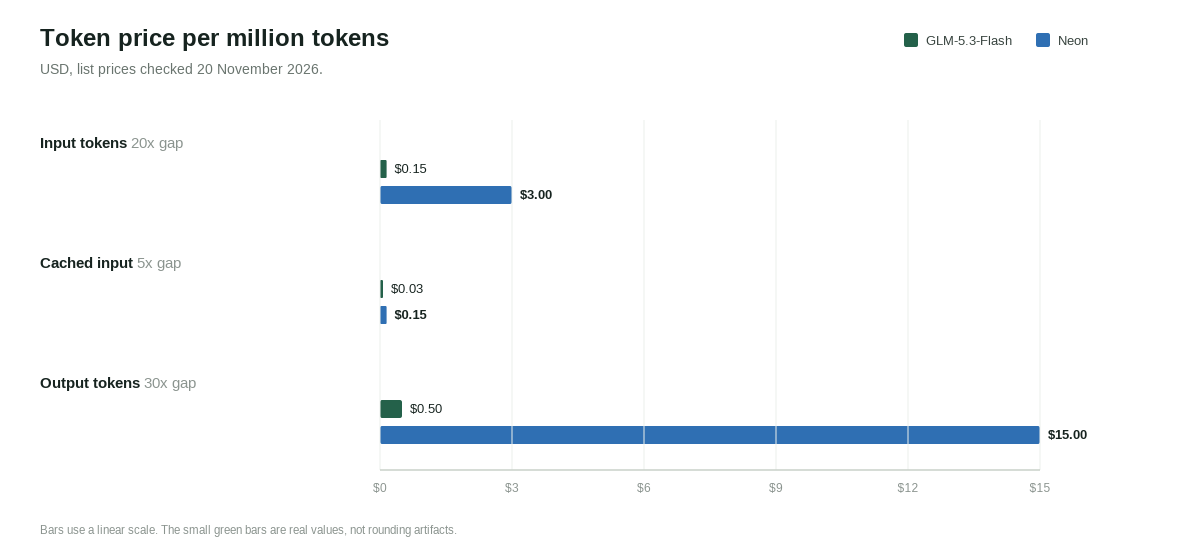
A batch job that reads 100 million input tokens and writes 10 million output tokens costs about $20 on Flash and about $450 on Neon. That ratio is the product difference. At $0.15 per million input tokens you can attach a full manual, a long transcript or a slice of a repository to every call and keep the bill small. At $3 you start choosing which context to send.
Price per token is not price per task. A model that needs fewer turns, or that produces a usable first draft, can close part of a 20x gap. The benchmark lead above is that effect in reverse. The honest split is by workload: many cheap calls favor Flash, a few hard calls favor Neon.
Where the tool loop runs
Both APIs let you define your own functions. The difference is what else runs on the provider's side, and who owns the loop between calls.
GLM-5.3-Flash: the loop is yours
GLM-5.3-Flash uses an OpenAI-compatible chat completions endpoint. You declare up to 128 functions, the model returns tool_calls, your code executes them, and you post the results back as tool messages with the matching call id. tool_choice accepts auto only, so the model decides when to call. tool_stream lets a UI render arguments as they arrive.
Thinking is always on. reasoning_effort takes low, high or max, with max as the default, and interleaved thinking lets the model reason between calls and after a result comes back. Sending clear_thinking:false keeps earlier reasoning in the context for the next turn; the standard endpoint clears it by default, while the coding endpoint keeps it. If you replay reasoning, it has to match what the model produced, character for character.
Z.ai also documents server-side tool types in the same request. web_search is billed at $0.01 per call and returns title, content and link for each result, which the model cites as [Source: ref_N]. retrieval queries a hosted knowledge base. One caveat: the GLM-5.3-Flash model page does not list web search among its capabilities, and the documentation's search example uses an older model, so test it before you depend on it. There is no hosted code interpreter.
Gemini 4 Neon: the tools are hosted
Neon supports the same client-side pattern through function declarations, but most of the useful tooling runs on Google's side. Google Search grounding is enabled in the request, and the response returns the search queries, the source list and supports that map text spans to sources with confidence scores. Code execution runs Python in a hosted sandbox with a fixed library set and no internet access. URL context fetches up to 20 URLs per request.
Two constraints matter before you design around it. Search tools cannot be combined with function calling in the same request, so a turn is either grounded retrieval or your own functions. And thought signatures have to be returned unmodified on the next turn, or the model loses the reasoning state behind its tool calls.
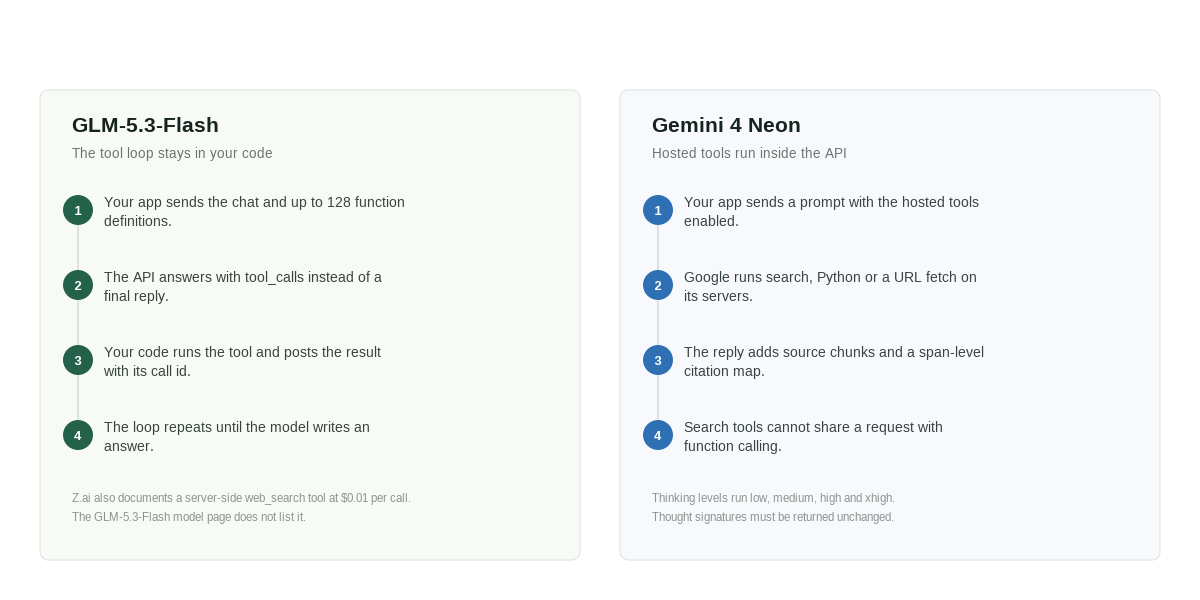
Z.ai sells a familiar loop plus optional search that you pay for per call. Google sells a runtime that returns a citation graph with the answer. The first is easier to drop into an existing client. The second does more work before the response reaches you.
Which workload leans which way
GLM-5.3-Flash fits work built from many small calls: extraction, classification, summarization, chart and screenshot reading, and long-context passes where you want a model opinion on every item. It also suits teams with an existing OpenAI-style client, since the migration is mostly a new base URL and key.
Gemini 4 Neon fits work built from fewer, harder calls: research answers that need current sources, data tasks that want Python in the same request, long agent sessions where the platform holds the loop, and coding tasks near the top of the benchmark table.
The two price ratios point in opposite directions, and that is the decision. Ten thousand small calls and one stubborn refactor are not the same purchase, and each model is priced for one of them.
GLM-5.3-Flash runs on SiAPI.ai's recurring model plan. One key covers it alongside the rest of your stack, so a high-volume pipeline stays on a single bill.