
One Flat Rate, or Half Price at Night: GLM-5.3 Flash vs DeepSeek V4.1 Flash.
Published · 6 min read
GLM-5.3 Flash activates 18B of 320B parameters and charges one flat rate. DeepSeek V4.1 Flash splits input at 8B and output at 16B, then halves the price off-peak. In Quesma's Baba Is You run, GLM solved 9 of 15 levels for $0.90; DeepSeek V4 Pro solved 13 for $8.48. The gap is a different stopping rule, not just a different price.
In this article
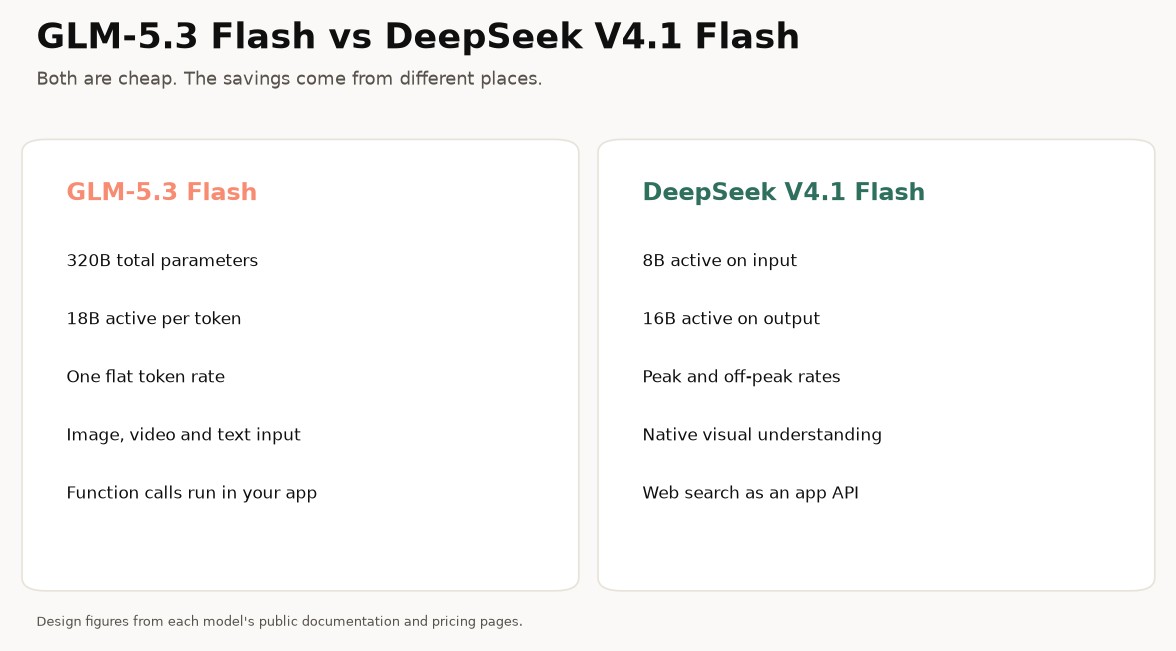
Two ways to cut the same bill
GLM-5.3 Flash keeps the frame of the larger GLM model and activates 18B of its 320B parameters per token. Z.ai prices it at one tenth of GLM-5.3, or one twentieth during the launch discount. Input covers images, video, text, and files. Output is text. Context runs to 1M tokens, and a single answer can reach 128K.
DeepSeek V4.1 Flash takes a different route. It splits the model into two active paths: 8B parameters for input and 16B for output. The release notes describe it as faster and cheaper than the models it replaces. DeepSeek has started routing V4-Pro requests to it while V4.1-Pro is pending. Pricing has a peak rate and an off-peak rate at half the peak.
The difference shows up in the invoice. GLM sells one rate for one model. DeepSeek sells a lighter input path, a heavier output path, and a cheaper hour of the day. A product that runs all day gets a predictable bill from the flat rate. A batch job that can wait gets its saving from the off-peak window.
The tool loop stays in your code
Both models expect the application to run the loop.
GLM-5.3 Flash documents function calling and streamed tool arguments through tool_stream. The same page does not describe a built-in browsing endpoint. Web results arrive through a tool you define, and your code executes it.
DeepSeek keeps its chat endpoint in an OpenAI-compatible format. Web search, file input, and URL reading are listed as separate application APIs, not as parameters inside the completion. Search is a service call next to the model, not an action the model takes on its own.
The practical result is similar: the caller owns retries, timeouts, and the cost of each lookup. The packaging differs. GLM puts the tool schema in the same request and streams the arguments back. DeepSeek keeps search in a separate service, which is easier to replace or meter on its own.
What one benchmark run shows
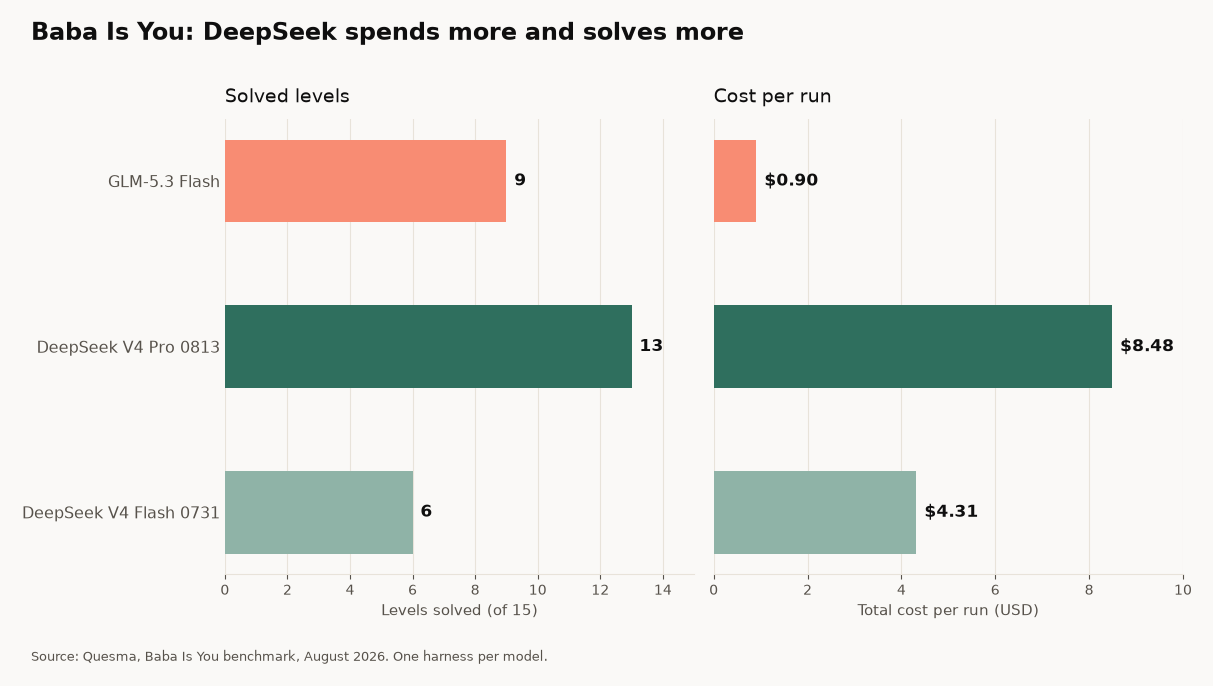
Quesma ran both models on Baba Is You, a puzzle game that forces an agent to plan, act, and revise. Stage 1 has 15 levels. GLM-5.3 Flash solved 9, spent $0.90, and wrote 8.6M output tokens. DeepSeek V4 Pro 0813 solved 13, spent $8.48, and wrote 75.6M. DeepSeek V4 Flash 0731 solved 6, spent $4.31, and wrote 92.8M.
Cost per solved level: GLM $0.10, DeepSeek V4 Pro $0.65, V4 Flash $0.72.
Stage 0, a shorter screening pass, points the same way. GLM-5.3 Flash reached a 67% pass rate in 11 turns for $0.32. The DeepSeek models reached 75% but needed 18 to 55 turns and $1.16 to $2.94.
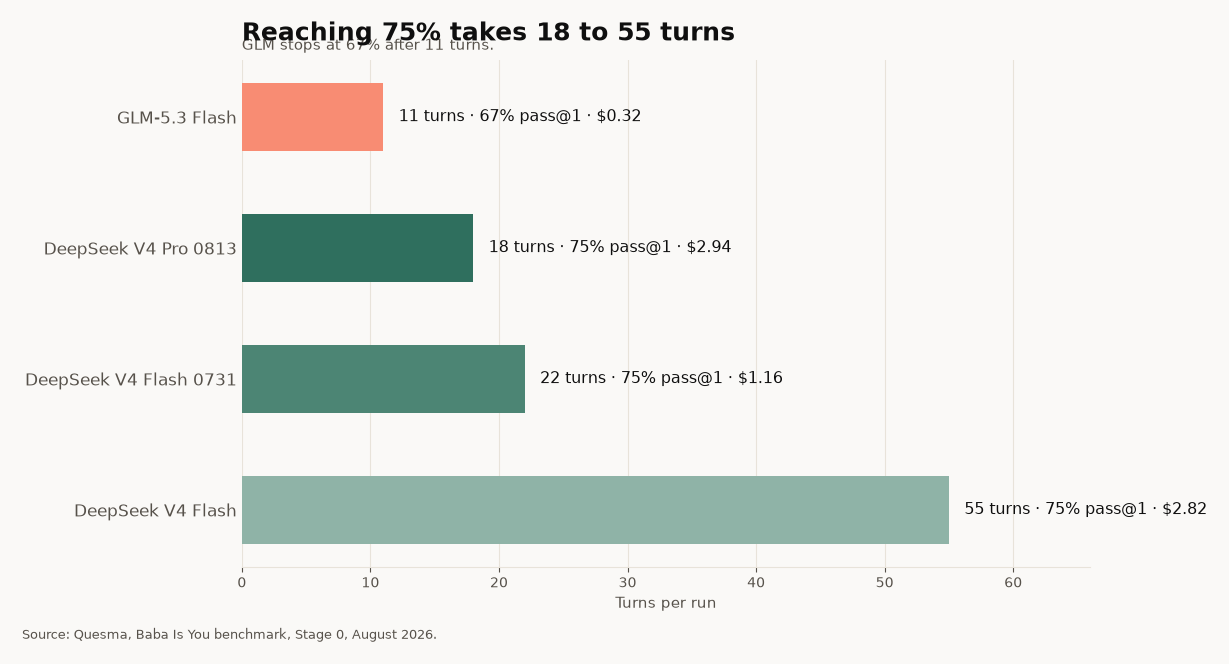
These numbers describe two stopping styles. GLM ends the run earlier: fewer turns, fewer tokens, a lower ceiling. DeepSeek keeps trying: more turns, a higher pass rate, a larger bill. Neither style is free. The extra attempts are paid in tokens or in wall-clock time.
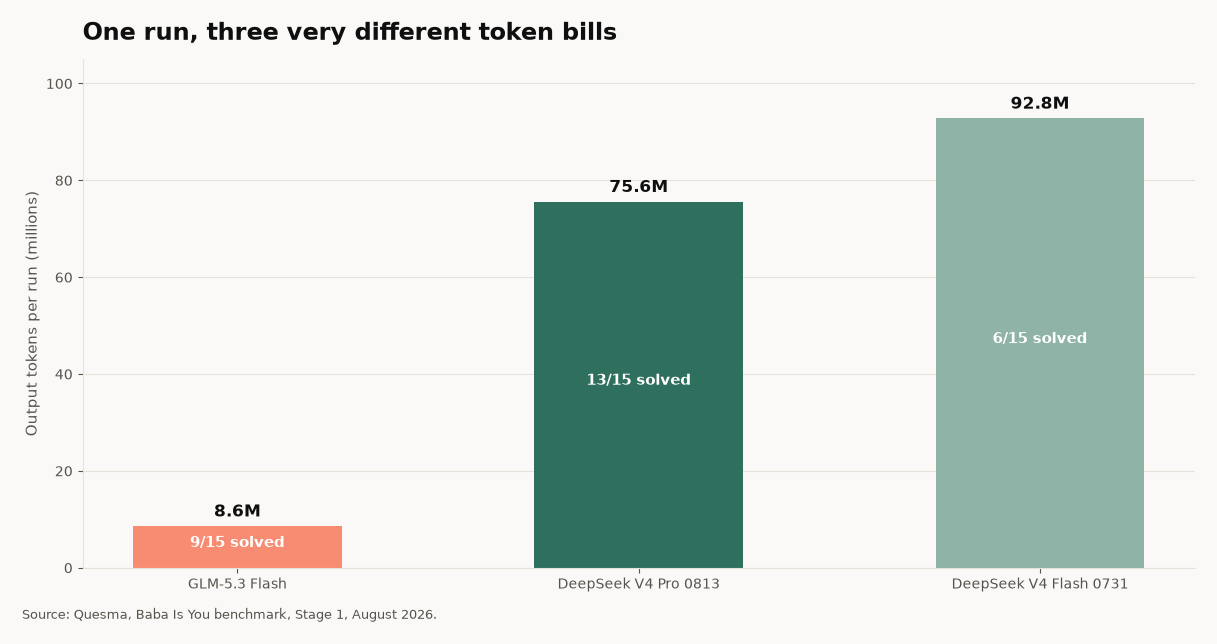
One detail matters when reading the table. The harnesses were not the same. GLM ran on Terminus-2; both DeepSeek runs used Claude Code. The costs are measured runs, not a controlled comparison on identical scaffolding.
Where each one fits
GLM-5.3 Flash fits work that starts with an image or a video and continues as text: document intake, screen understanding, long review where the same prefix stays in the window. The flat rate and the early stop suit interactive sessions and products that need a predictable bill. It is also the simpler choice when one key has to cover vision and text.
DeepSeek V4.1 Flash fits work that can be scheduled: overnight evaluation, batch extraction, large agent sweeps where more attempts improve the result. The off-peak rate rewards jobs that can wait, and the heavier output path helps tasks where the model writes a lot. Teams already inside the DeepSeek API keep their client code.
| Workload | Better fit | Why |
|---|---|---|
| Image or video intake, then text output | GLM-5.3 Flash | Native multimodal input on the low-cost tier. |
| Long context with a stable prefix | GLM-5.3 Flash | A 1M-token window and one flat rate. |
| Predictable billing across the day | GLM-5.3 Flash | No peak or off-peak split. |
| Overnight batch agents | DeepSeek V4.1 Flash | Off-peak pricing at half the peak rate. |
| Tasks that improve with more attempts | DeepSeek V4.1 Flash | Benchmark runs show more turns and a higher pass rate. |
| Output-heavy generation | DeepSeek V4.1 Flash | 16B active on the output path. |
GLM-5.3 Flash sits on our recurring plan with the other models in the catalog. One key covers it, and the model page lists the current price and limits.
Current terms are on the GLM-5.3 Flash plan page.