
GLM-5.3 cache pricing: $0.26 per million, and the hit rate that sets your bill
Published · 6 min read
GLM-5.3 bills a cache hit at $0.26 per million tokens against $1.40 for fresh input, so a cached token costs 19% of the normal rate. DeepSeek V4.1-Flash caches at 2% and Claude Sonnet 5.5 and Opus 5.5 at 5%, but the discount is not the bill: on a 400M token RAG workload at a 90% hit rate, GLM-5.3 lands at $264 a month, Sonnet 5.5 at $339 and DeepSeek Flash at $22. Output tokens decide the rest, because reasoning always runs and is billed at $4.40 per million against $1.40 on input.
In this article
What a cache hit costs on GLM-5.3
GLM-5.3 charges $0.26 per million cached input tokens. A fresh input token costs $1.40 and an output token costs $4.40, so a cache hit runs at 18.6% of the normal input rate, an 81% discount, and the cached prefix is stored free of charge while Z.ai's promotion lasts.
There is nothing to configure. Z.ai matches the request against recent prefixes on its own, bills the matching part at the lower rate, and reports the result in usage.prompt_tokens_details.cached_tokens. You do not mark a breakpoint, pass a cache_control block or set a TTL, which is the opposite of how Anthropic's prompt caching works.
Whether you get that rate depends on details that are easy to get wrong. The prefix has to be identical byte for byte, and it has to be long enough to be worth matching. A single changed character at the start of the system prompt drops the whole prefix back to full price. The cache also expires on its own schedule, so a job that runs once a week pays the fresh rate most of the time.
How the cache discount compares across providers
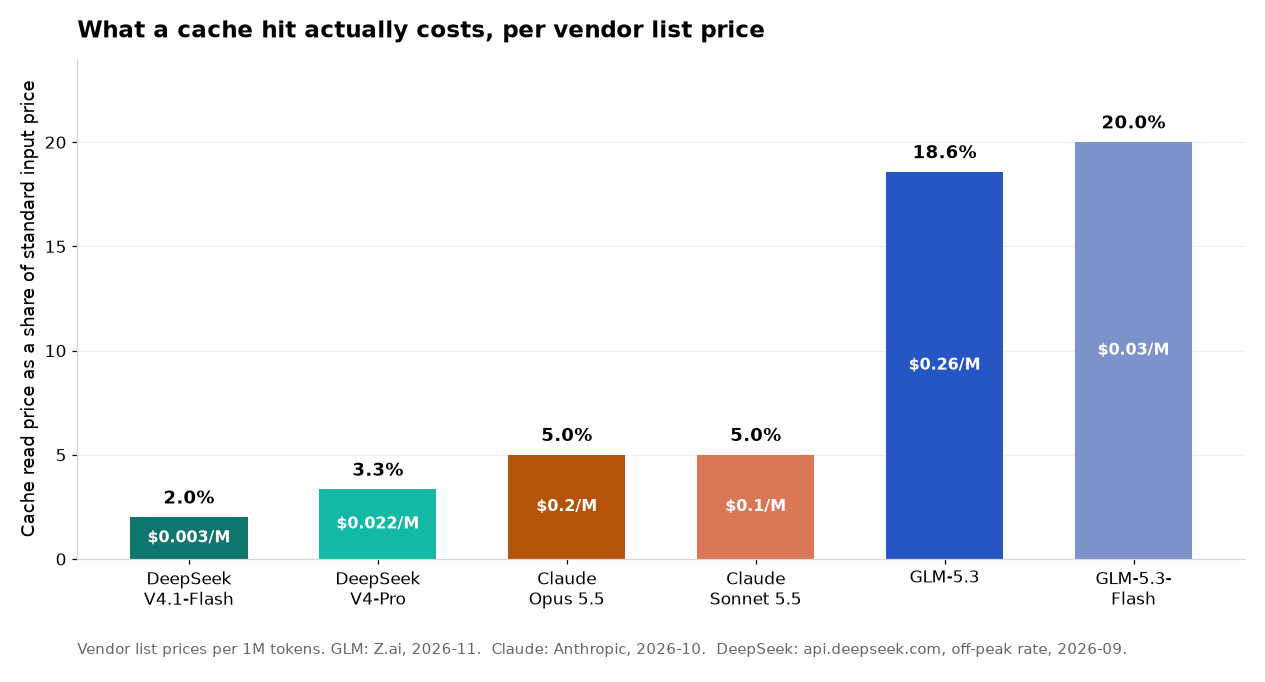
GLM-5.3 has the most aggressive discount among the premium models, and the gap is wide. Claude cuts a cache hit to 5% of input, DeepSeek Flash to 2%. GLM sits at 19%.
| Model | Input | Cache read | Output | Cache read as a share of input |
|---|---|---|---|---|
| GLM-5.3 | $1.40 | $0.26 | $4.40 | 19% |
| GLM-5.3-Flash | $0.15 | $0.03 | $0.50 | 20% |
| Claude Sonnet 5.5 | $2 | $0.10 | $10 | 5% |
| Claude Opus 5.5 | $4 | $0.20 | $20 | 5% |
| DeepSeek V4.1-Flash | $0.15 | $0.003 | $0.60 | 2% |
| DeepSeek V4-Pro | $0.66 | $0.022 | $1.98 | 3% |
Discount percentage is a trap when you compare bills. Claude's 5% looks better than GLM's 19%, but Claude starts from a higher base, $2 per million against $1.40. One million fully cached tokens cost $0.10 on Sonnet 5.5 and $0.26 on GLM-5.3, so Claude still wins the cached read on its own. What settles a workload is output, and there the two models are far apart, $10 per million on Sonnet 5.5 against $4.40 on GLM-5.3.
DeepSeek V4.1-Flash sits at the other end. Its cache read is one fiftieth of the miss price, and its output is $0.60. On input-heavy work nothing else in this table is close. It is also the only one of the three with a peak rate, and peak is double the off-peak rate, so a batch job that crosses the peak window pays twice as much.
How the hit rate moves the bill
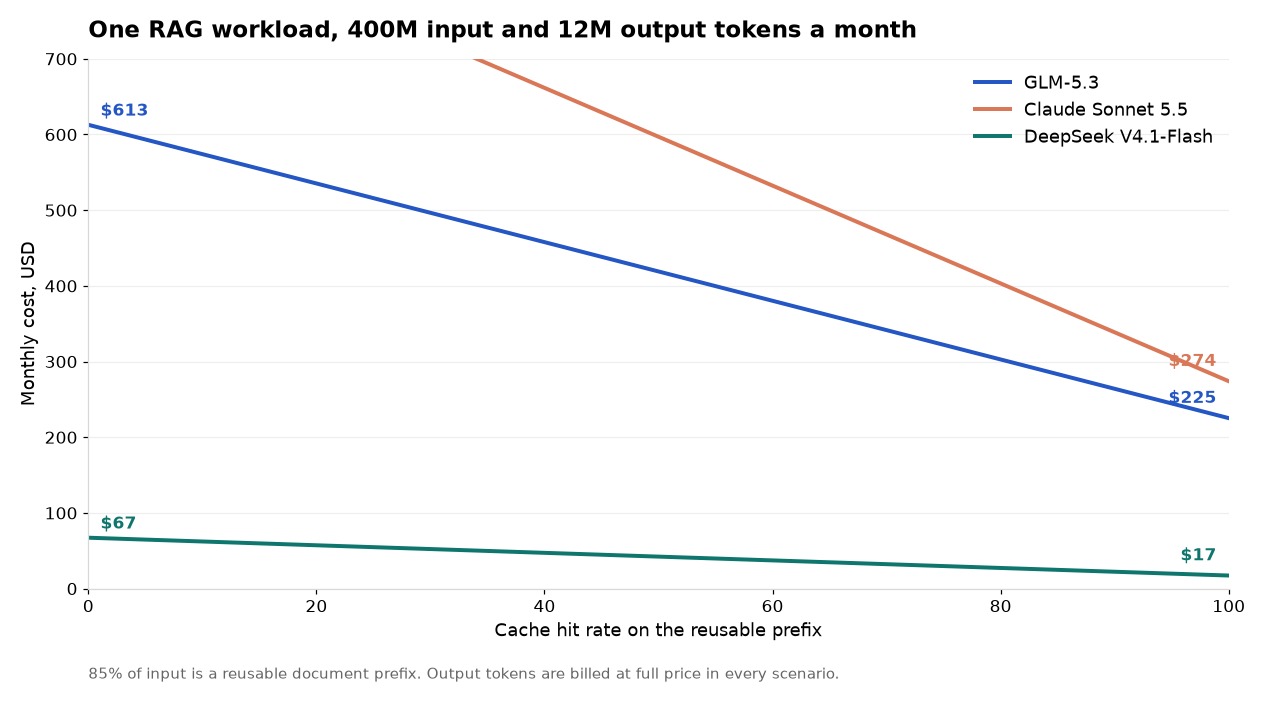
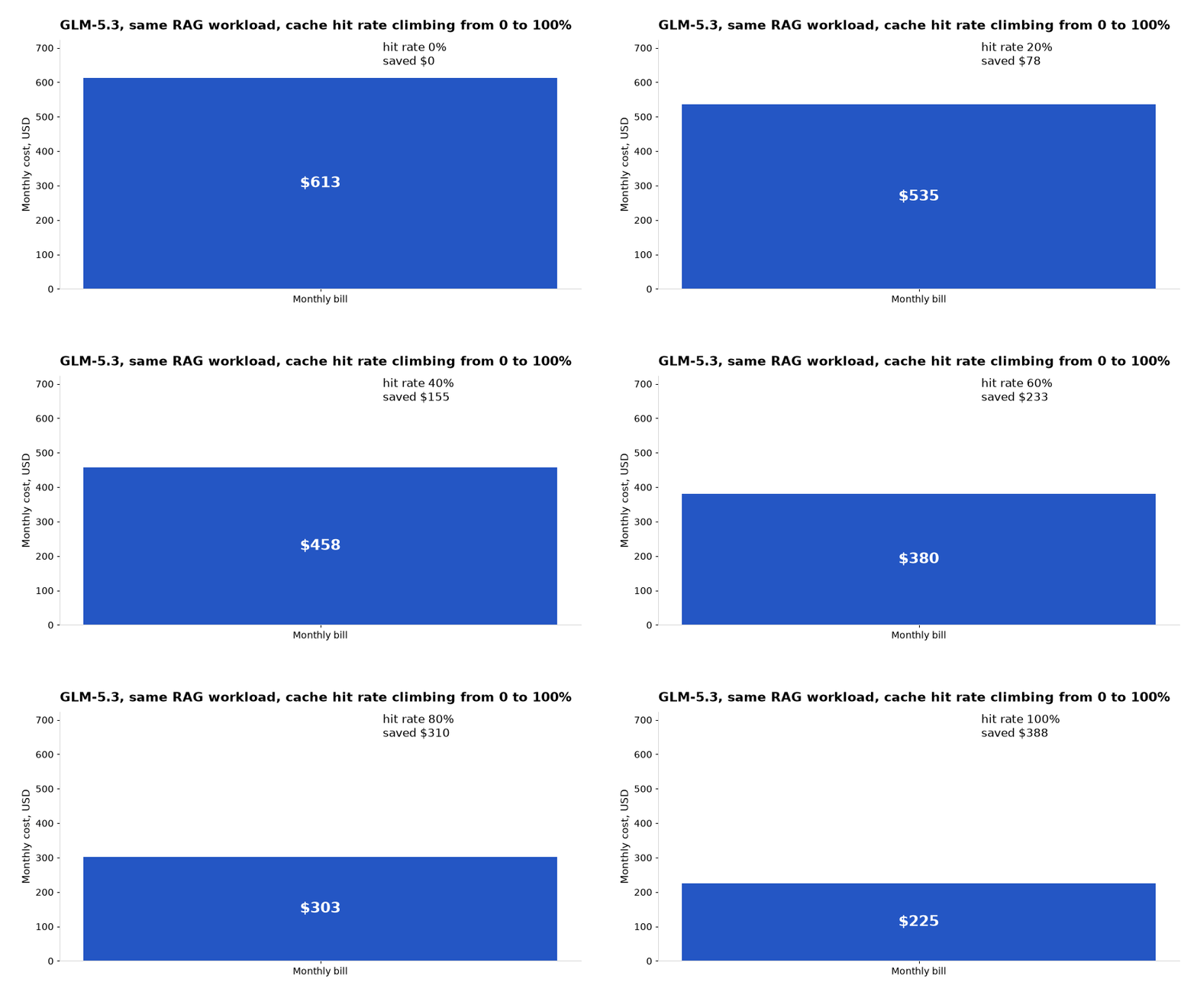
Take one workload: a document assistant that sends 400M input tokens and 12M output tokens a month, where 85% of the input is the same document set and the rest is the question.
| Cache hit rate | GLM-5.3 | Claude Sonnet 5.5 | DeepSeek V4.1-Flash |
|---|---|---|---|
| 0% | $613 | $920 | $67 |
| 50% | $419 | $597 | $42 |
| 80% | $303 | $403 | $27 |
| 95% | $245 | $306 | $20 |
Moving from no cache to a 95% hit rate takes GLM-5.3 from $613 to $245 a month, a 60% cut, and Sonnet 5.5 from $920 to $306. DeepSeek Flash starts at $67 and ends at $20, a smaller absolute number because its input price is already low.
The shape of the curve matters more than the size of any discount. Every point on it carries the same output charge, which no cache can touch, and in this workload those 12M output tokens are $53 on GLM-5.3 and $120 on Sonnet 5.5 before a single input token is billed.
What three workloads cost per month
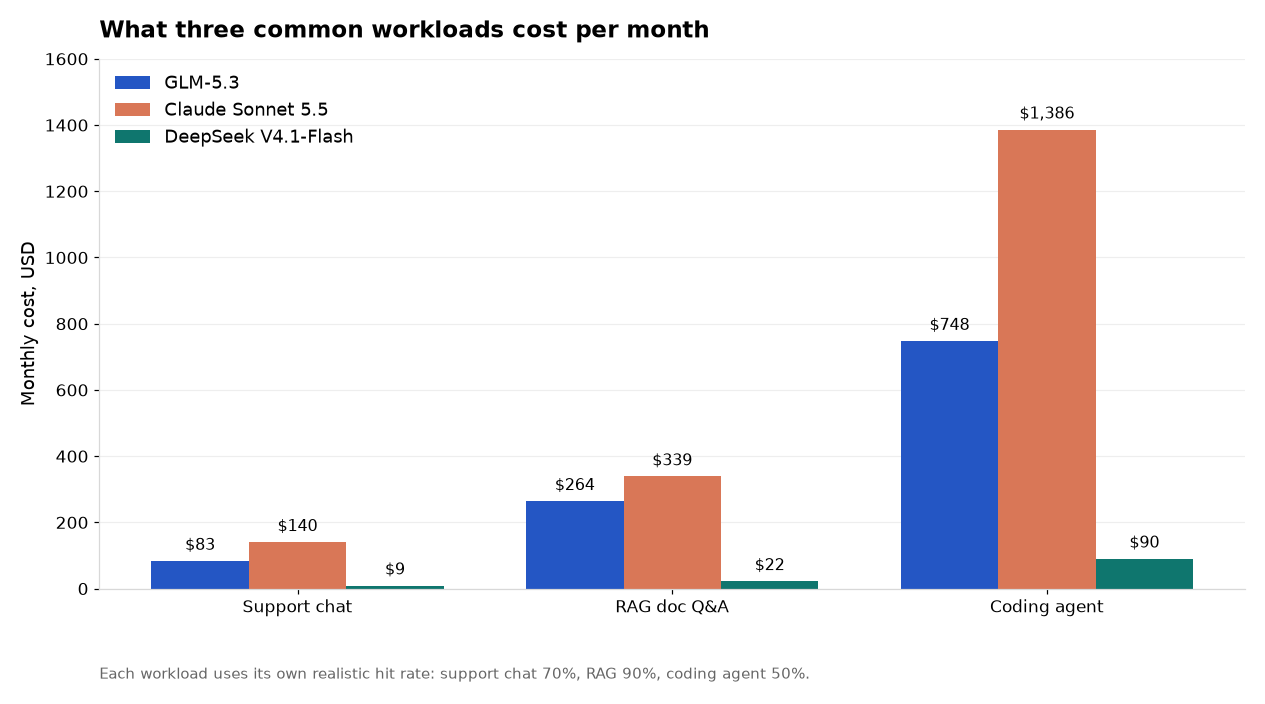
Cache hit rate is not a free parameter. It depends on how much of the prompt repeats, and how much repeats depends on the product you built.
| Workload | Input / month | Output / month | Repeating prefix | Hit rate | GLM-5.3 | Claude Sonnet 5.5 | DeepSeek V4.1-Flash |
|---|---|---|---|---|---|---|---|
| Support chat | 60M | 8M | 75% | 70% | $83 | $140 | $9 |
| RAG doc Q&A | 400M | 12M | 85% | 90% | $264 | $339 | $22 |
| Coding agent | 300M | 90M | 40% | 50% | $748 | $1,386 | $90 |
The coding agent row is worth reading twice. GLM-5.3 spends $748 a month and $396 of that is output. Sonnet 5.5 spends $1,386, with $900 of it output. Tuning the cache on a workload like this buys a fraction of what picking the right effort level buys.
Support chat is where the cache rate works hardest, because the system prompt and the policy documents repeat on every call and the user's question does not. DeepSeek Flash wins that row by a wide margin, and the reason is the input rate rather than the cache.
Where the money goes: output tokens and native tools
GLM-5.3 cannot turn reasoning off. thinking.type accepts only enabled, and reasoning_effort takes low, high or max with max as the default. Reasoning tokens are billed as output at $4.40 per million, 3.1 times the input rate, which makes the effort level the most expensive line in the request.
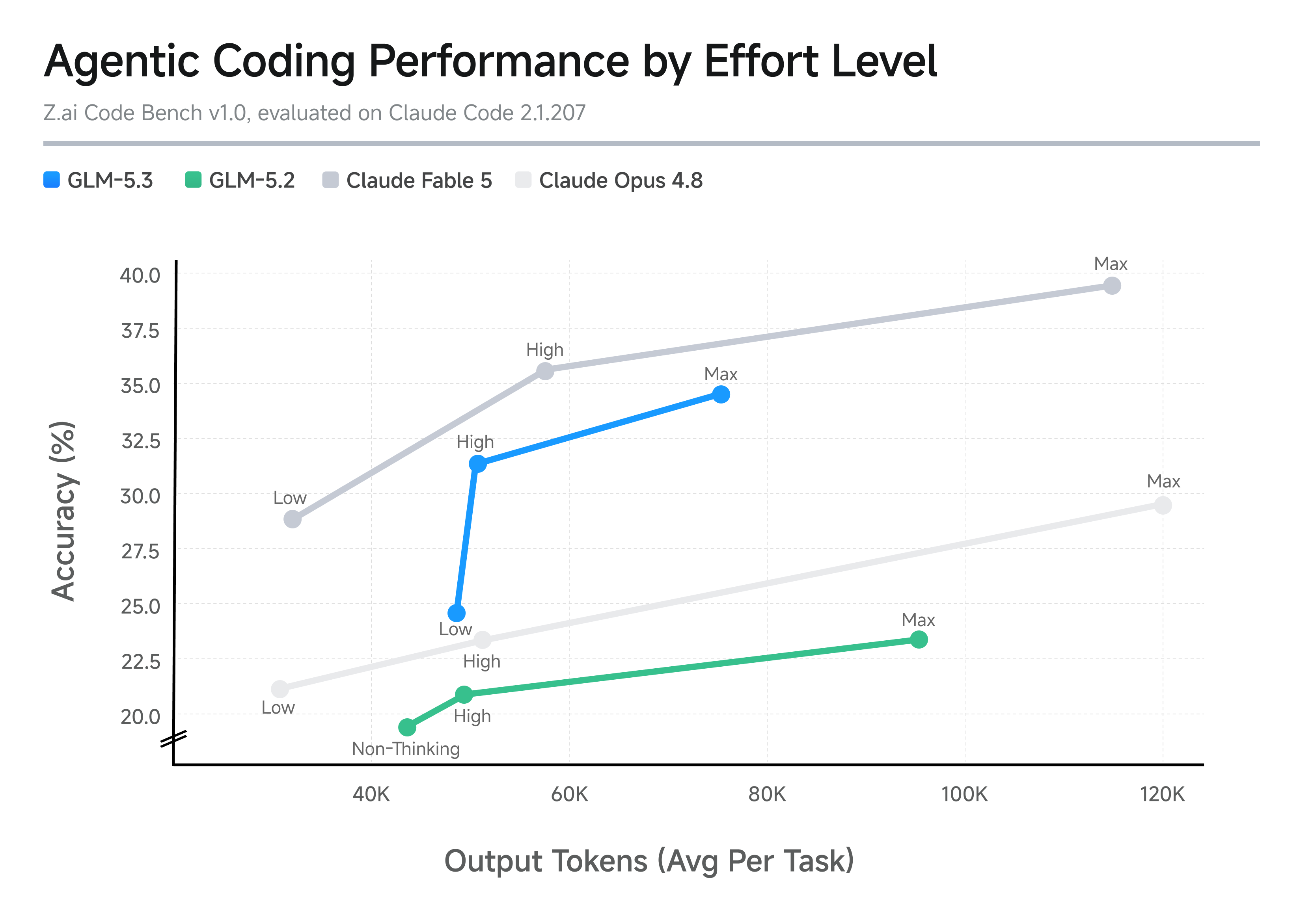
That chart is the reason cache tuning on its own is not a cost strategy. The accuracy ladder between effort levels is real, and so is the token ladder underneath it. A team that leaves the default at max is paying for 75K output tokens per task before it has paid for a single input token.
GLM-5.3 also ships web search inside the chat API. You pass a web_search tool block with an engine, a result count, an optional domain filter, a recency window and a summarising prompt, and the model calls it, reads the results and cites them. Z.ai lists the tool at $0.01 per use, which is small next to 75K output tokens at max effort.
Tool calling follows the OpenAI shape. tool_choice lists auto only, and tool_stream streams the arguments while they are produced. One detail is easy to miss: when you keep the model's reasoning across turns, you have to send the reasoning_content back unmodified, and Z.ai warns that a reordered or edited block degrades the cache hit rate. The reasoning you return becomes part of the prefix the cache prices, so a client that drops it pays the fresh rate on every turn.
How to get the hit rate, and when one key is enough
The hit rate is mostly prompt layout. Put the system prompt, the tool definitions and the retrieved documents at the front of the request, in that order, and append whatever changes at the end. Keep the front byte-identical, including whitespace, because a timestamp appended to the system prompt is enough to lose the match. Read usage.prompt_tokens_details.cached_tokens on every response and treat a drop as a bug rather than weather.
If the cache is not paying for itself, the cause is usually in the first part of the prompt, not in the model. A prefix that changes on every request cannot hit, however good the rest of the setup is.
SiAPI.ai's catalog currently lists GLM-5.3 at $1.20 input, $0.50 cached input and $4 output per million, GLM-5.3-Flash at $0.135, $0.045 and $0.45, and DeepSeek V4.1-Flash at $0.135, $0.01 and $0.55. Input and output sit under Z.ai's list price while cached input sits above it, so cache-heavy GLM traffic is cheaper straight from the vendor and the rest of a multi-model stack is easier to run on one key.
SiAPI.ai serves GLM-5.3, GLM-5.3-Flash and DeepSeek V4.1-Flash on one key and one bill. Current catalog rates for every model are on the pricing page.
Questions developers keep asking
Is there a TTL on the GLM-5.3 cache?
No, and there is nothing to set. Z.ai expires the prefix on its own schedule and recalculates it, so a workload that runs a few times a day hits and one that runs once a week does not.
Can I reach GLM-5.3 from an existing coding client?
Yes. Z.ai exposes OpenAI Chat Completions, OpenAI Responses and Anthropic Messages endpoints, so most clients need a base URL and a model name. Accounts that have held a GLM Coding Plan subscription can currently reach the model API through the Chat Completions protocol only.
Is the $0.26 cache read permanent?
No. The price table marks cached input storage as free for a limited time, and Z.ai has changed GLM rates before. $0.26 is today's list price, not a promise.
Does turning thinking off work on GLM-5.3?
No. A request with thinking.type set to disabled fails with a 400 and a message saying the model always reasons. Use reasoning_effort: low for short work instead.