
GLM-5.3 Always Thinking: Where Your Reasoning Tokens Go
Published · 4 min read
GLM-5.3 has no off switch for thinking. The API accepts only thinking.type: "enabled", and a request that sends "disabled" fails outright. The one knob left is reasoning_effort: low, high or max, defaulting to max. Reasoning tokens are billed as output tokens, so that knob is also the cost knob. Here is what the forced chain buys, what it costs, and how to set the effort per workload.
In this article
A switch that no longer exists
Most reasoning models let you skip the thinking step on easy prompts. GLM-5.3 does not. Z.ai's documentation lists a single accepted value for thinking.type, which is "enabled", and the migration note is blunt about it: if your application currently sends thinking.type: "disabled", change it to "enabled" before you swap the model ID to glm-5.3, or the request fails. There is no fallback value, no per-turn override, and no "none" effort level that silences the chain.
That places GLM-5.3 in a small camp. GLM-5.2 and GLM-5.1 read each request and decide for themselves whether to think, so a simple prompt can come back with zero reasoning tokens. GLM-4.7 always thinks but lets you toggle it per turn. GLM-5.3 and GLM-5.3-Flash think on every request and every turn, without exception.
| Model | Thinking can be turned off | Effort levels |
|---|---|---|
| GLM-5.3 / GLM-5.3-Flash | No | low, high, max (default max) |
| GLM-5.2 | Yes | high, max (low maps to high) |
| GLM-5.1 / GLM-5 | Yes | Not supported |
| GLM-4.7 | Per turn | Not supported |
What you get instead of the switch is a dial. low runs a lightweight chain, high an enhanced one, max a deep one. Z.ai recommends max for coding and other multi-step work, and it is the default, so a request that says nothing about effort gets the deepest chain the model can run.
Reasoning is output, and output is the expensive direction
The chain of thought is generated text. It streams into delta.reasoning_content ahead of the first word of the answer, and usage.completion_tokens counts it together with the answer. A provider that bills input, cached input and output therefore bills your reasoning at the output rate, the highest of the three.
The arithmetic bites hardest on small requests. A 300-token answer wrapped in 1,200 tokens of reasoning is billed as 1,500 output tokens, five times the visible reply. At ten thousand such requests a day, the reasoning overhead is four fifths of the output bill. Nothing about the answer got longer; the thinking did.
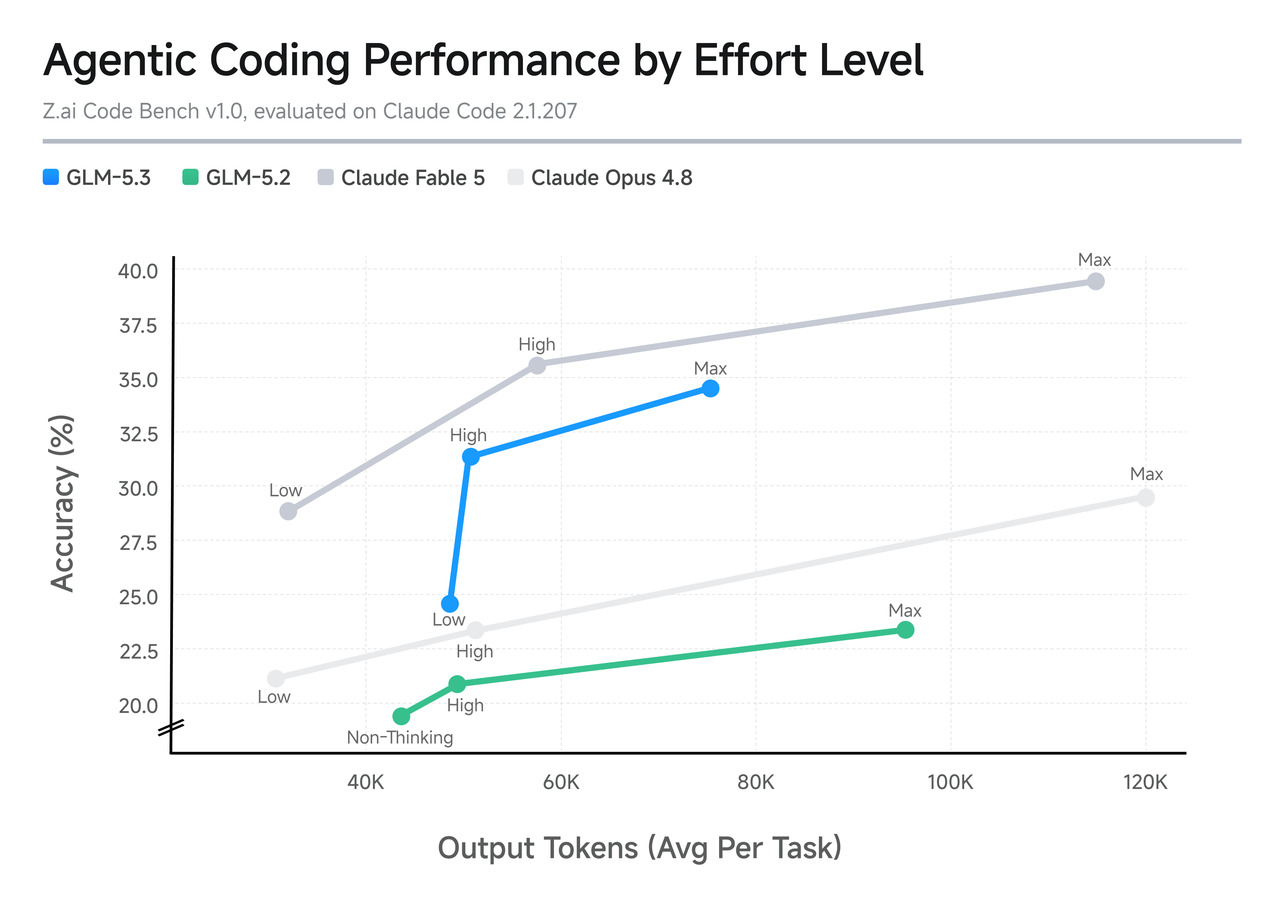
On long agent tasks the picture flips, because deeper thinking can shorten the run as a whole. Z.ai's own Code Bench plots accuracy against average output tokens per task, and the shape of that curve is the whole argument for the dial:
| Setup | Output tokens per task | Score |
|---|---|---|
| GLM-5.3 at max | ~75,000 | 34.5% |
| GLM-5.3 at high | ~50,000 | 31.4% |
| GLM-5.2 at max | ~96,000 | 23.4% |
Max costs about half again as much as high per task and returns roughly three points of accuracy. On a hard agentic coding job that trade usually pays for itself. On a chatbot it usually does not.
Setting effort per workload
Opting out is gone, so the work moves to choosing the effort deliberately instead of inheriting the default.
low fits classification, extraction, templated replies and anything where the answer is already half present in the prompt. It is the shortest chain the model allows and the cheapest call you can make on this model. high is the sensible default for mixed traffic: most of the accuracy at about two thirds of the tokens max spends. max is for long-horizon agents, refactors that span files, and debugging sessions with tool calls, which is exactly where Z.ai points it.
Two operational details matter once thinking is always on. First, leave headroom in max_tokens. Reasoning spends from the same output budget as the answer, so a tight cap can return an empty reply with a finish_reason of length. Second, decide what happens to old reasoning in a multi-turn agent. Preserved thinking, set with clear_thinking: false, keeps earlier chains in context and expects them replayed verbatim in later requests. Dropping them shrinks the context bill but asks the model to re-derive work it already did.
What the lock costs, and what it buys
What you give up is the cheap trivial call. Every prompt now pays for at least a short chain, and high-volume workloads made of simple questions feel that first. What you get is consistency: no silent fallback to non-thinking on a prompt the model misjudges, and no request-to-request variance in whether the model checked its own work before answering.
The benchmark sheet shows where that consistency lands. On Terminal Bench 3.0, GLM-5.3 scores 28.3 against 4.6 for GLM-5.2. DeepSWE moves from 46.2 to 66.9, and Agents' Last Exam from 23.8 to 28.5. The same always-on chain is running behind all of those numbers.
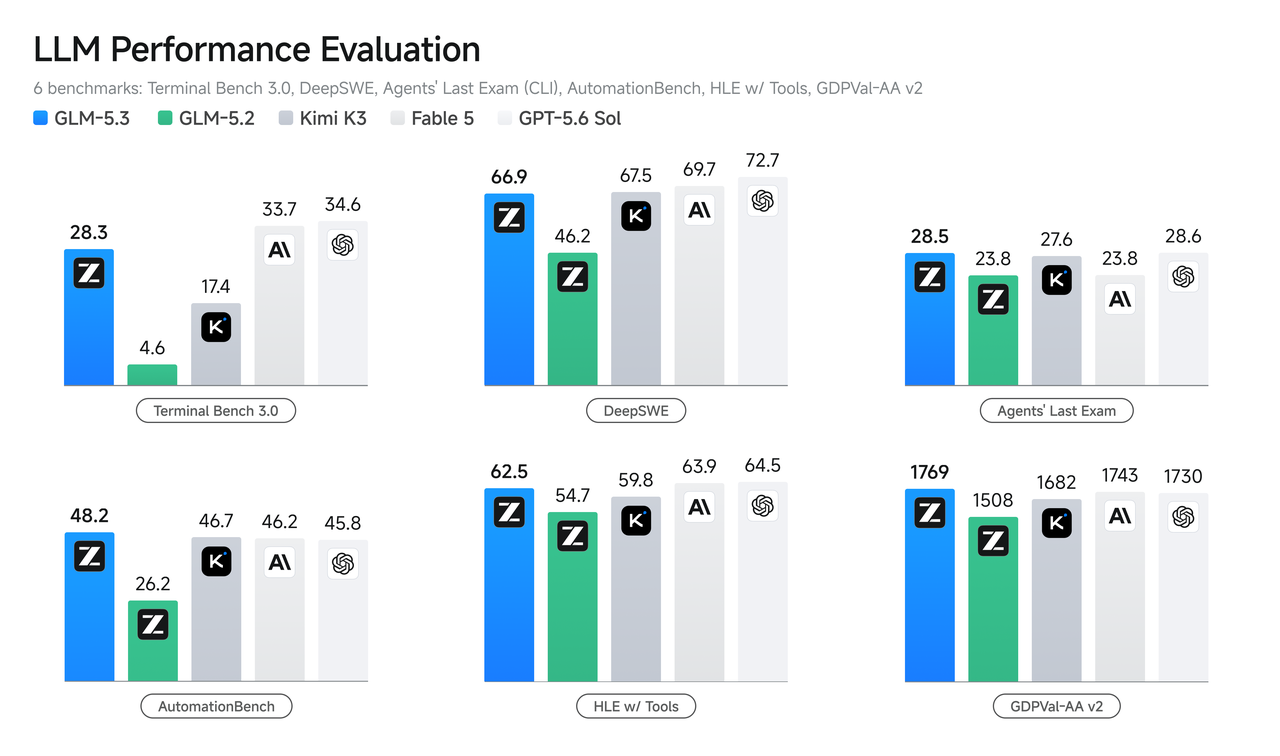
The honest reading is that forced reasoning is a pricing and behavior decision, not a quality verdict. If your traffic is mostly short questions, GLM-5.2 with thinking disabled or GLM-5.3-Flash at low effort will bill less for the same answers. If your traffic is agents that run for minutes at a time, the always-on chain at max is the point of the model, and the token curve above is the argument for paying for it.
SiAPI.ai lists GLM-5.3 on a recurring plan behind a single key, with OpenAI- and Anthropic-compatible endpoints. That makes it cheap to point an existing client at the model and measure what the forced chain actually costs on your own traffic before you commit to it.
Plan details and quota for the billing period are on the GLM-5.3 model page.